Published · Updated · 12 min. read
Audio Engineer Resume: Page One, Credits List and Reel
An audio engineer resume is only one of three documents you send. The resume gets you past HR and the applicant tracking system, while the credits list and the reel decide whether a studio, venue or production company calls you back.
I'm a Certified Professional Resume Writer (CPRW) and I've conducted 200+ job interviews as the interviewer. But I'm not an audio engineer. I work with rotating equipment in oil and gas, and the frequency spectra I read come from vibration analysis, not from a PA system. That's why the audio-specific facts here are taken straight from the BLS, O*NET, Audinate, AVIXA and SBE.
Here's the plan. First, which job title to put on top and what goes on page one for each kind of audio job. Then the numbers worth counting, certifications by job type and a full sample you can copy.
Which Title Goes on Top: Audio Engineer, Sound Engineer or AV Technician
Take the title from the job posting, then add your niche. "Audio Engineer, Live Sound (FOH and Monitors)" tells a production manager more than "Audio Engineer" alone. A post house that posted a "Sound Editor" job wants to see those two words, not a creative title you made up.
A senior title needs proof under it. If you write Senior Audio Engineer, the specific consoles, venues and crew size on page one should back it up. Recruiters read the title first and check the numbers second.
The titles also point to different employers. In O*NET, recording engineer, mixing engineer and sound technician sit with sound engineering technicians, while audio technician, AV tech, media technician and stagehand belong to audio and video technicians. Outside the US the same document is often called an audio engineer CV, and the rules below work for it too.
The numbers show where the jobs are. The BLS counted 15,000 sound engineering technician jobs in 2025, with a median pay of $73,130, and 87,600 audio and video technician jobs at $58,100. Audio and video technicians set up systems in offices, arenas, hotels, schools and hospitals. AV is almost six times bigger, and it's the side where your resume usually goes through HR and an ATS.
Sound engineering is the smaller group. In studios, a referral and your credits often matter more than the resume itself. If you're on the AV side, our technician resume guide covers the base sections; audio adds two documents on top.
Resume, Credits List or Reel: What Goes Where
Each of the three documents proves something different. A common problem in audio resume examples online is mixing them up. You get a page full of song titles and no work history, or two pages of duties and no link to any audio.
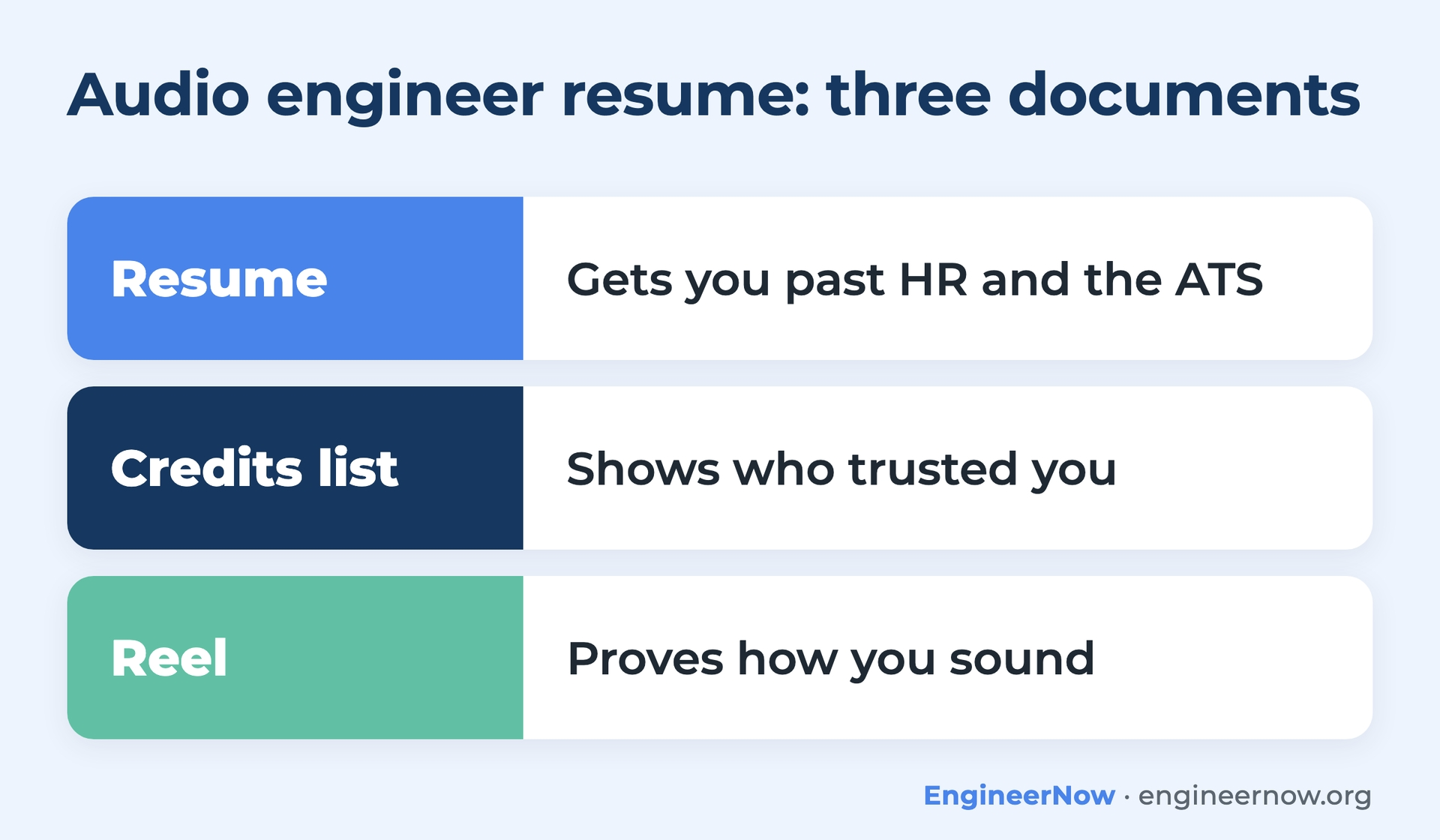
The resume is one or two pages for HR and the ATS: title, summary, skills section, work experience and certifications. The credits list is a separate page: project, artist or client, your role and the year. On the resume itself keep 3 to 5 selected credits, the ones closest to the job description.
For the skills section, copy tool names from the posting: the console families, the DAW, Dante, wireless coordination. A name the ATS can match beats a long list of soft skills.
If the posting says Logic Pro, write Logic Pro, the exact product name, next to Pro Tools instead of a vague "DAW experience". List only the software you can open and run a session in.
The reel, which some postings call a portfolio, is a link in your header. A few short clips of your work are enough, with a before and after if you do mixing, mastering or dialogue cleanup. Don't attach audio files to an online application. Many ATS forms take only a document, and a hiring manager won't download a large WAV file to find out how you mix.
Use the same name and job title across all three documents, so a recruiter who finds your reel can match it to your resume.
Who reads first depends on the job.
| Job type | Who reads it first | Page one leads with | Credits and reel |
|---|---|---|---|
| Studio: recording, mixing, mastering | Studio owner or producer | Selected credits, DAWs, studio skills | The reel decides; credits list attached |
| Live sound and touring | Production manager at a rental company or venue | Shows, venue sizes, consoles, systems | Short credits list; reel optional |
| Post-production and broadcast | Post supervisor or chief engineer | Deadlines, delivery specs, software | Reel with before and after |
| AV and corporate events | AV manager, often HR through an ATS | Events a month, room sizes, systems | Rarely asked; keep the resume clean |
One career can touch all four rows. Keep a master file with everything you've done, and cut a separate version for each job type you apply to. A resume that tries to sell studio, stage and conference rooms at once sells none of them.
Numbers an Audio Engineer Can Honestly Count
Many audio engineer resume examples use lines like "improved audio quality by 28%". Nobody can check that number, and the first interview question will be "measured how?". Sound quality is judged by ear, so count the work around it instead.
If you can't measure it, you can't improve it, and you can't defend it in an interview either. Luckily, audio work leaves a paper trail: call sheets, timesheets, invoices, session logs and delivery notes. Here's what's worth counting, depending on your niche:
- shows or sessions a season, and the capacity of the venues
- console channel count, wireless microphones on the show, and the sound reinforcement systems you set up and tuned
- tracks, podcast episodes or film reels delivered a week, and how many on time
- deliveries that passed the venue's or broadcaster's spec on the first pass
- shows lost to audio equipment failure, ideally zero
- crew size you led and people you trained
You don't need all six. Pick two or three you can back up with a document, and write them into your work history, where a production manager reads them as proof.
A good line looks like this.
"Mixed FOH for [N] shows a season at [N]-capacity venues on a [N]-channel console, with zero shows cancelled for technical issues." Swap the brackets for your own data. If a production manager asks where the number came from, "from my invoices" is a perfect answer.
If you have the raw counts but not the wording, the generator below turns them into resume lines.

Audio Certifications by Job Type
Most employers don't ask for a certificate. The BLS says that although employers usually don't require it, voluntary certification may offer advantages in getting a job as a broadcast or sound engineering technician. Pick the one that matches the job you want:
- Live sound and AV networks. Dante Certification from Audinate, a free program with training courses online and in person (Audinate).
- AV and corporate events. The CTS from AVIXA covers general audiovisual tasks. CTS-I adds installation and CTS-D adds design, and you need the CTS before either one.
- Broadcast. SBE certifications run from certified operator to Certified Professional Broadcast Engineer.
- Studio and post-production. There's no must-have certificate here. List the software you really use, Pro Tools and other digital audio workstations, in your technical skills, and let the reel do the rest.
Write each certificate on one line: certificate name, issuing body, year earned. A vendor webinar is training, not a certification, so list it under training. If Dante work pulls you toward networks, our network engineer resume guide shows what IT employers look for.
Audio Engineer Resume Example
Below is a full audio engineer resume sample for live sound and AV. The engineer has five years in live sound and AV, the last three and a half at FOH and monitors. Fictional example: made-up name, company, venues and numbers. Borrow the structure; the numbers have to be yours.
Look at the top first. The niche is in the job title, the reel link is in the header, and the summary gives console sizes, venue capacity and a show count. Selected credits sit at the bottom with a pointer to the full list.
Entry level is the other common case: a graduate going for an assistant job in a recording studio, with no paid studio work yet. Here's how the summary and the credits can look.
Fictional example: made-up name, projects and numbers. Entry level assistant engineer.
Summary: Audio production graduate looking for an assistant engineer role in a recording studio. 600 hours of studio time in college, a 3-month internship at a local recording studio and session prep in Pro Tools. Quick with patch bays, mic placement and session backups.
Selected credits:
- Local band EP (fictional), 5 tracks, recording assistant, 2026
- Student short film (fictional), dialogue editing and mix, 2026
- College jazz ensemble live recording (fictional), recording engineer, 2025
Real sessions count, even small ones, as long as your exact role is on the line. "Assistant" is a fine word on a credit. A borrowed "producer" title isn't, and it's easy to check with one phone call.
Put education on one short line near the bottom. The BLS says programs for sound engineering technicians can take several months to a few years and may lead to a nondegree award or a college degree. A bachelor's degree in fine and performing arts or a related field may help, but it's typically not required. So write what you actually earned, for example "Bachelor of Science, Audio Production, [University], 2026", or the certificate and the school's name. With no degree, keep the line short and let the credits carry it.
Your numbers are ready, so choose a layout that keeps them easy to read.
Be critical of templates, though. Many audio resumes online use two columns, icons and skill bars, and a bar showing 90% in Pro Tools tells a recruiter nothing they can check. A one-column format with plain headings and only relevant credits reads the same across every system and every printer.


Three documents, one goal: show who trusted you and how you sound. Good luck, friends.
What does an audio engineer do?
The BLS says sound engineering technicians assemble and operate sound equipment. In practice that means recording, mixing or mastering in a studio, mixing FOH or monitors at shows, or cleaning dialogue in post. Put the side you work on in your job title.
Do freelance audio engineers need a resume?
Yes, for rental companies, venues, AV firms and anyone with an HR department. Studios more often go by credits and referrals. The BLS counts 11% of broadcast, sound and video technicians as self-employed, so freelance work is common. Keep the resume, the credits list and the reel up to date, and send a short cover letter with each application.
Are audio engineers paid well?
Better than the rest of their group. Sound engineering technicians earned a median of $73,130 in May 2025, per the BLS. That's against $60,150 for all broadcast, sound and video technicians and $58,100 for audio and video technicians. By industry, the highest median, $75,450, is in motion picture and sound recording. Expect evening, weekend and holiday work, though.
Is AI taking over audio engineering?
Not taking over, but it is cutting some jobs. The BLS projects employment of sound engineering technicians to drop 3% between 2025 and 2035. Part of the reason: advances in technology, including AI, will let fewer technicians set up and run systems in film and sound recording. Audio and video technicians are projected to grow 4%, and the whole group has about 9,800 openings a year.
What qualifications do you need to be an audio engineer?
It depends on the job. The BLS says requirements range from a high school diploma to a college degree. In O*NET, 32% of sound engineering technicians say a high school diploma is required, 20% a post-secondary certificate and 20% a bachelor's degree. Certification is voluntary but can help, and your credits and reel carry the rest.

Written by
Recent Posts