

11 min. read
Machine Learning Engineer Resume Guide for 2026


Your quick and easy guide to crafting a top-notch machine learning engineer resume. Highlight skills, quantify achievements, tailor your application for success!
Crafting an Effective Machine Learning Engineer Resume
The right resume is your first and most crucial impression for any machine learning engineer role. It’s not just about listing technical skills; it’s about demonstrating your journey, engineering acumen, value through measurable results.
Resume Formats and Structure
A machine learning engineer resume almost always works best in reverse-chronological order. This format lets recruiters see your most recent learning, machine, engineering achievements right away.
One-page resumes are ideal if you’re entry-level or mid-level, focusing on your key projects, job roles, and achievements. Senior machine learning engineers with years of complex project experience, publications, or management of larger teams can use a two-page resume, but only if every line provides clear, relevant content.
Non-traditional structures like summaries or bullet-point highlights at the top—grab attention and quickly showcase your value. Consider using a short summary to highlight your learning philosophy, machine and data impact, and most recent engineering results.
Avoid fancy designs: Keep your resume simple and easy for applicant tracking systems (ATS) to process. Do not use columns, images, or photos. Stick with standard fonts, white backgrounds, and clean section headers so every machine can read your resume correctly.
In the section "Resume Formats and Structure," it is important to trust insights from experienced professionals. As a Chartered Mechanical Engineer with 17+ years of hands-on experience in the oil and gas industry, I have worked under extreme conditions ranging from -50°C to +50°C, which taught me the value of clarity and precision in communication, skills directly transferable to resume writing for engineers.
Pro tip: Save your machine learning engineer resume as a PDF, clearly named, like Firstname_Lastname_Machine_Learning_Engineer_Resume.pdf. Check your file on different devices to ensure formatting is consistent.
Writing Impactful Experience Sections
Use your resume experience to show how your learning led to business outcomes:
- Focus on **achievements, not just responsibilities**. Instead of saying “Developed learning models,” write “Engineered and deployed a deep learning system, increasing model accuracy from 85% to 93%, reducing time-to-prediction by 25%.”
- Start each bullet with strong action verbs: engineered, implemented, deployed, optimized, spearheaded, improved, analyzed, automated.
- Always **quantify your impact**. Example: “Reduced model inference time by 60%, saving $100,000 annually on cloud compute costs.”
- Explain your role across the **full machine learning lifecycle**: data pipeline creation, feature engineering, model architecture, deployment, monitoring, and continuous improvement.
- Give context for every technical achievement—explain business outcomes, cost savings, or customer experience improvements enabled by your engineering and learning.
My background includes conducting over 200 technical interviews and passing more than 50 technical and managerial interviews as a candidate. This firsthand experience gives me a precise understanding of what hiring managers look for when scanning resumes, enabling me to guide how to best showcase quantifiable achievements.
Key Skills to Showcase
Your resume should clearly list the core technical and soft skills that set machine learning engineers apart:
Programming languages and frameworks:
- Python, Java, R, C++, Scala (with real project examples on your resume)
- Machine learning frameworks/libraries: TensorFlow, Scikit-learn, PyTorch, Keras, XGBoost
Machine learning engineer must-haves:
- MLOps and cloud: Kubernetes, Docker, MLflow, Kubeflow, AWS SageMaker, Azure ML, GCP AI Platform
- Big data and processing: Apache Spark, Hadoop, Pandas, Kafka
- Specializations: NLP, Computer Vision, Deep Learning, Federated Learning, Large Language Models, classification/detection algorithms
Soft skills:
- Technical communication (explain complex concepts simply to non-technical managers or recruiters)
- Leadership and mentoring (coaching junior engineers, leading teams)
- Business and product focus (solving revenue-impacting problems for your company)
- Cross-functional collaboration, effective documentation, and continuous self-learning
Quick checklist:
- List 8–12 relevant skills; tailor these to match each job description using the exact keywords.
- Mention AI, deep learning models, data science, and any special systems or programming projects (especially if you have open source or published work).
Advanced Resume Writing Strategies and Additional Components
Fine-tuning your machine learning engineer resume for every job will significantly increase your chances. Matching the exact wording and published requirements from each listing helps you pass ATS scans and catch hiring managers’ attention.
Tailoring Your Resume for Each Job Application
- Analyze job descriptions carefully to extract the most relevant machine learning, engineering, software requirements.
- Incorporate keywords naturally from each job description. Use language and verbs seen in the listing (engineered, deployed, optimized, etc.), especially for AI, algorithms, and data tasks.
- Place high-impact, role-specific achievements in your summary and experience sections so a recruiter quickly sees how you fit the role’s top requirements.
Balancing Research and Production Experience
- If you have machine learning research, published papers, or open-source contributions—highlight these in your resume. Show how your learning translated into production-ready systems.
- List training and certifications in recent, high-demand technologies like large language models or advanced MLOps.
- Present ongoing learning via courses, online workshops, GitHub repos, or competitive events.
Example:
Deployed a research-driven anomaly detection algorithm in a production pipeline, improving incident detection speed by 50%, reducing false positives.
Demonstrating Leadership and Communication
- Include mentoring, project management, or tech lead roles. Describe how you supported team learning or led key engineering efforts.
- f you collaborated with non-technical teams—managers, stakeholders, or product—clearly spell out business, product results.
- Avoid jargon where possible; if you must use technical language, also include the plain-language benefit or value.
Education, Certifications, Awards, Projects
- List degrees in computer science, data science, statistics, or engineering fields—always with relevant coursework.
- Highlight recognized certifications (AWS ML Specialty, TensorFlow Developer, Azure AI Engineer, Google Cloud Professional Machine Learning Engineer).
- Add recent learning through completed MOOCs or industry training.
- Include AI hackathons, Kaggle rankings, or competition wins.
- Provide links to your GitHub, LinkedIn, or project portfolios—especially if you have AI models, MLOps tools, or research papers.
To enhance your machine learning engineer resume, it's also beneficial to emphasize your open source contributions and participation in relevant competitions. For instance, listing active GitHub projects or Kaggle competition rankings showcases practical skills and commitment to continuous learning, which recruiters highly value.
Including specific certifications related to machine learning engineering can further strengthen your profile. Certifications like AWS Certified Machine Learning – Specialty, Google Cloud Professional Machine Learning Engineer, or TensorFlow Developer Certificate display your validated expertise in key industry tools and technologies.
References and Cover Letters
- Prepare current references who can speak to your learning, engineering, collaboration, outcomes.
- Tailor your cover letter for each application—showing your passion for machine learning, that you understand the company’s challenges, and can generate business value.
- Use your cover letter to translate technical learning and engineering achievements into clear, quantifiable business results.
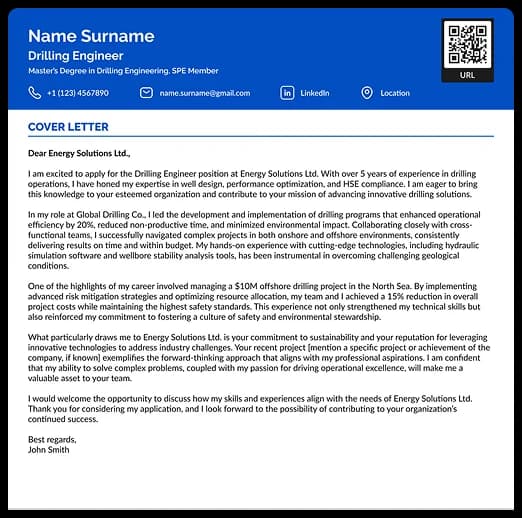
Cover Letter Builder
Use proven templates to craft an effective cover letter in minutes.
CREATE COVER LETTERResume Optimization and Final Checklist
- Ensure formatting is consistent: use clear section headers, adequate whitespace, no unusual symbols.
- Proofread multiple times; ask industry peers or mentors for feedback (or use resume optimization tools).
- Save as a PDF; double-check that formatting works across systems.
- Make sure your resume addresses the exact responsibilities, learning outcomes, machine engineering needs of your target job.
When tailoring your resume for individual job applications, consider closely analyzing the company's tech stack and culture to align your language and achievements accordingly. For example, if applying to a company focusing on cloud-based AI deployments, highlight your experience with AWS SageMaker or Azure ML platforms.
Resume Examples
The following three machine learning engineer resume examples—across entry, mid, and senior levels—demonstrate these principles. Each highlights continuous learning, machine engineering achievements, real-world results.
Entry-Level, Mid-Level Machine Learning Engineer Resume
Mid-Level Machine Learning Engineer Resume
Senior Machine Learning Engineer and MLOps Resume
Conclusion
A well-crafted machine learning engineer resume does not just list technical terms—it connects learning, machine-driven solutions, and engineering results to clear, quantifiable business impact. Use your resume to show your evolution as an engineer, commitment to continuous learning, and measurable success in applying machine learning to solve real problems.
- Keep your resume structured with ATS-friendly formatting.
- Quantify the impact of your learning, models, and engineering.
- Highlight key skills and tailor your content for each role.
- Showcase education, certifications, and continuous professional development.
Machine learning engineering is continuously evolving. Stay at the cutting edge by optimizing your resume just as you would optimize your models—for results.
FAQ
What is the best resume format for a machine learning engineer?
The reverse-chronological format is best. It highlights your most recent learning, machine engineering projects, quantifiable results—essential for both ATS systems and technical recruiters.
How can I effectively quantify my achievements in ML projects?
Always connect your engineering with numbers: improve model accuracy (“raised accuracy by 16%”), reduce cloud cost (“saved $60k/year”), or boost efficiency (“cut deployment time from days to hours”). Use before-and-after comparisons for impact.
Should I include research and publications on my resume?
Yes. Listing research, publications, or open source helps prove you’re serious about learning and contributing to the field. Even for applied roles, it’s a strong differentiator in machine learning engineering.
How do I highlight both technical and soft skills?
Mix technical skills (Python, TensorFlow, Docker) with soft ones (team leadership, technical communication, stakeholder collaboration) in both your skills and experience sections. Use clear bullet points showing where each made a difference.
What keywords are important for ATS when applying for ML roles?
Important keywords include: machine learning, learning, engineer, Python, TensorFlow, PyTorch, deep learning, MLOps, data science, feature engineering, AI, data pipelines, model deployment, cloud, Kubernetes, NLP, computer vision, and more. Always match those used in the job description.
How long should a machine learning engineer resume be?
Entry-level and intermediate resumes should fit on one page. Senior machine learning engineer or MLOps resumes can go to two pages—but only if content is dense with relevant learning and business results. Never include filler.
Should I include a cover letter with my resume?
Yes—especially for machine learning engineer jobs at top tech companies. Use the cover letter to translate your technical learning into clear value for the company and show passion for both the role and industry.
How can I tailor my resume for different ML job applications?
Identify machine learning, data, programming, and engineering keywords in each posting. Rewrite your resume summary, experience, and skills to match those terms. Highlight the exact AI/ML/engineering results relevant to the target job to show you’re the best fit.
Additionally, leveraging video resumes or integrating a brief video introduction can provide a unique edge by demonstrating communication skills and passion, especially critical in collaborative machine learning environments. For insights on this approach, check out: Engineering Video Resume: How to Stand Out From 90% of Engineers in 2026.
For deeper guidance on crafting a resume that reflects your journey, skills, and results effectively, you might find this guide helpful: How do I write the PERFECT Engineering resume using ChatGPT? Step-by-step instructions...

Written by
Recent Posts

Pub: 09 Sep 2025 - Upd: 25 Jul 2026
14 min. read
Engineering Internship Resume Examples: 5 Samples That Get Hired in 2026
Pub: 18 Nov 2025 - Upd: 01 May 2026
8 min. read
Essential Certifications for Mechanical Engineers to Build an International Career

Pub: 06 Apr 2025 - Upd: 01 May 2026
44 min. read
How to Write a Mechanical Engineer Resume: Examples, Guide, and Template