Published · Updated · 11 min. read
Best Engineering Degrees 2026: 19 Ranked by Pay and Growth
By pay and job growth, the best engineering degrees right now are computer engineering, AI and cybersecurity, followed by data, software, aerospace and electrical engineering. Computer hardware engineers earn a median of $161,740 a year, more than three times the $50,980 median for all US workers (BLS, May 2025).
But is the "best" degree on paper the best one for you? I grew up in Siberia and studied mechanical engineering at a free state university, and that degree took me to Shell and Saudi Aramco. I'm Alex, a Chartered Mechanical Engineer with 18+ years in the industry, and I've sat on the hiring side of the table more than 200 times. My personal top 3 is different from the data ranking, and I'll explain why at the end.
How I Ranked These Engineering Degrees
I used one source for every degree: the Bureau of Labor Statistics Occupational Outlook Handbook. Each degree gets points for two things:
- Pay: median annual salary in May 2025. $140,000 and more gives 5 points, under $95,000 gives 1.
- Growth: projected employment growth from 2025 to 2035. Over 10% gives 5 points, 0% or less gives 1.
The total is out of 10, and a tie goes to the higher median. Tiers: S is 9 to 10 points, A is 8, B is 7, C is 6 or less.
Why not starting salaries? Because nobody publishes them in a way you can check. My old version of this article used Glassdoor screenshots, and those numbers are impossible to verify today.
The highest paying engineering degrees aren't automatically the best ones either. Petroleum engineering has the highest top earners in this list, and it still lands in B-tier.
For a few modern fields BLS has no engineer occupation at all. For AI I use computer and information research scientists, for cybersecurity information security analysts, for data engineering database architects, and for software engineering software developers. It's the closest honest match.
Engineering Degrees Ranked: The Full Table
Here are all 19 engineering majors ranked, with the BLS numbers behind each score. I verified every figure in October 2026.
| Rank | Degree | BLS occupation | Median pay, May 2025 | Growth 2025-35 | Score | Tier |
|---|---|---|---|---|---|---|
| 1 | AI Engineering | Computer and information research scientists (nearest) | $140,300 | 22% | 10 | S |
| 2 | Computer Engineering | Computer hardware engineers | $161,740 | 9% | 9 | S |
| 3 | Cybersecurity Engineering | Information security analysts (nearest) | $129,180 | 21% | 9 | S |
| 4 | Data Engineering | Database architects (nearest) | $139,500 | 9% | 8 | A |
| 5 | Software Engineering | Software developers (nearest) | $135,980 | 10% | 8 | A |
| 6 | Aerospace Engineering | Aerospace engineers | $134,960 | 8% | 8 | A |
| 7 | Electrical Engineering | Electrical and electronics engineers | $125,040 | 8% | 8 | A |
| 8 | Petroleum Engineering | Petroleum engineers | $144,910 | 2% | 7 | B |
| 9 | Chemical Engineering | Chemical engineers | $125,040 | 5% | 7 | B |
| 10 | Materials Engineering | Materials engineers | $112,860 | 8% | 7 | B |
| 11 | Marine Engineering | Marine engineers and naval architects | $112,230 | 7% | 7 | B |
| 12 | Biomedical Engineering | Bioengineers and biomedical engineers | $109,370 | 8% | 7 | B |
| 13 | Mechanical Engineering | Mechanical engineers | $104,110 | 11% | 7 | B |
| 14 | Industrial Engineering | Industrial engineers | $102,440 | 12% | 7 | B |
| 15 | Environmental Engineering | Environmental engineers | $107,110 | 6% | 6 | C |
| 16 | Mining and Geological Engineering | Mining and geological engineers | $106,220 | 4% | 6 | C |
| 17 | Agricultural Engineering | Agricultural engineers | $98,590 | 7% | 6 | C |
| 18 | Nuclear Engineering | Nuclear engineers | $133,970 | 0% | 5 | C |
| 19 | Civil Engineering | Civil engineers | $100,840 | 6% | 5 | C |
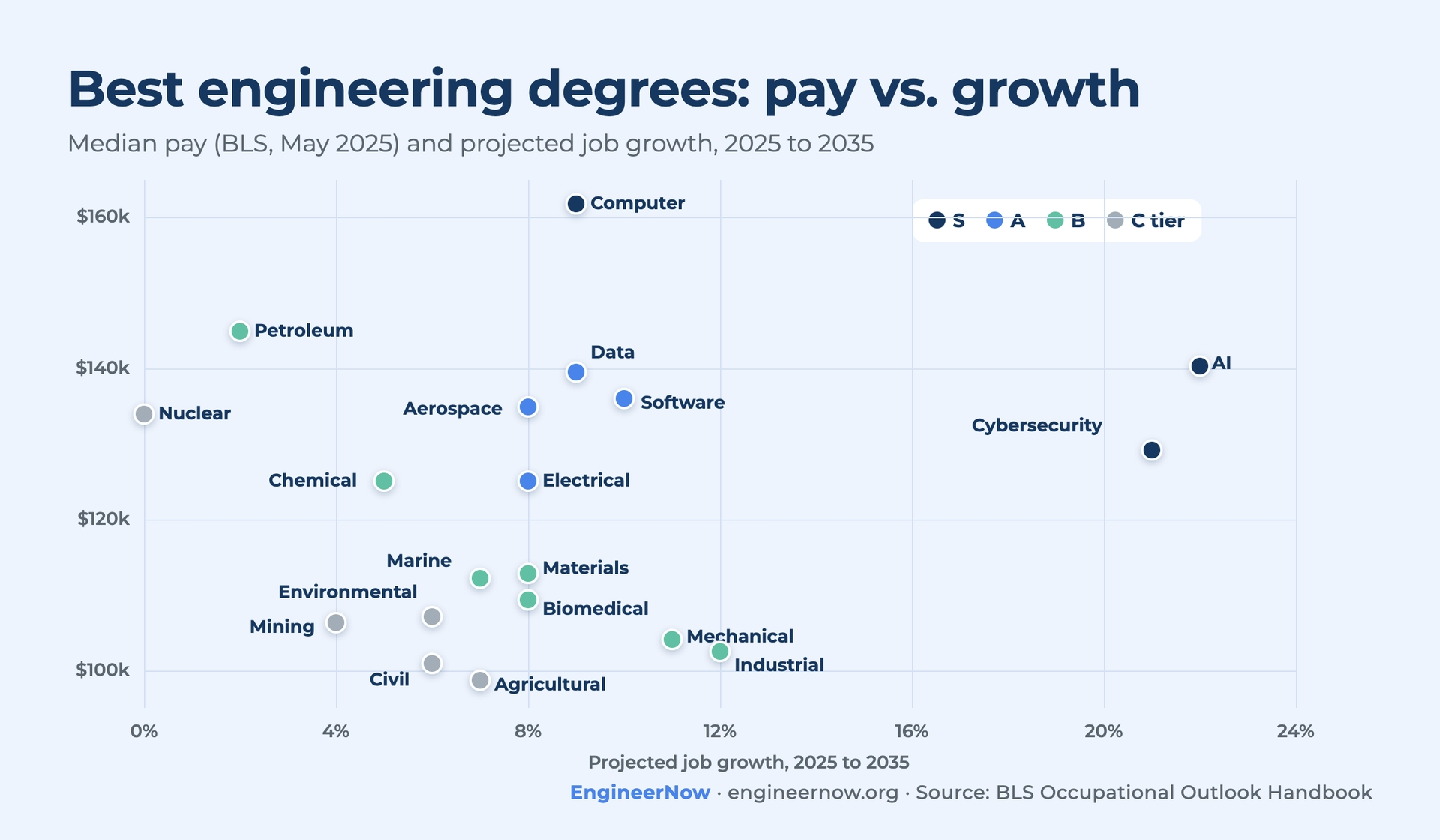
The chart shows the main thing: pay and growth rarely line up. Look at the left side: petroleum and nuclear pay well but barely grow, while industrial and mechanical grow fast on lower pay.
S-Tier: The Best Engineering Degrees by the Numbers
These are the best engineering majors on my engineering tier list. Two of the three are IT fields, and that tells you where the money is moving.
#1 AI Engineering
Computer and information research scientists earn a median of $140,300, and jobs are projected to grow 22%, the fastest in this list. BLS ties that demand to new technologies in artificial intelligence, and the work leans on data science and machine learning. One catch: the typical entry-level education here is a master's degree, so read my take on whether a master's or PhD is worth it first.
#2 Computer Engineering
Computer hardware engineers have the highest median pay in this list, $161,740, with 9% growth. You design processors, circuit boards and memory devices, and make sure they work with the latest software. If you like both electronics and code, this is the safest high-paying bet.
#3 Cybersecurity Engineering
Information security analysts earn $129,180, and jobs are projected to grow 21%. Most people get there after a few years in IT, BLS lists "less than 5 years" of related work experience. So treat it as a direction for a computer science or computer engineering degree, not a first job.
A-Tier: Strong Pay, Steady Demand
#4 Data Engineering. Database architects earn $139,500 and grow 9%. You build the systems that store and move data, so you need strong programming.
#5 Software Engineering. Software developers earn $135,980, with 10% growth. It's the biggest field in the whole list, about 1.7 million jobs.
#6 Aerospace Engineering. Aerospace engineers earn $134,960 and grow 8%. Aircraft, satellites, defense, a lot of physics and math.
#7 Electrical Engineering. Electrical and electronics engineers earn $125,040 and grow 8%. Power systems, control systems, electronics: almost every industry needs them.
My take
Notice that four of the top seven are IT fields. If you hate programming, that's fine, but be honest with yourself about it before you choose. Classic engineering still pays well above average, it just grows slower.
B-Tier: Good Pay or Good Growth, Rarely Both
#8 Petroleum Engineering. Petroleum engineers earn $144,910, and the top 10% earn more than $253,200. But growth is only 2%. I've spent my whole career in oil and gas. The money is real, but this market grows slowly.
#9 Chemical Engineering. $125,040 and 5% growth. Chemicals, pharmaceuticals, energy, food production.
#10 Materials Engineering. $112,860 and 8%. New alloys, composites and semiconductors.
#11 Marine Engineering. Marine engineers and naval architects earn $112,230, with 7% growth. A small field, about 8,400 jobs.
#12 Biomedical Engineering. $109,370 and 8%. Medical devices and healthcare technology. Remember this one for my top 3.
#13 Mechanical Engineering
Mechanical engineers earn $104,110, and jobs grow 11%. It's my profession, and BLS even lists robotic engineers as a specialty inside mechanical engineering. On pay it's only B-tier, but this degree moved me across countries: I've worked at sea, in deserts, swamps and forests, from −50°C to +50°C. If you want to know what a mechanical engineering career really looks like, I wrote about it separately.
#14 Industrial Engineering. $102,440, and 12% growth, the fastest of all classic engineering occupations. Manufacturing, logistics, operations.
C-Tier: Narrow Markets
These degrees aren't bad. Their markets are just smaller or slower right now.
#15 Environmental Engineering. $107,110 and 6%. Water systems, pollution control, climate projects. It's also number one on my list of the engineering jobs I'd think twice about, because the work is often harder than the pay suggests.
#16 Mining and Geological Engineering. $106,220 and 4%. About 300 openings a year.
#17 Agricultural Engineering. $98,590 and 7% growth, but only about 1,500 jobs in the whole US and around 100 openings a year.
#18 Nuclear Engineering. $133,970, but BLS projects little or no change in jobs. Still, about 800 openings come up every year, mostly to replace people who leave or retire.
#19 Civil Engineering. $100,840 and 6%. Last on points, yet civil engineers held 380,600 jobs, and about 22,700 openings come up every year. Among the classic engineering fields, only industrial engineering has more. Bridges, roads and water systems will always need people.
Best Engineering Degrees for the Future: Robotics and Renewable Energy
You won't find them in the table, and that's on purpose. BLS has no engineer occupation for either. BLS lists robotic engineers as a specialty inside mechanical engineering, so use the mechanical numbers.
Renewable energy is similar. The fast growth you see in headlines belongs to technicians: wind turbine technicians grow 30% and solar installers 37%, but their median pay is $64,120 and $53,140. For more ideas, here are the engineering professions of the future outside IT.
What Is the Best Engineering Degree? My Personal Top 3
My first choice is AI engineering and everything connected to IT. It's a big part of our present, and it will be an even bigger part of our future. The data agrees.
But if you're far from IT and hate coding, I'd look at biomedical and agricultural engineering. Why? Because the world's population keeps growing, and more people means more demand for health care and food. People will always need to eat.
Yes, agricultural engineering sits at #17 in my own table. I know. The US market is tiny today, so this is a long-term bet, not a ten-year salary plan. I'd still take it seriously.
In my video The BEST Engineering Degrees RANKED I talk through this choice in more detail. The salary figures there are older, the table above has the current BLS ones.
How to Choose the Right Engineering Major for You
The table gives you the market. Your answers to four questions give you the major:
- Which subjects are you strong in? Strong math and science skills point to mechanical, electrical or aerospace. Chemistry points to chemical or materials. Biology points to biomedical.
- Do you want options? Mechanical, electrical and civil degrees open the most industries.
- Will you study after your bachelor's? AI and research roles usually need a master's degree.
- Where do you want to work? An office, a lab, a plant or a rotation offshore are very different lives.
By the way, if you're stuck between two majors or two countries and want my personal advice, book a consultation with me.
Which engineering degree pays the most?
Computer engineering. Computer hardware engineers have a median of $161,740 a year (BLS, May 2025). Next come petroleum engineering at $144,910 and AI-related research roles at $140,300. My own income grew about 10 times after I moved to Saudi Aramco.
Can an engineer earn $200,000 a year?
Yes. In several fields the top 10% earn more than $200,000. For petroleum engineers that line is $253,200, for computer and information research scientists $230,630. Then come computer hardware engineers above $225,330, software developers above $214,670 and aerospace engineers above $205,890. It usually takes experience, a strong specialty and sometimes a move to another country.
What are the big 3 engineering degrees?
Traditionally mechanical, electrical and civil engineering. They're also among the largest occupations: about 380,600 civil, 298,500 mechanical and 297,900 electrical and electronics engineering jobs in the US (BLS, 2025). Industrial engineering is right there too, with 365,100 jobs. Together they cover the widest range of industries.
Is an engineering degree still worth it?
In my opinion, yes. BLS reports a median wage of $100,000 for workers with an engineering degree, compared with $70,000 for all degree holders (Field of degree: Engineering, 2023 data). Just pick a field you can stand working in for 40 years.
So choose with your head and with your heart, friends. A degree is only the start. What you do with it in the first five years matters much more. Good luck!
Your first internship starts with a resume
Pick an engineering resume template made for students and graduates, and fill it in for your first internship or co-op.
CREATE RESUME
Written by
Recent Posts