

Published · Updated · 11 min. read
Cable Technician Resume: Broadband, Low Voltage or Fiber?
A cable technician resume has to show which cable job you actually do: broadband install and repair, low voltage cabling or fiber. Each one has a different reader, different numbers and different certificates, and a resume that mixes all three reads like nobody's.
I'm a Certified Professional Resume Writer (CPRW) and I've conducted 200+ job interviews as the interviewer. I'm not a cable tech, though. My field is oil and gas maintenance, and at Shell I ran a mechanical maintenance department of 50+ people. So the cable facts below come from the BLS, O*NET and the certifying bodies themselves.
Below are the three lanes and the screening lines hiring managers check first. Then come the numbers worth counting, with [brackets] where your own data goes, an honest list of certifications and a full sample. The general rules of a technician resume still apply. This guide covers what's specific to cable work.
One note on words. US employers say resume. In many other countries the same document is called a CV, and a cable technician CV follows the same rules. So everything below works for your resume in either market.
What Does a Cable Technician Do? Three Jobs Under One Title
A cable technician does the installation and maintenance of the lines and equipment that bring internet, TV and phone service to homes and businesses. O*NET lists "Cable Tech (Cable Technician)" among the job titles of telecommunications line installers and repairers, next to cable splicer and fiber optic splicer (O*NET). Broadband technician and customer service technician sit in a neighboring group, telecommunications equipment installers and repairers.
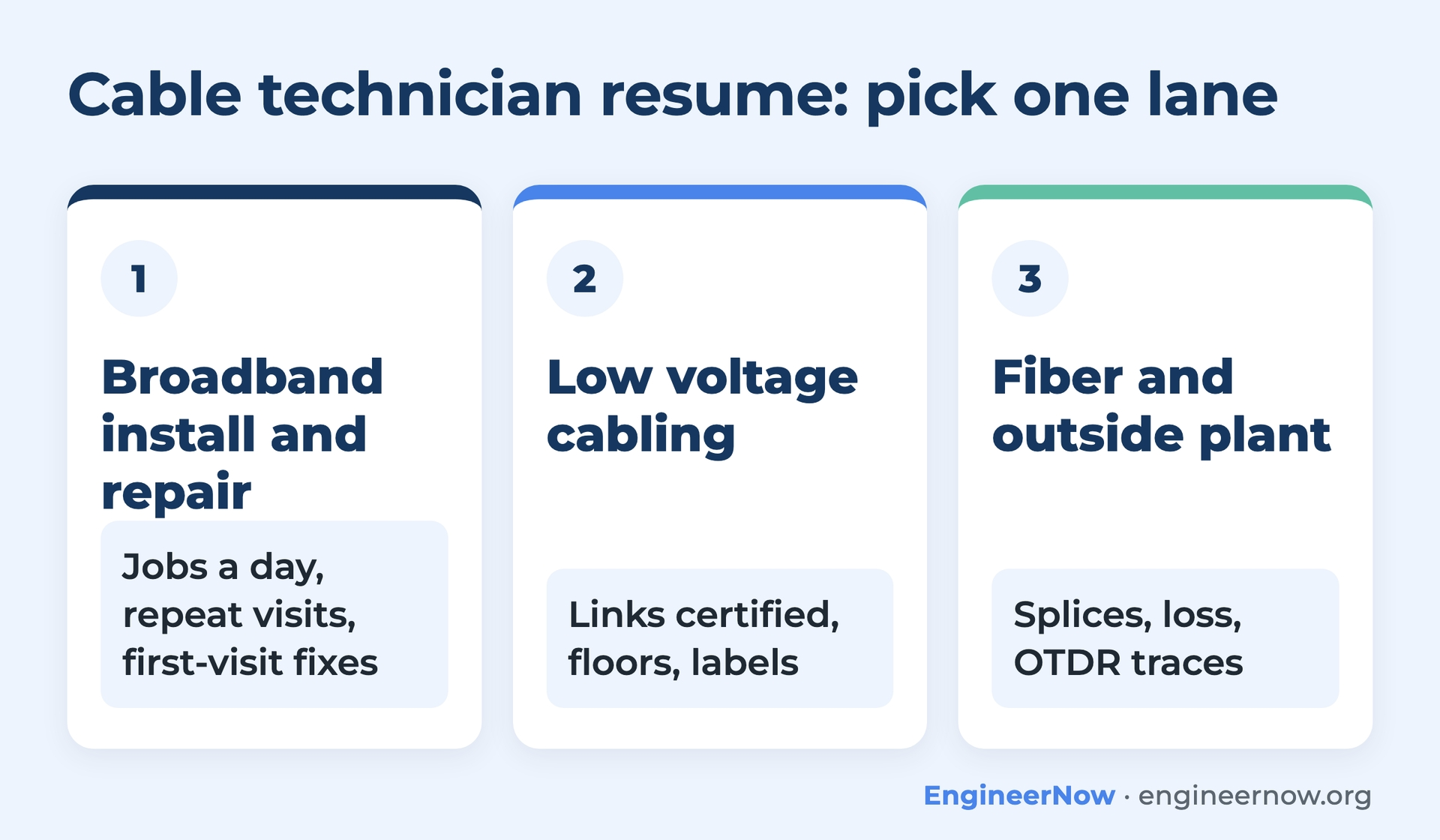
In practice the title covers three different jobs.
- Broadband install and repair. Coax and fiber drops, modems, gateways and set-top boxes for residential and commercial customers, mostly homes and small businesses. Job ads call this role cable installer, cable tech or broadband technician, so a cable installer resume follows this lane too. Your reader is a field supervisor at a cable operator or an installation contractor.
- Low voltage and structured cabling. Copper and fiber cabling systems inside offices, hospitals and data centers: CAT6 runs, racks, patch panels and tested links. Your reader is a foreman or project manager at a contractor. If most of your work is in server halls, our data center engineer resume guide covers that side.
- Fiber and outside plant. Cable splicing, cable testing, poles and underground conduit for fiber optic cable. Your reader is a splicing crew lead.
The pay is decent. The BLS puts the median pay of telecommunications technicians at $66,200 in May 2025, and $75,680 for those in telecommunications companies, which employ 61% of them (BLS). O*NET shows a median of $74,330 (2025) for telecommunications line installers and repairers.
So before you write a single bullet, decide which reader you're writing for. One resume, one lane.
Put the Screening Lines at the Top
Field jobs filter people out before anyone reads your work history. BLS notes that telecom technicians may need a driver's license to travel to jobsites, and workers who drive heavy vehicles usually need a commercial driver's license (CDL). The same page says they climb onto rooftops, into attics and up ladders, telephone poles and towers, wearing hardhats and harnesses.
If the job ad asks for these things, answer them early. Put them in the resume summary or right under it:
"Valid driver's license, [N] years with no at-fault incidents. Comfortable on [N]-ft ladders, on poles with fall protection, in attics and crawl spaces."
These lines also show that you take safety protocols seriously before the interview even starts. Add on-call work, weekend rotation or a background check only if the posting mentions them. BLS also says some employers prefer or require first aid or CPR, so list it if you have it.
Then add one short line on your qualifications. Name the knowledge you use while working: coax and fiber terminations, signal testing, fall protection. BLS lists the ability to work at heights and mechanical skills among the important qualities for telecom technicians. Show both with facts, not adjectives.
Employer training counts. List company courses by name and year under training: "[Course name], employer training, [year]". OSHA 10 and 30 go there too, as course completion cards (OSHA).
Numbers That Belong on a Cable Technician Resume
Most cable technician resume examples online list the same duties under work experience: cable installation, troubleshooting connectivity issues, customer service. Every tech on the crew could write those lines. What separates you is the count, and field work leaves a trail: each service call is a work order with times on it.
Broadband install and repair
These are the numbers worth counting in residential and small business work. Use the same words as the job posting: one company writes "repeat truck roll", another "repeat visit". These go into bullet points, not into a skills list.
- installs and trouble calls a day or a week
- share of visits inside the booked time window
- repeat visits on your jobs, in the window your company tracks
- trouble calls fixed on the first visit
- customer ratings after the visit
- years of safe driving
You don't need all six. Pick the ones you can back up when someone asks.
Resume bullet
Responsible for installing and troubleshooting cable, internet and phone services for residential customers.
Wrong
Resume bullet
Completed [N] service calls a day with [N]% repeat visits within 30 days (team average [N]%) and [N]% fixed on the first visit.
Right
If a supervisor asks how you counted, "from the work order app" is a good answer. It shows you know where your numbers live.
Low voltage and fiber
In low voltage work, count links that passed certification against industry standards on the first test, and floors or IDF and MDF rooms finished. Add labeling, as-built drawings handed over and punch list items closed: that's your quality control. In fiber, count splices a day, links within the loss budget, OTDR traces in the test report and homes passed or connected.
If you pull power, not data, you're writing a different resume. Our construction electrician resume guide fits that work better.

Resume Builder
Use proven engineering templates to build a job-winning resume in minutes.
CREATE RESUME| Certificate | Issuer | Lane | Good to know |
|---|---|---|---|
| Broadband Premise Installer (BPI) | SCTE | Broadband | Entry level: you know how to do a premises install but aren't yet proficient |
| Broadband Fiber Installer (BFI) | SCTE | Broadband, fiber to the home | Installing services over fiber to the customer's premises (FTTH); exam online |
| Broadband Premises Technician (BPT) | SCTE | Broadband | Aimed at experienced field techs who install and troubleshoot complex services |
| Installer 1 (INST1), Installer 2 Copper (INSTC), Installer 2 Optical Fiber (INSTF), Technician (TECH) | BICSI | Low voltage | BICSI's installation and technician track |
| Certified Fiber Optic Technician (CFOT) | FOA | Fiber | The basic fiber certification; through an approved school or Work to Cert with 2+ years of recent experience; renewed every 3 years |
| CPCT (premises cabling) | FOA | Low voltage | Copper, fiber and wireless cabling inside buildings |
| Fiber Optics Installer (FOI), Data Cabling Installer (DCI) | ETA | Fiber, low voltage | Hands-on course with an ETA-approved trainer; valid 4 years |
| OSHA 10 or OSHA 30 | OSHA Outreach | All | Course completion card, not a certification |
Write each one on its own line: the name, who issued it and the year. "In progress" is fair only if your exam is booked. And check the prerequisites before you list something: ETA's Fiber Optics Technician (FOT) requires a current FOI, so FOT alone without FOI looks odd to anyone who knows the field.
Don't upgrade a course card to a certification. It's one of the easiest things on a resume to check.
Cable Technician Resume Examples
Below is a full cable technician resume sample for the main lane: a broadband install and repair technician with five years in the field. Fictional example: made-up name and numbers. Copy the structure and put in your own data.
Use the samples below as a starting point. If a line doesn't match your cable technician work, cut it. A borrowed number falls apart at the first interview question.
Look at what's on top: years of experience, the license, the ladders and the certificate come before any duties. Technical skills sit in one short block. The key achievements carry numbers a supervisor can check.
Switching lanes is the second common case. Here's a short example of a broadband installer moving into low voltage, with the summary and three lines that carry over.
Fictional example: made-up name and numbers. Broadband installer moving into low voltage.
Summary: Broadband technician with 3 years of residential and small business installs, now moving into structured cabling. Terminates and tests copper and fiber, and keeps clean labels in occupied buildings. BICSI Installer 1 (INST1) exam scheduled for [month].
- Terminated and tested coax, CAT6 and fiber drops on 3,000+ service calls with a 7% repeat visit rate.
- Labeled every outlet and run on business installs; left job notes the next crew could follow.
- Worked after hours in occupied offices and clinics with zero customer complaints in 2025.
What carries over is testing and labeling in a live building. Put those first, and the contractor sees a cabling tech, not a home installer. The general mistakes are the same in every trade, and I went through them in my video 5 Resume Mistakes you MUST Avoid.
Now pick a clean layout and drop your own numbers in.


That's the whole method: one lane, the screening lines on top and real counts. Good luck, friends.
Are cable technicians in demand?
Fewer new jobs, but steady hiring. BLS projects employment of telecommunications technicians to fall 3% from 2025 to 2035, partly because government-funded broadband expansion projects are being completed and newer fiber needs fewer repairs. Still, it expects about 20,300 openings a year as workers leave the field. The jobs are there, and with fewer of them a clear resume matters more.
What skills and tools should a cable technician list on a resume?
List the tools and equipment you really used, by type: signal level meter for signal strength, cable certifier or tester, OTDR, fusion splicer, toner and probe, ladders and bucket trucks. Brand names are fine if the posting uses them. Keep it to one skills line, and back at least one tool with a number in your experience section.
How do I write an entry level cable technician resume?
Open with a short objective that names your lane, then lead with what an employer checks first: a driver's license, a clean driving record and comfort with heights. Add your training next: a technician course, SCTE BPI, ETA DCI or FOI, and an OSHA 10 card. BLS says most technicians start with a high school diploma and learn on the job.
Do you need a bachelor's degree to become a cable technician?
No. BLS says telecommunications technicians typically need at least a high school diploma or equivalent, then train on the job for several months to several years. Some employers prefer a certificate or an associate's degree. A bachelor's degree isn't on that list. So put your training and certificates where a degree would sit, and don't apologize for the gap.
Can a cable technician become a network engineer?
Yes, and cable work is a fair start, because you already know the physical layer: cables, connectors and testing. The gap is configuration: routers, switches and network certifications. Close it step by step, then see our network engineer resume guide for what the next resume should show.

Written by
Recent Posts

Pub: 06 Feb 2026 - Upd: 01 May 2026
26 min. read
Automotive Engineer Resume Examples Complete Guide for 2026
Pub: 08 Mar 2026 - Upd: 01 May 2026
26 min. read
Production Engineer Resume Examples, Format, Skills & ATS Tips
Pub: 05 Feb 2026 - Upd: 20 Nov 2026
12 min. read
Hydraulic Engineer Resume: Prove What Your Models Decided
Pub: 07 Mar 2026 - Upd: 01 May 2026
23 min. read
Mechanical Design Engineer Resume Examples & Templates