

Published · Updated · 12 min. read
Hydraulic Engineer Resume: Prove What Your Models Decided
A hydraulic engineer resume has to show what your models decided: the pipe size, the floodplain line, the culvert that got approved. "Performed hydraulic modeling" is a common line in resume examples online, but the design storm, the size of the system and the decision behind it are usually missing.
I'm a Certified Professional Resume Writer (CPRW) and I've conducted 200+ job interviews as the interviewer. My own field is mechanical: at Shell I headed a mechanical maintenance department of 50+ people. So the water facts below come from official sources: the BLS, NCEES, FEMA, the U.S. Army Corps of Engineers and the EPA.
Below you'll find the numbers for four project types, how to list software and licenses, and one short example with [brackets] for your own data.
This guide is for hydraulic engineers in water resources: stormwater, rivers and floodplains, water and sewer networks. If you design hydraulic cylinders and power units, your resume is closer to a mechanical design engineer resume.
What Does a Hydraulic Engineer Do, and Who Reads the Resume?
In the US, a hydraulic engineer is usually a civil engineer who works with moving water. That means stormwater management and drainage systems, rivers and floodplains, water supply and distribution systems, sewers, and structures like culverts, channels and bridges. "Civil hydraulic engineer", "water resources engineer" and "H&H engineer" (hydrologic and hydraulic) often describe the same job.
There is no single job code for this title. The closest U.S. data is for civil engineers. Their median pay was $100,840 in May 2025, with about 380,600 jobs in 2025. BLS projects 6% growth from 2025 to 2035 and about 22,700 openings a year (BLS).
That's the nearest public number for a hydraulic engineer salary. BLS lists water and sewage systems among civil engineering projects and notes that these engineers use design software for hydraulic systems.
O*NET has a separate profile for water/wastewater engineers. Its tasks include hydraulic analysis of water distribution networks and studies of stormwater or floodplain drainage to control erosion. HEC-RAS is on its software list, marked "In Demand".
So who reads your resume? Usually one of the project managers or the lead of a water resources group at a consulting firm, a county or a utility. The job postings we reviewed ask for the same three things again and again: the type of infrastructure projects, the modeling software and your license status. If your work is wastewater treatment and permits rather than pipes and rivers, our environmental engineer resume guide fits better.
Four Project Types and the Numbers That Prove Them
Many hydraulic engineer resume examples online say "performed hydraulic analysis" or "designed drainage systems". Every candidate did that. What's missing is the scale and the result. A water resources engineer resume gets stronger when each of your bullet points answers one question: what did the model change?
Pick the two or three project types you really worked on. Don't stretch into all four.
| Project type | What to count | Bullet template |
|---|---|---|
| Stormwater and site drainage | Drainage area, design storm, peak flow before and after, pond or pipe sizes, plan approval | Modeled [N]-acre site drainage for the [N]-year storm in [software]; sized [N] ponds to cut peak flow from [X] to [Y] cfs; plans approved by [agency type] |
| Rivers and floodplains | Reach length, 1D or 2D model, the 1% annual chance (100-year) flood, change in water surface elevation | Built a 2D HEC-RAS model of a [N]-mile reach; showed [X] ft rise or no rise for the 100-year flood; study accepted by [agency type] |
| Water distribution | Miles of pipe or nodes, calibration against hydrant flow tests, pressure and fire flow problems found | Calibrated an EPANET model of [N] miles of pipe against [N] hydrant flow tests; found [N] low-pressure zones; [N] fixes went into the capital plan |
| Sewers and hydraulic structures | SWMM model size, modeled overflows, culverts and bridges checked, scour | Updated a SWMM model of [N] miles of sewer; cut modeled overflows from [N] to [N] a year; sized [N] culvert replacements |
FEMA calls the flood with a 1% chance of being equaled or exceeded in any given year the base flood, or the 100-year flood. Write the storm or flood event in every bullet. "Modeled drainage" without an event tells the reader nothing about your design criteria or the regulatory standard you met.
One strong bullet carries one project, one model and one decision. If a number came from a report you didn't write, take the part you did: the model you built, the calibration you ran, the alternative you tested. Small real numbers read better than big borrowed ones.
Every number on the page is a question you may get in interviews with the hiring team. Keep only the numbers you can explain: how you calibrated the model, what the reviewer asked, what changed.
Senior and lead roles need one more layer. The reader wants to see projects from proposal to final report, including the work around the model: scope, budget, schedule and review comments.
Senior resumes can show business development too, if you really did it. Name the proposals you helped write and the client meetings you led. Use real numbers or none.
Pick the verb that is true for your role: coordinated, led or reviewed. A line like "Coordinated [N] engineers and [N] subconsultants on a [N]-mile flood study" shows the work around the model.
Before you send it, check that the model names and terms in your resume match the posting. One firm writes H&H, another hydrology and hydraulics, a third flood control or stormwater.

Resume Scanner
AI scanner performs 15 essential checks to ensure your resume is optimized for the jobs you're applying to.
SCAN RESUMEHow to List HEC-RAS, SWMM and EPANET Without a Keyword Dump
Fifteen programs in a skills section say very little. Hydraulic modeling software matters when the reader sees what you modeled with it. So write each program once in your skills line, then show it again in a bullet with a project behind it.
Here's what the main tools are for, according to their developers:
- HEC-RAS from the U.S. Army Corps of Engineers Hydrologic Engineering Center runs one-dimensional steady flow, one and two-dimensional unsteady flow, sediment transport and stormwater pipe network models (USACE).
- HEC-HMS, also from the USACE Hydrologic Engineering Center, is designed to simulate the complete hydrologic processes of dendritic watershed systems.
- SWMM from the EPA is used for planning, analysis and design of stormwater, combined and sanitary sewer systems. EPA calls it open source, publicly and freely available software (EPA).
- EPANET, also from the EPA, models water distribution systems: the hydraulic and water quality behavior of pressurized pipe networks. EPA says it's public domain software.
Because SWMM and EPANET are free, a student can show a real model from coursework, an internship or a capstone. For a junior or entry level resume, a line like "Built a SWMM model of a [N]-acre campus watershed for a senior design project" is honest. Commercial tools like WaterGEMS, Civil 3D and AutoCAD, and GIS software such as ArcGIS or QGIS, go in only if you used them. Name them the way the job posting does.
EIT, PE and CFM: Licenses on a Hydraulic Engineer Resume
You don't need a license to start. BLS says licensure is not required for entry-level civil engineers, but civil engineers typically must be licensed if they provide services directly to the public. That's why the reader of a hydraulic engineer resume looks for where you are on the path.
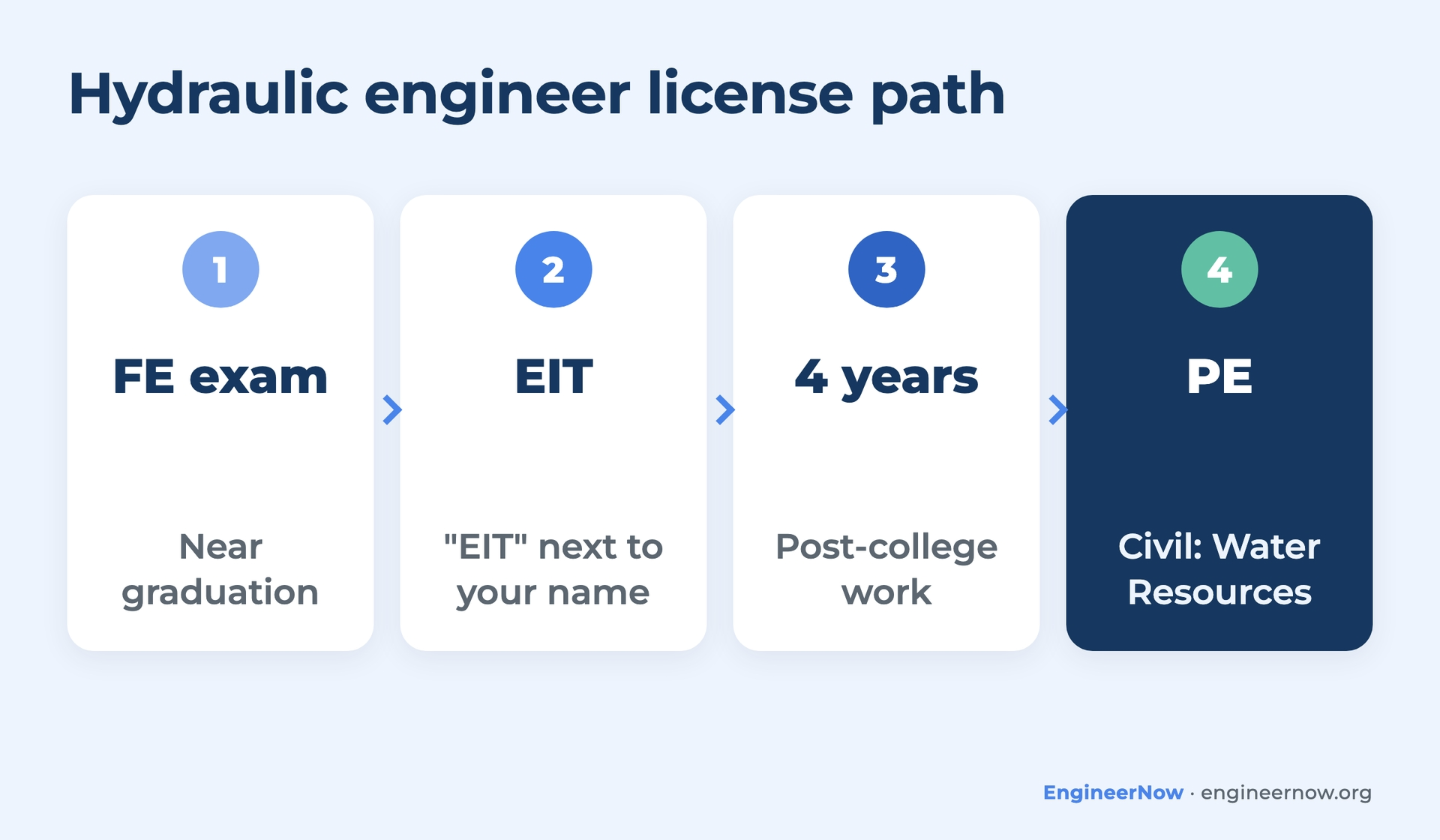
Here's each step and how to write it on the page.
- FE exam. NCEES designed it for recent graduates and students close to finishing an engineering degree, and it has 110 questions. NSPE says that after passing it you can become classified as an engineer intern (EI) or engineer-in-training (EIT). Write "EIT ([state], [year])" next to your name.
- PE Civil. The Professional Engineer exam in civil has 80 questions, and one of its five disciplines is Civil: Water Resources and Environmental. NCEES designed it for engineers with a minimum of four years of post-college work experience (NCEES). Once you hold the PE license, write "PE, [state]" after your name. If the exam is booked, "PE exam scheduled, [month year]" is honest and useful.
- CFM. The Certified Floodplain Manager program of the Association of State Floodplain Managers (ASFPM) requires passing an exam and earning continuing education credits every year (ASFPM). It matters if you work on floodplain studies, mapping or permits.
Write each credential exactly as the issuing board names it, and don't invent titles that no board issues.
These are United States credentials. If you're applying outside the US, the closest step in the UK is chartered status.
Hydraulic Engineer Resume Example
Here's a short hydraulic engineer resume sample for an engineer with an EIT and four years in consulting who is getting ready for the PE. Copy the layout and the logic, not the numbers.
Fictional example: made-up project and numbers.
[Your Name], EIT · Water resources engineer · PE exam scheduled, [month year]
Summary: Hydraulic engineer with 4 years of experience in stormwater and floodplain work at a mid-size consulting firm. Builds HEC-RAS 2D and SWMM models and turns them into design decisions and technical reports that pass review.
- Built a 2D HEC-RAS model of a 3-mile creek reach for a county flood study; the 100-year floodplain changed for 40 parcels.
- Modeled drainage for a 120-acre residential site in HEC-HMS for the 25-year and 100-year storms; sized 2 detention ponds that kept peak flow at predevelopment levels.
- Updated a SWMM model of 18 miles of storm sewer for the 10-year storm; found 6 undersized pipes that went into the city's capital plan.
- Checked 9 culvert and bridge replacements in HEC-RAS for the 100-year flood; all 9 design reports were accepted on first or second review.
Look at what's not there: no list of soft skills, no objective and no "responsible for". The resume summary is two lines, and the work experience is four bullets with an event, a model and a decision in each. Put your version into a clean template with the license in the header.
A simple formula for that summary: "[N] years of experience with [models] in [project types], [license status]." Then let the bullets prove your experience, one decision at a time.


Show the storm, the model and the decision, and your resume reads like engineering work, not like the job ad. Good luck, friends.
Below are a few frequently asked questions about the title, the license and the tools.
Is a hydraulic engineer a civil engineer?
In the US, usually yes. Hydraulic engineering is a civil engineering specialty, and BLS lists water and sewage systems among civil engineering projects. BLS also says civil engineers typically need a bachelor's degree in civil engineering or a related field. The word "hydraulic" has a mechanical meaning too (cylinders, pumps, valves), so read the posting before you apply.
Do you need a PE license to work as a hydraulic engineer?
Not to start. BLS says licensure is not required for entry-level civil engineers, but they typically must be licensed if they provide services directly to the public. The usual path is the FE exam, then work as an EIT, then the PE Civil exam, which NCEES designed for engineers with at least four years of post-college experience. Put your current status in the header.
What software should a hydraulic engineer list?
Only the tools you built or ran models in. For water resources work that often means HEC-RAS, HEC-HMS, SWMM or EPANET, plus CAD and GIS if you used them. Name each tool the way the job posting does, and back every one with a bullet that shows the project and what the model decided.
I design hydraulic cylinders and power units. Is this guide for me?
Not really. That's fluid power, a mechanical field with different readers and different numbers: pressures, flow rates, component selection. Our mechanical design engineer resume guide fits you better. IFPS also runs a Fluid Power Specialist certification with a hydraulic track, worth listing if you hold it.

Written by
Recent Posts

Pub: 27 Jan 2026 - Upd: 01 May 2026
45 min. read
Construction Electrician Resume Examples: What Employers Look for in 2026 (And How to Show You Have It)
Pub: 06 Feb 2026 - Upd: 01 May 2026
26 min. read
Automotive Engineer Resume Examples Complete Guide for 2026
Pub: 15 Jan 2026 - Upd: 19 Nov 2026
12 min. read
Apprentice Electrician Resume: Get In With No Experience
Pub: 25 Feb 2026 - Upd: 01 May 2026
58 min. read
Cable Technician Resume Examples & Guide: From Job Posting to Job Offer in 30 Days