

Published · 9 min. read
Chartered Engineer (CEng): What It Is and How to Get It
A Chartered Engineer (CEng) is a legally protected UK professional title for engineers who solve complex engineering problems and can take technical accountability for systems with real risk. You get it through the Engineering Council by joining a licensed institution like IMechE and passing a Professional Review, and you can do it from any country.
I'm Alex, a Chartered Mechanical Engineer (CEng MIMechE) and European Engineer (EUR ING) with 18+ years of experience, including Shell and Saudi Aramco. I studied at a free state university far from the UK. Out of my first 300 resumes, I didn't get a single reply. Later, Chartered status and the CMRP helped turn my applications into three interview invitations, so below I explain how to become a chartered engineer and what it really gives you.
What Is a Chartered Engineer?
A chartered engineer is an engineer registered as CEng with the UK Engineering Council, which holds the national register and sets the competence standard, UK-SPEC. Chartered Engineers develop solutions to engineering problems using new or existing technology, and they may have technical accountability for complex systems with significant levels of risk.
You don't apply to the Engineering Council directly. You apply through a licensed institution for your field: IMechE for mechanical engineers, ICE for civil, IET for electrical and so on.
The title is protected by law, so only people on the register can use it. After registration you put the letters after your name, like my CEng MIMechE. CEng simply stands for Chartered Engineer. It's one of four registration titles: EngTech, ICTTech, IEng (Incorporated Engineer) and CEng. IEng engineers maintain and manage current technology, while CEng adds new solutions and accountability for complex, risky systems.
Chartered Engineer vs Professional Engineer (PE)
If you work in the US, this matters. A PE is a state license, and candidates typically pass the FE and PE exams developed by NCEES. CEng is a UK registration.
In my experience, CEng works as a credibility shortcut with international employers. But it won't let you sign and seal drawings in a US state: only a licensed engineer can do that. If your US job needs it, you need the PE.
How to Become a Chartered Engineer in 5 Steps
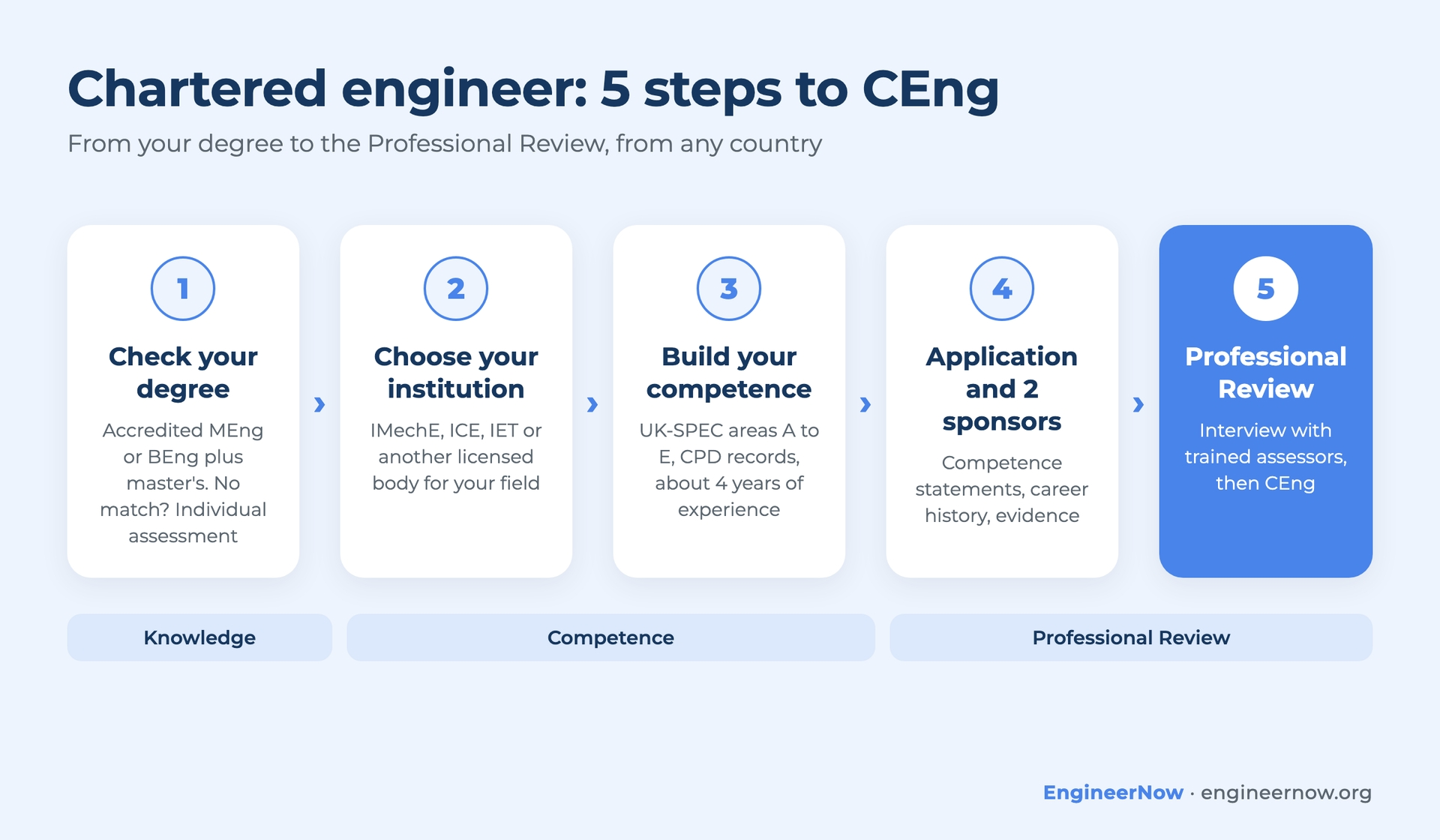
The chartered engineer requirements are the same at every institution, because all of them assess you against UK-SPEC, but each sets its own details. At IMechE there are three stages: knowledge, competence and Professional Review, and most engineers need a minimum of about 4 years of experience with growing responsibility before they apply.
Step #1: Check your degree
The standard path is an accredited integrated MEng degree, or an accredited BEng (Hons) plus an accredited master's, EngD or further learning to master's level. No accredited degree? You can still become a Chartered Engineer: your institution assesses your learning individually and may ask for a technical report or a technical interview. I got CEng with a degree from a university outside the UK, so a foreign diploma is not a reason to give up.
Step #2: Choose your institution
Pick the institution that matches your field. I'm a mechanical engineer, so I joined IMechE. There, annual membership at CEng level costs £320 (as of October 2026), and Engineering Council and application fees come on top. If you're a mechanical engineer, also look at the certifications mechanical engineers need for an international career.
Step #3: Build and record your competence
UK-SPEC checks five areas, A to E:
- A: knowledge and understanding
- B: design, development and solving engineering problems
- C: responsibility, management and leadership
- D: communication and interpersonal skills
- E: professional commitment
Keep a record of your CPD (continuing professional development) from your first job. For area C, think of real responsibility. Running a maintenance department of more than 50 people, like I did at Shell before I turned 30, is exactly the kind of evidence it asks for. Here is the difference in how you describe it, using a real result from my own career:
Competence statement
We upgraded the compressor station and improved availability.
Wrong
Competence statement
I led the root cause analysis on our main gas compressors and changed the maintenance strategy. Availability went from 68% to 95%.
Right
Step #4: Write your application and find two sponsors
The application includes competence statements, your career history, key achievements and evidence. You also need two sponsors who support it.
Quick tip
Write "I", not "we". The reviewers want to see what you did personally. Pick examples that show depth, complexity and responsibility, as IMechE advises.
Step #5: Pass the Professional Review
The last step is a Professional Review Interview with trained assessors, based on your application. Some institutions ask for more: ICE, for example, adds a written report and a communication task. Be ready to talk about your own decisions, with numbers.
How CEng Helped Me Get My First Job Abroad
Here is my real story. I joined Shell right after university. After about five years, I got my first invitation from abroad, from Qatar: around $4,000 a month, without family relocation. I said no.
My target was at least $10,000 a month NET. I realized I needed 7 to 8 years of experience, professional engineering status and extra certifications. So I got my UK Chartered Engineer status and passed the CMRP exam.
Then I applied again and got three interview invitations, one of them from Saudi Aramco. Aramco made me an offer, and I moved there with my family at 31. My taxes went from about 40% to zero.
CEng alone didn't get me the job. But it got me into the room.
The full story is in how I found my first job abroad. By the way, if you want my personal advice on building an international engineering career, join my Engineer-Millionaire course:
Is Chartered Engineer Status Worth It?
For me, yes. In my opinion it's worth it if:
- you want to work abroad, especially in the Middle East
- you work in oil and gas, energy or consulting
- you plan to move into management
It gives you less if you work only in the US and need to sign drawings, because there you need the PE. It's also early if you have less than about 4 years of experience.
What about salary? I can only speak for myself: CEng and CMRP helped me get the Aramco job, and my income grew almost 10 times, partly because of zero tax.
Remember, it's not a one-time payment. You pay the annual membership and keep up your CPD every year. In many Arab countries and companies, job descriptions show a clear preference for candidates with titles like this. And employers do check it: I was asked to provide proof of my Chartered Engineer status. My video on certifications for engineers seeking jobs overseas covers the titles that help most:
And here is my list of other certifications that help engineers get hired overseas.
FAQ
Here are short answers to the questions people search most about chartership.
How long does it take to become a chartered engineer?
Most engineers need a minimum of about 4 years of experience with growing responsibility, according to IMechE. Then you prepare the application and pass the Professional Review. My advice: start recording your competence from your first job, and you will save a lot of time later.
Can you become a chartered engineer without a degree?
Yes. The Engineering Council says you can still become a Chartered Engineer without the standard academic qualifications. Your institution assesses your learning individually, through a work-based route. Expect to show more evidence, so start collecting it early.
Can I become a chartered engineer outside the UK?
Yes. Registration is open whatever your nationality or where you live, as long as you meet UK-SPEC. You don't need to move to the UK. That's why I think CEng is one of the most accessible professional titles for engineers who want to work abroad.
What is chartership equivalent to?
Abroad, people usually compare CEng with a Professional Engineer license in the US, P.Eng in Canada or CPEng in Australia and New Zealand. They are similar in level but not interchangeable, because each one follows its own country's rules.
How hard is it to become a chartered engineer?
It's not easy, but the hard part is evidence. You show competence in UK-SPEC areas A to E, get two sponsors and discuss your application with other professional engineers, in person or by video. It's a real process, but you can do it from any country.
My Final Advice
If you plan an international career, start collecting your evidence now, even if you apply in three years. If you don't knock, the door won't open. And if you want help planning your path, book a consultation with me:
Good luck, friends.

Written by
Recent Posts



Pub: 18 Nov 2025 - Upd: 01 May 2026
8 min. read
Essential Certifications for Mechanical Engineers to Build an International Career