

Published · 10 min. read
Electrical Engineer Certification: 7 That Actually Pay Off
The most valuable electrical engineer certification in the US is technically a license: the Professional Engineer (PE) license, because it lets you sign and seal your own designs. If you want to work abroad, a Chartered Engineer (CEng) title through the IET often counts for more, in my experience. Add one industry certification for your field, like CAP, CEM, CESCP or PMP, and the picture is complete.
Which of these will a hiring manager actually notice? I've been on that side of the table more than 200 times. I'm Alex, a UK Chartered Engineer, European Engineer (EUR ING) and CMRP with 18+ years in engineering, including Shell and Saudi Aramco.
This list is for electrical engineers. My general list of certifications that help engineers land jobs overseas covers everyone else.
Certification, License or Certificate: What's the Difference?
People mix these up, and recruiters notice it. The short version:
- A degree in electrical engineering, like a Bachelor or Master of Science in Electrical Engineering, is your base. Most licenses and certifications build on it.
- A license, like the PE, gives you the legal right to practice and sign off work in a US state.
- A professional certification, like CAP or PMP, means you passed an exam set by an industry body. Most need renewal through continuing education.
- A certificate program from a university shows you completed specialized training. A graduate certificate, for example in electric power systems or electrical systems design, is a short program that goes deep into one area at master's level. It's education, not a credential.
- A membership grade, like MIET or IEEE Senior Member, shows your standing in a professional society. IEEE stands for the Institute of Electrical and Electronics Engineers.
Free online courses help you learn new software. On a resume they show curiosity, not qualification.
7 Electrical Engineer Certifications Worth Your Time
I picked these by two filters: do employers respect it as proof of your skills and knowledge, and does it still work when you move to another country. Most certifications for electrical engineers need real work experience, so they are not entry-level. There are many more. The US Department of Labor's My Next Move lists 47 for electrical engineers, and my wider list is in my top engineering certifications.
#1 PE license (Electrical and Computer)
The PE is the electrical engineer license in the US, issued by each state. Usually you start with a degree in electrical engineering from an ABET-accredited program and the Fundamentals of Engineering (FE) exam, which in most states gives you EIT or EI status. Then you build about four years of work experience and pass the PE Electrical and Computer exam. You choose one of three exams: Power; Electronics, Controls, and Communications; or Computer Engineering. Licensure requirements vary by state.
To keep the license, most state boards require continuing education, and the NCEES standard is 15 professional development hours (PDH) a year.
My take: number one if you stay in the US, where only licensed engineers can seal drawings. Abroad it's a strong line on your resume, but it gives you no legal rights there.
#2 CEng and EUR ING through the IET
Chartered Engineer is a UK title regulated by the Engineering Council. For electrical engineers, the usual route is the IET. You prove your competence against the UK-SPEC standard and pass a Professional Review interview, and you can apply from any country. I got mine through IMechE as a mechanical engineer, and the logic is the same. With CEng you can then apply online for EUR ING, the European title from Engineers Europe.
From the field
After about five years of experience, I got my first offer from Qatar: around $4,000 a month without family relocation. I said no. Then I got CEng, passed the CMRP exam, applied again and got three interview invitations. One of them, Saudi Aramco, ended with an offer.
#3 PMP (Project Management Professional)
Issued by PMI. It suits electrical engineers moving into project management on complex projects: substations, plants, infrastructure. You need documented experience leading projects (a four-year degree shortens it) plus formal project management training. If that's your direction, read my electrical project manager resume guide too.
My take: get it once you really lead projects. Without that experience behind it, it's just letters.
#4 Certified Automation Professional (CAP)
Issued by ISA. It's for engineers in automation and control systems: process automation, manufacturing, system design and software. It requires education and work experience in automation, so it's not for your first year.
My take: strong in automation roles, almost invisible outside them.
#5 Certified Energy Manager (CEM)
Issued by the Association of Energy Engineers (AEE). It fits energy management, efficiency projects and renewable energy, especially in facilities, utilities and consulting.
My take: worth it if energy is your daily work. If not, put that time into the PE or CEng.
#6 Certified Electrical Safety Compliance Professional (CESCP)
Issued by NFPA, the organization behind the NFPA 70E electrical safety standard. Some websites call it an IEEE certification. It isn't. It fits safety, compliance and contractor roles.
My take: it's built on a US standard, so I'd count on it mainly in the US.
#7 Certified Maintenance & Reliability Professional (CMRP)
Issued by SMRP. It covers maintenance, reliability and asset performance for manufacturing plants, oil and gas and power generation. I'm a CMRP myself, and together with CEng it changed my career. If you prefer a more statistical path, look at the Certified Reliability Engineer (CRE) from ASQ.
Electrical Engineering Certifications Compared
Here is the whole list in one place. The last column is my personal view on how each one works outside the US.
| Certification | Issued by | Best for | My view: value abroad |
|---|---|---|---|
| PE (Electrical and Computer) | NCEES exams, US state boards | Design sign-off in the US | A strong resume line, no legal rights |
| CEng / EUR ING | Engineering Council via IET (EUR ING: Engineers Europe) | International careers | High |
| PMP | PMI | Project roles | High |
| CAP | ISA | Automation and control systems | Good in automation |
| CEM | AEE | Energy management | Good in energy roles |
| CESCP | NFPA | Electrical safety | Mostly US |
| CMRP | SMRP | Maintenance and reliability | High |
Short version: the PE is a license for one country, CEng travels with you, and an industry certification shows what you're good at.
Which Certifications Count When You Apply Abroad?
At Shell and Saudi Aramco, and later with the 100+ engineers I helped get jobs abroad, I saw that international employers look for titles they can recognize quickly. A US PE is respected, but it's tied to one state. CEng can be done while living in any country, and EUR ING is an online application on top of it. In many Arab countries and companies, job descriptions show a clear preference for candidates with such titles.
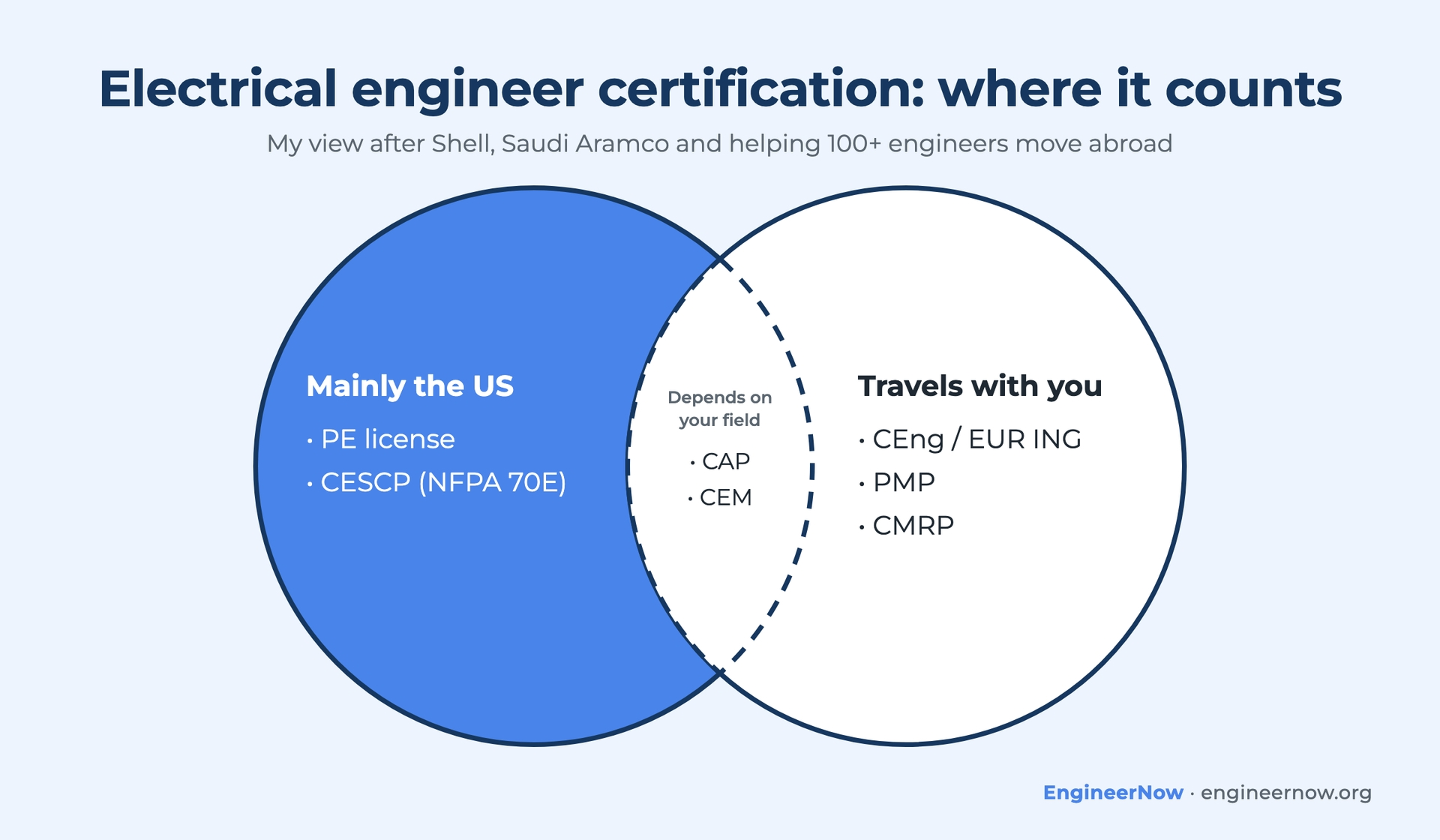
Membership in a professional institution also helps. It shows you're part of the profession, not just a degree holder. I go through the certifications that help most overseas in my video:
How to List Certifications on Your Resume
Write the full name and the abbreviation, because ATS systems search for both, for example "Project Management Professional (PMP), PMI, 2024". Put them in a separate section and add the main one next to your name.
Certifications section
PMP, CAP, CEM
Wrong
Certifications section
Project Management Professional (PMP), PMI, 2024. Certified Automation Professional (CAP), ISA, 2023.
Right
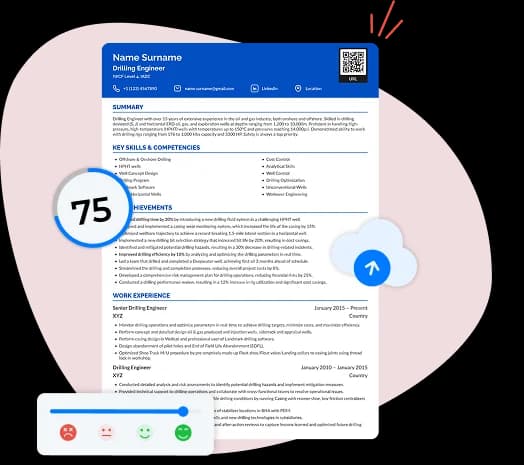
I learned the value of a good resume the hard way: my first 300 resumes got zero replies. Early in your career? Check my electrical engineering technician resume examples. And before you apply, run your resume through our scanner:
Resume Scanner
AI scanner performs 15 essential checks to ensure your resume is optimized for the jobs you're applying to.
SCAN RESUMEWhich One Would I Choose?
So what are the best certifications for electrical engineers? It depends on where you want to be in five years:
- Student or graduate: start with the FE exam to prove your fundamentals.
- Staying in the US, in design: the PE.
- Planning to work abroad: CEng, plus one industry certification like CMRP, CAP or CEM.
- Moving into projects: PMP.
And ask your employer to pay. In my first five years at Shell, the company spent about $50,000 on my training. If you don't ask, you won't get it.
By the way, if you want my personal advice on an international career, join my Engineer-Millionaire course:
Good luck, friends.
FAQ
Three questions electrical engineers ask me most about certifications.
Can I get an electrical engineer certification online?
Partly. Many university certificate programs (what search results call electrical engineer certification programs) are fully online. The FE exam is computer-based and runs year-round at approved Pearson test centers, and the PE exam is computer-based too. CEng you can apply for from any country, without moving to the UK. So most of the path works from home, except exam day.
How much does an electrical engineer certification cost?
It depends on the title. NCEES charges $225 for the FE exam ($250 at some international test centers). The PE Electrical and Computer exam costs $400, and some state boards add their own application fee. For CEng you pay your institution's annual membership plus Engineering Council and application fees. Always check the official site, because fees change.
Are free online electrical engineering courses worth it?
For learning, yes. For your resume, they're a small plus. I'd list one or two that match the job under training and keep the certifications section for real credentials. Employers pay for proven competence.

Written by
Recent Posts