Published · 10 min. read
CMRP Certification: How I Passed and What I'd Do Differently
CMRP certification (Certified Maintenance and Reliability Professional) is the credential of SMRP, the Society for Maintenance and Reliability Professionals. You pass one closed-book exam of 110 questions in 2.5 hours at a Pearson VUE test center. There are no education or experience prerequisites, and the fee is $300 for SMRP members or $470 for nonmembers.
I passed it in 2016 on my first attempt. Barely. I'm Alex, a Chartered Mechanical Engineer with 18+ years in engineering, including maintenance and reliability roles at Shell and Saudi Aramco. Here's what the exam really is, how I nearly failed it and how I'd prepare today.
What Is CMRP Certification?
CMRP is a professional certification for people who manage or improve maintenance, reliability and physical asset management. It's an SMRP certification run by SMRPCO, the certifying organization of SMRP, and SMRP says it's accredited by ANAB under the ISO/IEC 17024 standard. According to SMRP, more than 5,000 professionals worldwide hold it.
SMRP describes the Certified Maintenance & Reliability Professional (CMRP) certification as the leading credential for the knowledge, skills and abilities of maintenance, reliability and physical asset management professionals. The foundation of the exam is the SMRP Body of Knowledge. SMRP says the CMRP was developed to assess you within the five pillars of that Body of Knowledge.
One warning: there's a healthcare credential with the same letters, the Certified Materials and Resource Professional. This article is about the maintenance one. For the wider picture, see my list of top engineering certifications.
Who Accredits CMRP: ANSI and ANAB
On its CMRP page, SMRP calls it the only certification program of its kind accredited by the American National Standards Institute (ANSI). The accreditation itself comes from the ANSI National Accreditation Board (ANAB). SMRP describes ANAB as an independent third-party organization that evaluates certification programs. The standard is ISO/IEC 17024, and CMRT has the same accreditation.
Why does it matter? Someone outside SMRP checks how the program works. In my opinion, that's a fair signal for an employer abroad.
The CMRP Exam: Format and the Five Pillars
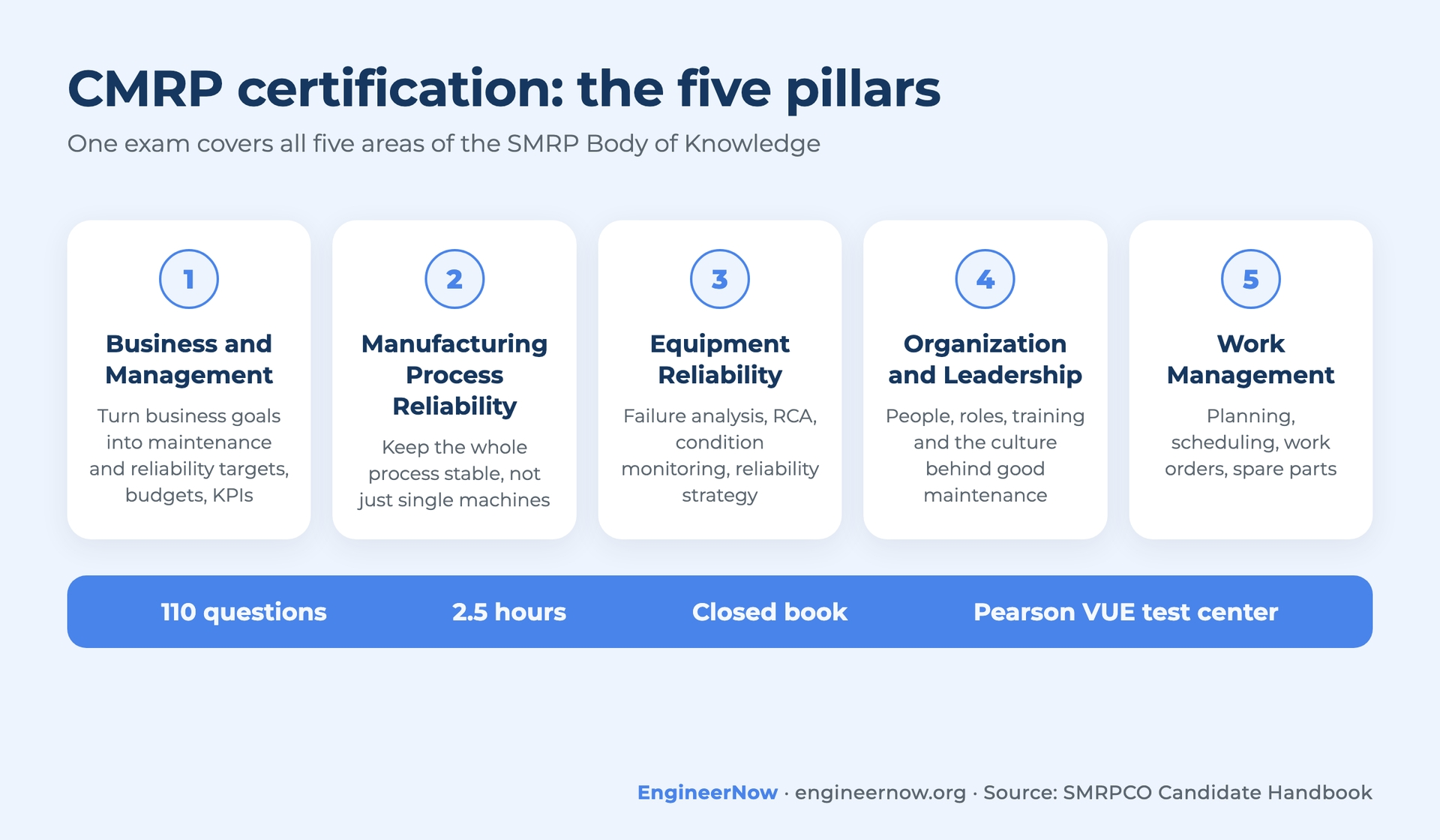
According to the SMRPCO Candidate Handbook, the CMRP exam has 110 multiple-choice questions with four options each. You get 2.5 hours, the exam is closed book, and you use an on-screen calculator. You can mark questions and come back to them before you submit.
The questions cover five pillars of the SMRP Body of Knowledge:
- Business and Management;
- Manufacturing Process Reliability;
- Equipment Reliability;
- Organization and Leadership;
- Work Management.
You see pass or fail right after the exam. The score report also shows how you did in each pillar.
What CMRP Exam Questions Look Like
Memory alone won't get you through. Some questions ask you to calculate, for example MTBF from 500 hours and five failures, and many ask which practice fits a situation. The Handbook includes 15 sample questions with answers, and SMRP sells official practice tests for 30 or 60 days.
Exam Day at a Pearson VUE Testing Center
You schedule the exam through Pearson VUE, which SMRP calls its official testing provider, and you sit it at one of their testing centers. The certification exam runs on the center's computer, so candidates don't need to bring their own. Your six months start after application approval and payment. So check dates at your nearest center before you pay, not after.
CMRP Certification Cost and Requirements
There are no education or work experience requirements. But the Candidate Handbook is clear that this is an experience-based exam, and you're unlikely to pass it from a book or a course alone. After you pay, you have 6 months to sit the exam. If you fail, you can retake it after 6 months, applying and paying again as a new candidate.
| Item | CMRP |
|---|---|
| Exam fee, SMRP member | $300 |
| Exam fee, nonmember | $470 |
| Exam fee, sustaining sponsor employee or U.S. veteran | $250 |
| Questions and time | 110 questions, 2.5 hours |
| Retake | After 6 months, pay again |
| Valid for | 3 years |
| Recertification | 50 course hours; fee $150 member, $320 nonmember |
The CMRP certification is valid for 3 years. To renew, you log 50 course hours from at least two kinds of activity and apply within 90 days of expiry, or you sit the exam again. To apply the first time, you register and pay on smrp.org, then Pearson VUE sends you an Authorization to Test and you book a center.
How I Passed the CMRP Exam on My First Attempt
It was 2016. I had read some books on maintenance and reliability, and I even had the official SMRP book. I ordered it myself. I just never properly read it.
To sit the exam I had to fly to another city. On the way I told myself: whatever happens, happens.
After the first few questions I realized I would probably fail. Seriously. So I kept going and answered what I knew. At least it would be experience, and next time I'd prepare properly.
I passed. But only just. I was barely above the passing line in all five pillars. I got through, but it was very hard, and I was not ready.
Mistake I made
I bought the official SMRP book and didn't read it before the exam. I really regretted it during the exam. After the exam I read it properly, plus a lot of other material, and took courses. If I could go back, I'd do it in the opposite order.
How to Prepare for the CMRP Exam
If you want to pass it comfortably, prepare seriously. Here's what I recommend:
- The official SMRP book. SMRP's study material is the SMRP Guide to the Maintenance and Reliability Body of Knowledge. Read it pillar by pillar.
- Ramesh Gulati's book. Maintenance and Reliability Best Practices, third edition (Industrial Press, 2020). It's on SMRP's own CMRP reading list.
- SMRP Best Practices. The metrics and guidelines document, free for SMRP members.
- Official practice tests. Find your weakest pillar early.
- SMRP Training Academy. SMRP encourages its self-paced CMRP Five Pillars of Knowledge online course series.
More books on similar topics will help too, but these are the core.
Study plan
I have ten years in maintenance. I'll skim the SMRP book the week before and trust my field experience.
Wrong
Study plan
I'll read the SMRP Body of Knowledge pillar by pillar and take an official practice test. Then I'll read Gulati's book, starting with the chapters for my weakest pillar.
Right
Who Should Get CMRP?
SMRP says the CMRP is available to any maintenance and reliability professional, regardless of education or work experience. In practice, it fits maintenance and reliability engineers, planners, supervisors and managers, and people who lead maintenance teams or want to.
The work behind these roles is broad. You help operations reduce downtime on critical equipment. You weigh risk and safety when you decide what to repair now and what can wait. You keep the spare parts inventory in order, so one failed pump doesn't stop the plant for weeks. When it works, product keeps flowing to the customer.
I became CMRP certified in 2016. In my opinion, the credential makes the most sense if this mix of tasks is your daily job, or the job you want next.
Is CMRP Certification Worth It?
In my opinion, yes, if you work in maintenance or reliability or want to join an international operator. SMRP's own survey says four out of five CMRP holders would recommend it to advance their careers.
After about five years of experience, my first offer from Qatar was around $4,000 a month without family relocation, and I said no. Then I got my Chartered Engineer title and CMRP, applied again and got three interview invitations. One of them, Saudi Aramco, ended with an offer. I told the whole story in how I found my first job abroad.
By the way, if you're planning an international career, I share everything I learned on that road in my course.
Is the CMRP exam difficult?
For me it was very hard, even with years of experience. It covers all five pillars, far beyond your daily work. SMRP doesn't publish the passing score or the pass rate, so ignore the percentages you see online and prepare as if experience alone won't be enough.
CMRP vs CRE: which is better?
They test different things. ASQ's CRE needs eight years of experience, three of them in a decision-making role, and goes deep into reliability statistics. CMRP has no prerequisites and covers the whole maintenance and reliability system, from business goals to work management.
Can I take the CMRP exam online?
SMRP lists only Pearson VUE test centers, more than 5,000 of them worldwide. I couldn't find any official mention of remote proctoring. In 2016 I had to fly to another city, so check your nearest center early.
What is the difference between CMRP and CMRT?
CMRT certification is SMRP's credential for maintenance technicians. It covers maintenance practices, preventive and predictive maintenance, troubleshooting and analysis, and corrective maintenance. The exam has 175 questions in 3 hours and costs $250 for members or $300 for nonmembers.
Should a technician take CMRT or CMRP?
CMRT stands for Certified Maintenance & Reliability Technician. SMRP describes it as a credential for the knowledge, skills and abilities of maintenance and reliability technicians, the multi-skilled people who do preventive, predictive and corrective work. If you're a hands-on reliability technician, start there. If you plan the work, manage people or want a lead role, I'd go for CMRP.
So prepare as if you had no experience at all, friends. Your experience will still help, it just won't be enough on its own. Good luck!

Written by
Recent Posts