Published · Updated · 10 min. read
Money Habits for Engineers: What I Changed After 9 Years
Good money habits for engineers are boring: track your money, invest a fixed share of every paycheck on payday and don't let spending grow as fast as your salary. I learned this late, because for the first 9 years of my career I spent everything I earned.
I'm Alex, a Chartered Mechanical Engineer with 18+ years in oil and gas, including Shell and Saudi Aramco. I'm not a licensed financial advisor, so everything below is my personal experience, not financial advice. These are the financial habits that changed my numbers, plus a few that didn't work.
The Bad Money Habits That Kept Me Living Paycheck to Paycheck
Like many people, I had a mortgage and a car loan. Whenever my salary arrived, I felt I had to spend it all. Nothing went to savings or investments. For 9 years, those were my financial habits.
You're not alone if this sounds familiar. In the Federal Reserve's survey for 2024, 63% of US adults said they would cover an unexpected $400 expense using only cash or its equivalent (Federal Reserve). More than a third would have to find the money some other way. A good salary doesn't fix that on its own. Healthy habits do.
What changed things for me was a book. I read Rich Dad Poor Dad by Robert Kiyosaki, then more than 100 books on investments, money management, finance and business. After that, I changed my financial habits one by one.
Mistake I made
For 9 years, I had a mortgage, a car loan and zero savings. At work I measured everything, from vibration to pump failures. At home I didn't measure my own money at all. Don't wait as long as I did.
How to Track Expenses Like You Track Equipment
Income and expenses tracking was the first habit I started. There's a phrase I repeat a lot: if you can't measure it, you can't improve it.
For engineers, this should feel natural. At Shell, I ran condition-based maintenance and vibration programs. Nobody repairs a compressor based on a feeling. You measure first, then you decide. Money works the same way.
Here's how to track expenses without making it a second job. For one month, write down every dollar of income and every expense: card payments, cash, daily coffee, everything. A spreadsheet or a banking app is enough. Then group the costs into a few categories: housing and loans, food, transport, kids and school, the rest.
At the end of the month, review where your money went and cut what didn't add any value. Then create a budget from real numbers, not guesses, and set long-term financial goals you can check. If you carry high-interest debt, like credit cards, many people pay it down before they invest more.
Pay Yourself First: 10% on Payday, Not What's Left
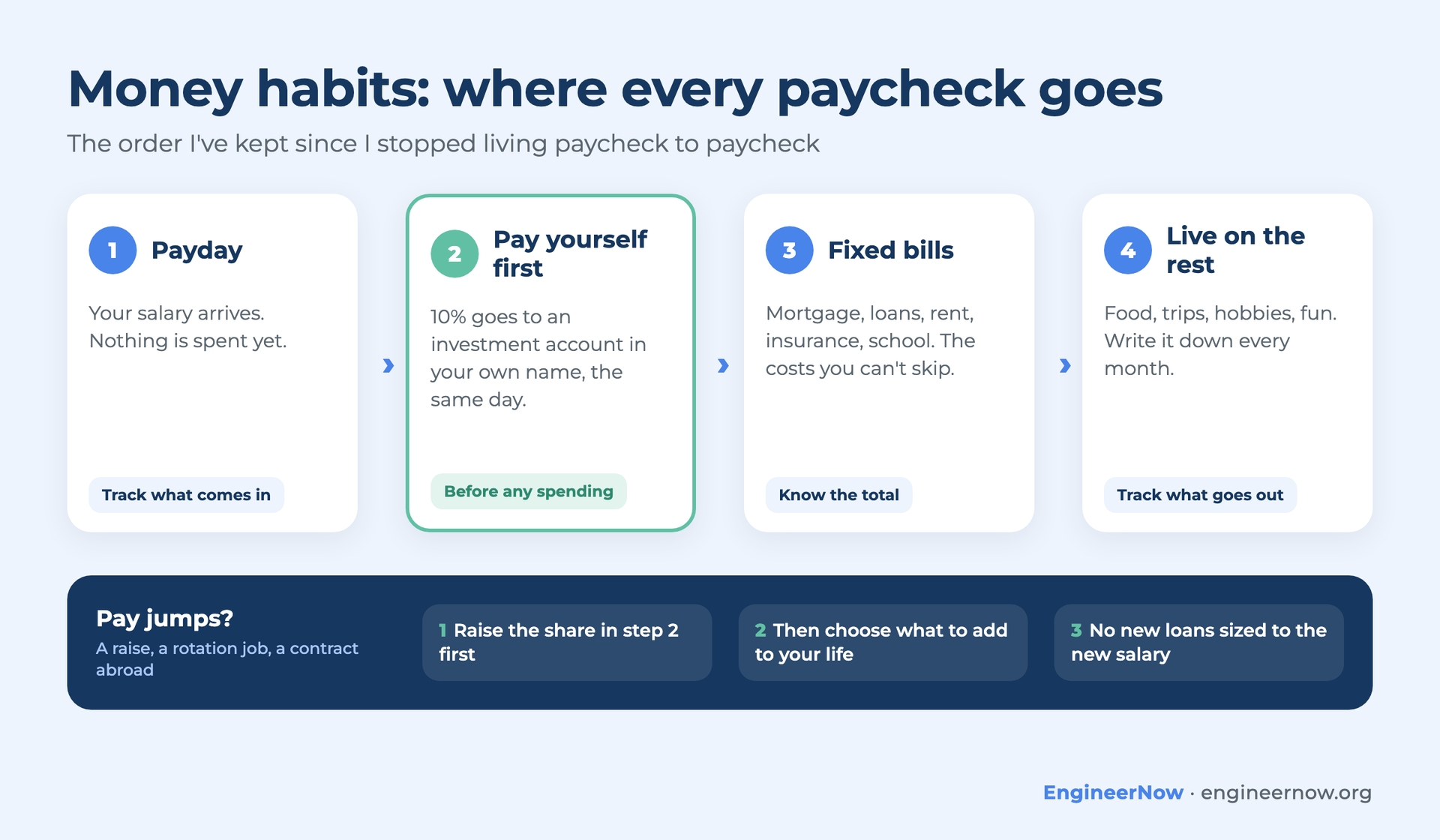
Pay yourself first was the habit I started right after Rich Dad Poor Dad. The rule is simple: once your income arrives, take 10% and invest it. Before the bills, before shopping, before anything else.
I've kept doing it every month since. My 10% goes to a brokerage account, where I buy stocks and bonds.
Why not just save what's left at the end of the month? Because nothing is left. I tested that for 9 years.
Saving what's left
I'll invest whatever is left at the end of the month.
Wrong
Paying yourself first
On payday, 10% goes to my investment account. I live on the other 90%.
Right
Automatic transfers make this easier: set a standing order for payday, and the decision is made once, not every month. A bank savings account is good for short-term cash and an emergency fund for a few months of living expenses. But saving money in a bank account alone won't make you rich.
When Your Pay Jumps, Don't Let Lifestyle Creep Eat It
Lifestyle creep, or lifestyle inflation, is when your spending rises every time your income does. You get a raise, and a year later you save the same amount as before. Just with a nicer car.
For engineers, pay doesn't always grow by a few percent a year. It can jump: a rotation job, a contract abroad, a tax-free salary. After my move to Saudi Aramco, my income grew about 10 times. Part of that was tax: from about 40% to zero.
I've lived without income tax for 8 years now. That's my personal situation, not tax advice. Tax rules depend on your citizenship and where you live, so check yours with a tax professional.
A friend of mine doubled his salary in 6 months by changing 3 companies. Jumps like that happen. What you do with the difference decides whether you build capital or just bigger bills.
A pay jump is when habits matter more than the amount. So when your income goes up:
- increase your investing share before you add new spending;
- decide what you really want to add to your life, and add it on purpose;
- don't take new loans sized to the new salary, because contracts end and rotation jobs can stop.
A mortgage and a car loan kept me paycheck to paycheck on a much smaller salary. Bigger loans can do the same on a big one.
Invest in Your Skills Before You Invest in Stocks
For me, the best return came from education. About $50,000 went into my education over 5 years, and I still buy a new course almost every month. Learning became a passion.
Skills raise the income itself, and income is what you invest. Before Saudi Aramco, I gained more experience and passed the CMRP exam. If you want to work on the income side first, I wrote about how to make more money as an engineer.
Not all my financial decisions worked. I've also put money into crypto and startups, not very successfully. That's one more reason the boring 10% matters most to me.
By the way, if you want my approach to growing an engineering income and keeping it, that's what my Engineer-Millionaire course is about.
Keep Your Money in Your Own Name
My one firm rule: never transfer your money to anyone to "manage" it. Once you send it, you may never see it again.
My money sits in an account in my own name. I work with a professional financial advisor who has more than 30 years of experience. He can buy and sell assets in my account, but he can't withdraw the money.
Before you hire anyone, check them on Investor.gov, the SEC's site: its free search tool shows if a professional is licensed and registered. It also shows run-ins with regulators and complaints from investors (Investor.gov).
Then read every statement promptly. The SEC calls it your most important protection against unauthorized transactions (Investor.gov). This isn't paranoia: 21% of US adults experienced financial fraud or scams in 2024 (most often credit card fraud), per the same Federal Reserve survey.
Your money stays in an account in your name. Nobody else should be able to withdraw it.
Let Compound Growth Do the Boring Part
Compound growth is slow at first, and that's why most people quit. Same share of income every month, dividends reinvested, for years. Everybody wants to get rich quickly, and nobody wants to wait.
I won't promise you a number: markets go up and down, and nobody can guarantee a return. Put your own numbers into the SEC's compound interest calculator: initial investment, monthly contribution, length of time in years and an interest rate you consider realistic. Then change one input at a time and watch your progress over the years.
We all work to earn a living. The real question is how much of that living stays with you. Start with one habit this month, and the next one gets easier. Good luck, friends.
What are the most important money habits for engineers?
In my experience, four. Track your income and expenses, pay yourself first on payday, keep spending flat when your pay jumps, and keep your money in accounts in your own name. Engineers can get big pay jumps from rotation jobs or contracts abroad, so the third one matters a lot for us.
How much of my salary should I invest each month?
There's no single right number, and I can't give personal financial advice. I started with 10% and have kept it for more than 10 years, because it was small enough to do every month. Many people first pay off high-interest credit and build an emergency fund, then add retirement contributions. Pick a share you can keep and plan to raise it as your income grows.
How do I avoid lifestyle creep after a big raise or a job abroad?
Decide where the extra money goes before it arrives. Raise your investing share first, then choose one or two things you really want to add to your life. Don't take loans sized to the new salary, because contracts and rotation jobs can end. Track your spending for the first few months to see whether your costs quietly grow.
How do I check a financial advisor before hiring one?
Start with registration. The SEC says to check whether the person is registered with the SEC or a state securities regulator, and Investor.gov has a free search tool for people and firms. Ask about fees in writing. Keep the money in an account in your own name, never transfer it to the advisor, and read every statement and the balances as soon as they arrive.

Written by
Recent Posts