Published · Updated · 12 min. read
Industrial Engineer Resume: Examples That Prove Savings
An industrial engineer resume gets interviews when every improvement bullet shows where the process started, what you changed, the result and how long it held. "Reduced cycle time by 20%" with no starting point reads like a guess.
Plenty of resumes are full of those guesses. I'm a Certified Professional Resume Writer (CPRW) and I've conducted 200+ job interviews from the hiring side. A hiring manager who reads "improved efficiency by 18%" has one question: 18% of what, measured how?
This guide is for an industrial engineer with a few years of real projects. Below: the proof chain, a bullet template for each method with [brackets] for your data, Lean Six Sigma and two examples. If you're still in school, start with the industrial engineer intern resume instead.
A percentage without a baseline is an opinion. Write the before number, the after number and the period.
What an Industrial Engineer Resume Has to Prove
Start with the job itself. The U.S. Bureau of Labor Statistics lists what industrial engineers do in a clear order (BLS). They evaluate manufacturing, delivery or other systems and "collect data on processes and production through observations of work activities, time studies, and staff surveys".
Then they analyze the data, design better processes, work with other departments to implement them and present the analysis to management.
That's your resume. Each project should show the same steps when you improve existing processes: what you measured, what you designed, what changed and who accepted it.
The market is big, so employers can afford to be picky. BLS counts 365,100 industrial engineer jobs in 2025, a median wage of $102,440 in May 2025 and growth of 12% from 2025 to 2035, with about 23,100 openings a year. The largest employers are transportation equipment manufacturing (15%), professional, scientific and technical services (14%) and computer and electronic product manufacturing (11%).
So the same title sits in a car plant, a consulting firm and an electronics factory. What travels between them is the method and a result someone can check. Writing an industrial engineering resume for a continuous improvement engineer or process improvement engineer job? Different title, same proof.
Applying for a senior industrial engineer job? The bar moves from your own projects to the system around them. The reader looks for standards other engineers now use, projects you led from baseline to control plan and people you trained. Put your biggest result with your name on it in the summary line.
The Proof Chain Behind Every Improvement Bullet
A strong bullet carries five links: baseline, method, result, how long it held and who confirmed it. Miss the first one, and the rest can't be checked.
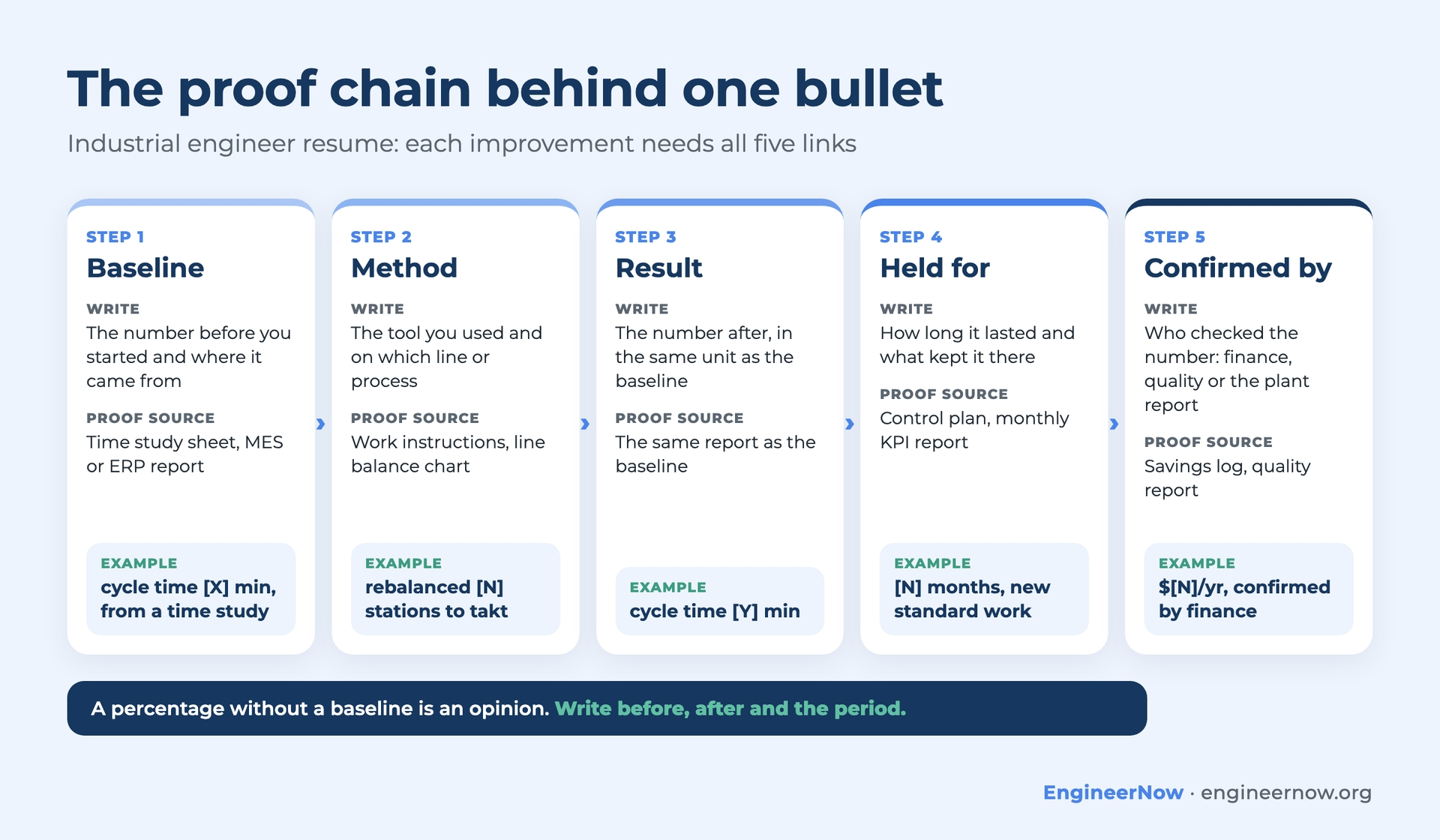
Where do the numbers come from? Your own time study sheets and process documentation, the MES or ERP production reports, the quality control report with scrap and rework, and the savings log that finance keeps. If the number exists in one of those documents, you can write it. If it only exists in your memory, write it as an estimate or leave it out.
Three rules keep the numbers honest:
- Annual and one-time savings stay separate. A one-off cost reduction in inventory isn't "$[N] per year".
- Hard and soft savings don't mix. Money that left the budget is hard. Freed labor hours that went to other work are soft. Both count, but label them.
- Team projects get your share. In cross-functional teams, say what you measured, proposed or implemented, not the size of the whole program.
Here's a template for every project.
[Verb] [method] on [line / process]: [metric] from [X] to [Y] over [period]; [$ per year] confirmed by [finance / quality].
Industrial Engineer Resume Bullets by Method
The table covers six core methods, on an assembly line or in a warehouse. Each one has a number the reader expects to see. Pick the two or three you actually used, from time studies and production planning to layout design and material flow. A list of every method you've heard of proves nothing.
| Method | What the reader checks | Bullet template |
|---|---|---|
| Time study, work measurement | How many observations, which time standard changed, what followed in staffing or the plan | Ran time studies on [N] operations; updated standards from [X] to [Y] min; [labor hours] freed per [week] |
| Line balancing and takt | Cycle time against takt, number of stations, balance loss before and after | Rebalanced [line] from [N] to [M] stations at takt [T] s; output from [X] to [Y] units per shift |
| OEE | Which factor moved (availability, performance or quality) and from what baseline | Raised OEE on [machine] from [X]% to [Y]% by cutting [downtime / speed loss / scrap] |
| Layout and material flow | Travel distance, WIP, floor space | Redesigned [area] layout; travel from [X] to [Y] m per order, WIP from [X] to [Y] |
| Simulation | Which decision the model supported and how it compared with reality | Built [Arena / FlexSim / AnyLogic] model of [system]; showed [N] stations were enough, avoiding $[X] in capital equipment |
| Lean or Six Sigma project | DMAIC phase you led, defects before and after, the control plan | Led DMAIC on [defect]; rate from [X] to [Y] ppm, held [N] months with a control plan |
Two definitions help you write these rows correctly. The Lean Enterprise Institute defines takt time as available production time divided by customer demand, so write cycle time against takt, not "met takt" with no number. And OEE is availability rate × performance rate × quality rate. If your OEE went up, say which of the three factors you moved. That's the part the hiring manager can ask you about.
One line on my own resume comes from my Shell years: main gas compressor availability went from 68% to 95% through root cause analysis. That's maintenance and reliability work, not industrial engineering. But availability is one of the three OEE factors, and the 68% is what makes the 95% believable. Without the starting point, it's just a nice number.
How to Put Lean Six Sigma on a Resume
Put the belt in your certifications section and the project in your work experience. They prove different things, so they belong in different places.
So a Green Belt alone shows knowledge and experience, not a finished project. Add the project line to your experience: the DMAIC phase you led, the defect rate before and after, and the control plan that kept it there.
I took a Lean Yellow Belt course myself. Here's how I see it: the belt line tells the reader what you learned. The project line tells them what you did with it.
Don't put "Six Sigma" in your skills if you can't name a project, and don't write "Lean Six Sigma certified" without the issuing body and level. A lean manufacturing engineer resume that says "ASQ Certified Six Sigma Green Belt, [year]" plus one DMAIC bullet with numbers beats a skills list of ten lean tools.
If a project is still sitting in your notes as a task, our achievement generator turns it into one result line.

Industrial Engineer Resume Outside the Factory
Industrial engineers don't only work in plants. BLS mentions healthcare, with improving hospital wait times as an example, and expects demand for industrial engineers to manage supply chains and logistics. The methods of process optimization stay the same. The metric changes.
- Warehouse and distribution: pick rate, picker travel per order, order accuracy, dock-to-stock time.
- Hospital: patient wait time, operating room utilization, patient flow between departments.
- Service and office: cycle time of a request, backlog, first-time-right rate.
The template doesn't change either.
Mapped [process] in [department]; [metric] from [X] to [Y] over [period], confirmed by [report].
Moving from a plant to a hospital or a distribution center? Translate your factory bullets into the reader's metric where you honestly can.
Industrial Engineer Resume Examples
Two industrial engineer resume examples, one plant and one warehouse, each built on the proof chain. Each has an industrial engineer resume summary and three bullet points. Both are fictional, so replace every number with your own.
Fictional example: made-up company and numbers. Industrial engineer at an appliance assembly plant.
Summary: Industrial engineer with 6 years in high-volume assembly; time studies, line balancing and OEE work across 3 lines.
- Ran time studies on 24 assembly operations; cut the final test standard from 9.5 to 8.0 min and freed 60 labor hours per week for a new line.
- Rebalanced final assembly from 14 to 12 stations at a takt of 55 s; output from 410 to 455 units per shift, held 9 months.
- Raised OEE on the press line from 61% to 72% by cutting changeover downtime; $[N] per year confirmed by finance.
Fictional example: made-up company and numbers. Industrial engineer at a regional distribution center.
Summary: Industrial engineer with 5 years in warehousing; layout, simulation and Lean projects in a 2-shift operation.
- Redesigned pick zones by order frequency; travel per order from 310 m to 190 m over one quarter.
- Built a FlexSim model of the outbound dock; showed 6 doors were enough, avoiding a planned expansion.
- Led a Lean project on mis-picks; error rate from 0.8% to 0.3%, held 6 months with a daily audit.
If your work is closer to tooling, fixtures and process setup, these manufacturing engineering resume samples will fit you better.
Education on an Industrial Engineer Resume
Keep the education section short: degree, major, industrial engineering university or college, and graduation year. After a few years of work, it goes below your experience. A recent graduate can add a capstone project, if it has a result.
Many industrial engineers come from mechanical engineering or electrical engineering degrees. That's fine. Write the degree as it is, and let your bullets show the industrial engineering work. A Six Sigma belt goes in the certifications section, not under education.
Industrial Engineer Skills That Match Your Bullets
Your technical skills section should repeat what your bullets already prove. Three short groups are enough:
- Methods: time study, line balancing, value stream mapping, DMAIC, SPC, root cause analysis.
- Tools: Minitab, AutoCAD, discrete event simulation (Arena, FlexSim or AnyLogic), Microsoft Excel, SQL or Python.
- Systems: the ERP, MES or SAP modules you used yourself.
The test: for every skill, can the reader find a bullet where you used it? If not, cut it or add the bullet. Format, length and keywords from the job description are the same for every engineer, and they're covered in our resume tips for engineers.
Two skills show up in almost every job description: problem solving and quality assurance. Don't list them as words. Show them in a bullet: a root cause you found, or a quality check you added and the defect rate after it.
The same goes for software. List only the relevant software: what the posting names and what you've really used. Ten programs you opened once make the real ones harder to find.
Then pick a clean layout so the numbers are easy to find.
Our templates keep the numbers easy to scan, and the bullets from the resume samples above drop straight in. If you use AI to draft your bullets, check every number against your own documents. AI can write a good sentence, but it doesn't know your baseline.


Let's be honest: anyone can write "improved efficiency". An industrial engineer can show the before, the after and the proof. Do that in every bullet. Good luck, friends.
Can I list cost savings that finance never confirmed?
Yes, but call them estimated and show how you got them: "estimated $[N] per year from [labor hours] at the standard rate". Never present an estimate as confirmed savings. An interviewer will ask who checked the figure, and the honest answer has to match the bullet. If nobody tracked the money, use the operational metric instead.
How do I write a team improvement project on my resume?
Write your part, not the team's. Say what you measured, proposed and implemented. Then give the project result with your role named: "led the time studies for a 5-person Kaizen team". The reader wants to know what happens if you join alone. Inflating your share is the fastest way to fail the technical interview.
Should I list a Six Sigma Green Belt without a finished project?
Yes. ASQ's Green Belt requirements list three years of experience, not a project affidavit, so the certification stands on its own in your certifications section. But expect the question "where did you apply it?" in the interview. Have one improvement ready, even a small one, with a baseline and a result.
What's the difference between an industrial engineer and a manufacturing engineer resume?
An industrial engineer resume is about flow, people, time and standards: time studies, line balancing, layout, OEE. A manufacturing engineer resume leans toward tooling, fixtures, process parameters and new product introduction. Many jobs mix both, so read the job description and lead with the bullets that match its first three duties.

Written by
Recent Posts


Pub: 14 Feb 2025 - Upd: 01 May 2026
34 min. read
How to Write a Resume for an Industrial Engineer Intern: Examples, Template, Quick Guide to Find Your Dream Job for 2026