Published · Updated · 10 min. read
Engineering Skills for a Resume: Prove Them, Don't List Them
The engineering skills for a resume that actually work are hard, checkable ones: tools, methods, codes and standards, and equipment. Each one needs a line in your work experience that proves it with a result, because a list of skills on its own convinces nobody.
I'm Alex, a Chartered Mechanical Engineer and Certified Professional Resume Writer (CPRW), and I've done 200+ interviews as the interviewer. In my opinion, the skills section is where engineers make the most common mistakes. Not because they lack skills, but because they list them instead of showing them.
Below I'll show you how to build the skills section and share my own real before and after lines. Then we'll look at what a professional engineer resume adds and how to match the job posting without stretching anything.
Hard Skills vs Soft Skills on an Engineering Resume
Ask Google or ChatGPT for the top skills of, say, a drilling engineer. Most of the list will be soft skills: communication, negotiation, time management, project management.
That's where an engineer's resume should look different from a sales manager's or a banker's. A hiring manager looking for an engineer wants specific technical knowledge first.
Experienced and competent engineers are distinguished by hard skills, not soft skills.
Don't get me wrong. I always say communication is among the most valuable skills today. But that's exactly why employers take it for granted, as something every specialist has. Writing "communication skills" in a list doesn't strengthen your resume.
The same goes for teamwork, leadership, attention to detail and problem-solving abilities. Every candidate has them on paper, and nobody can check them from a list. If you have these soft skills, demonstrate them with a result in your experience section. I'll show how in a minute.
And please, remove skill scales like "4 out of 5" or colored bars. Nobody can check a self-rating, so it tells the reader nothing. Just name the skill and prove it.
Engineering Skills for a Resume: How to Build the Skills Section
Group your technical skills, so a hiring manager finds what they need in a few seconds. For most engineering fields, four groups cover everything.
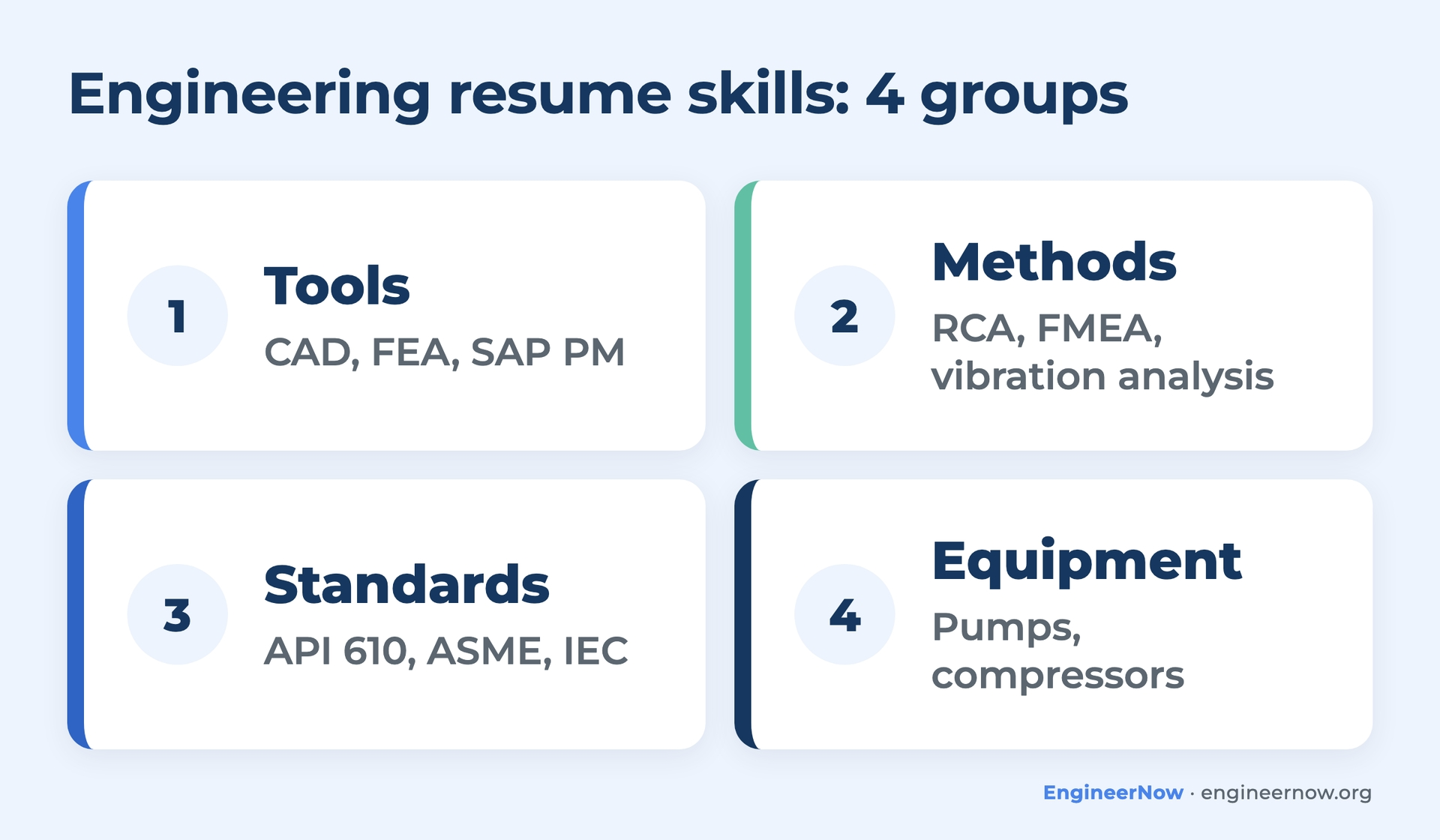
Here's what goes into each group, so you can use the same structure:
- Tools and software: CAD, FEA, SAP PM, data analysis tools, the exact programs you use.
- Methods and analysis: root cause analysis, FMEA, vibration analysis, reliability studies.
- Codes and standards: API 610, ASME, IEC, whatever your industry works to.
- Equipment: the machines and systems you designed, maintained or commissioned.
A few rules make this section work. Include only skills relevant to the position, and highlight the group the job posting cares about most at the top. Keep it to 8 to 12 items. Be specific: "API 610 centrifugal pumps" says much more than "pumps", and "SAP PM" more than "ERP". And no ratings, as I said above.
Only list what you've actually worked with. If you mention a tool, be ready to discuss what you did with it and what the result was.
To organize your skills section, put the group most relevant to the posting first and use short bullet points, not paragraphs. State your tools by their exact names: SolidWorks for CAD or SAP PM for maintenance, for example. SolidWorks is just an example of a tool name, so name only the programs you really use.
If you're a mechanical engineer and want a ready list for your profession, look at my mechanical design engineer resume guide.
Real Before and After: Turn Each Engineering Skill Into Proof
Here's a simple formula: skill + action + number + scale. The skill goes in the skills section, and the proof goes in your work experience, under the job where it happened. It works the same for design, production, maintenance and quality roles.
The first four lines below are from my own resume. The last one is a template for a soft skill: put your own numbers there.
| Skill on the list | Line in work experience that proves it |
|---|---|
| Root cause analysis | Raised main gas compressor availability from 68% to 95% through root cause analysis of failures (Shell) |
| Failure investigation | Extended gear pump MTBF from 3 months to 5 years after a detailed failure investigation |
| Vibration analysis and design | Designed detuning plates that reduced vibration on critical vertical pumps from 31 to 3 mm/s RMS |
| Project leadership | Led a BOM project that raised BOM connectivity from 45% to 85% (Saudi Aramco) |
| Communication (template) | [Ran] weekly [technical reviews] with [N] contractors, reducing response time from [N] to [N] days |
Compare this with a typical line that only lists responsibilities: "Responsible for maintenance of rotating equipment." It describes a job. It doesn't show what you changed.
A number does two things. First, it helps the reader understand the scale and the impact on the business. Second, it gives the interviewer something to ask about. An interviewer who reads "from 3 months to 5 years" will ask the obvious question: how did you do that? And a candidate who really did it can talk about the problem, the method and the result for as long as needed.
Write these lines as bullet points under each job, and choose projects that show a result and your own part in it. Add the duration when it helps: "over 6 months" tells the reader how fast you got there. The same works across your career, whether you work in manufacturing, maintenance or research: efficiency gains, saved hours, fewer defects or failures all count.
Look at the communication line, too. It never uses the word "communication", but it shows that you can communicate clearly with people outside your team. This is how soft skills should appear on an engineering resume.
Where do you find your numbers? In maintenance records, reports, KPIs, old performance reviews. Find them and create your result lines before you apply, not during the interview.
If you have a list of duties and don't know how to turn them into results, try our achievement generator. Paste a duty, and it helps you shape a result line.

What a Professional Engineer Resume Adds: Licenses and Certificates
A professional engineer resume differs from a student one in one more way: licenses and certificates. These are skills someone else has already checked, so give them their own section, separate from education.
In the US, the key one is the PE license, issued by state licensing boards. NCEES describes the usual route: two exams, first the FE and later the PE, plus four years of acceptable, progressive, and verifiable work experience in most states. It also says only a licensed engineer can prepare, sign, seal, and submit engineering drawings. That's why employers look for this line.
Write it simply: "Professional Engineer (PE), [State], [year]". If you've passed the FE exam but don't have the PE yet, list that too.
Outside the US, the logic is the same. In the UK, Chartered Engineer (CEng) is awarded through a licensed professional engineering institution against the UK-SPEC standard (Engineering Council). I explain the route in my guide on how to become a chartered engineer.
Here's how a skills and licenses section could look, based on my own rotating equipment background.
Skills
- Equipment: gas turbines, centrifugal and screw compressors, API pumps.
- Standards: API 610, API 617, API 682.
- Methods: vibration analysis, root cause analysis, FMEA, RCM.
- Tools: SAP PM.
Licenses and certifications
- Chartered Engineer (CEng); Member, IMechE (MIMechE).
- European Engineer (EUR ING).
- Certified Maintenance and Reliability Professional (CMRP).
If you're still studying, the licenses section can wait.
Match Your Engineering Skills to the Job Posting Without Stretching Them
You don't have to rewrite your entire resume for each application. But remove irrelevant information and emphasize the skills that meet the specific needs of this employer.
Use the same words as the posting. If it says "root cause failure analysis", write exactly that, not just "RCA". The reader is looking for those words. In my opinion, optimizing your resume for each role, and for applicant tracking systems (ATS), is the key to success.
Mistake I made
Not one of my first 300 resumes got a reply. I went deeper into resume writing, took more courses and started applying more selectively, tailoring each resume to each job. I even paid a British resume company 300 pounds, didn't like what I got and rewrote it myself.
But never add a skill just because the posting asks for it. Every item on your list must survive a few minutes of questions in the interview. Read where the line is between selling and lying on a resume.
And if you want to see how other engineers in your field present their skills, browse our 150+ engineering resume examples.
Ready to put it together? Pick a template and start with your skills section.


A skill in the list opens the door. A line with a number gets you the interview. Good luck, friends.
How many skills should I put on an engineering resume?
Usually 8 to 12 in the skills section is enough. More than that, and the important ones get lost. Choose them by the job posting: the skills it mentions go first. Then make sure each one has a line in your work experience that proves it with a result. A short list with proof works much better than a long list without it.
Should engineering soft skills go on a resume?
Yes, but not as words in a list. Communication, teamwork and leadership are taken for granted, so writing them adds nothing. Show them through results: a weekly review with contractors that cut response time, a team you led through a shutdown, a project delivered on schedule. Then the reader sees the skill without you naming it.
Where does a PE license go on a resume?
Give it a separate section called "Licenses and certifications", near the top for experienced engineers. Write the full title, the state and the year: "Professional Engineer (PE), [State], [year]". You can also add "PE" after your name in the header. If you've only passed the FE exam so far, list it in the same section.
What are 5 examples of technical skills for an engineering resume?
Good examples are CAD software, finite element analysis, vibration analysis, root cause analysis and knowledge of a specific standard like API 610. Notice that each one is specific and checkable. "Technical skills" or "engineering knowledge" on its own says nothing. Name the exact tool, method or standard, and prove it with a result line in your experience.

Written by
Recent Posts

Pub: 23 Jan 2025 - Upd: 09 Nov 2026
12 min. read
Industrial Engineer Resume: Examples That Prove Savings

Pub: 14 Feb 2025 - Upd: 01 May 2026
34 min. read
How to Write a Resume for an Industrial Engineer Intern: Examples, Template, Quick Guide to Find Your Dream Job for 2026