

11 min. read
Petroleum Engineer Resume Guide and Examples


Write a petroleum engineer resume that lands interviews in the oil and gas industry using proven formats, expert strategies, and real-world resume examples. This guide details each section for maximum impact, showcases ATS-ready templates, and demonstrates how to quantify your achievements and optimize your skills for top roles—whether you are entry-level, mid-career, or a senior professional.
Crafting an Effective Petroleum Engineer Resume
Resume Format and Structure
Selecting the right resume format is a foundational step for any petroleum engineer. The reverse chronological format is best for experienced candidates, placing your most recent and relevant experience first. For entry-level engineers or those switching careers into petroleum engineering, a hybrid format highlights technical skills and projects up front, followed by experience. Avoid purely functional resumes unless every skill directly matches the job description, as hiring managers and ATS systems want experience placed in context.
Key Resume Sections to Include
A great petroleum engineer resume includes essential content, logically ordered for easy review:
Header: Full name, professional title, up-to-date contact information, LinkedIn profile, and city/state.
Professional Summary: A sharp, engaging summary that showcases your years of experience, specific competencies, and major outcomes.
Experience: Clearly structured work history with bullet points featuring measurable results from oil, gas, or reservoir projects.
Skills Section: Mix of technical skills (e.g., reservoir simulation, drilling engineering, data analysis) and teamwork or leadership strengths.
Education: Degrees, university names, year of graduation, and notable academic or research projects.
Certifications: Key credentials (like IWCF, Petrel, or Professional Engineer) to prove your qualification for technical oil & gas positions.
Optional Sections: Projects, languages, publications, professional affiliations, or awards—relevant for both junior and senior resumes.
Tailoring Your Resume for Each Job
To get your resume noticed, tailor it by:
- Mirroring job description keywords: Include terms like “drilling optimization” or “reservoir simulation” exactly as listed.
- Displaying KPIs: Quantify achievements with production increases, cost savings, or successful compliance metrics.
- Mentioning relevant basins, formations, or field locations.
- Highlighting regulatory compliance and safety milestones—crucial for petroleum extraction projects.
Showcasing Experience and Skills
Writing Impactful Experience Bullets
Your petroleum engineer resume must quantify your impact. Each bullet point should use this structure:
Action verb + technology/tool + what you did + measurable result
For example:
- Optimized drilling operations using Petrel and real-time analytics, reducing non-productive time by 22% for offshore wells.
-
- Developed reservoir simulations in Eclipse, resulting in a projected recovery uplift of 18% across mature fields.
Hard Skills for Petroleum Engineers
Recruiters look for hard skills such as:
- Reservoir simulation (Petrel, Eclipse, CMG)
- Drilling and completion design
- Production optimization/surveillance
- Hydraulic fracturing & well test analysis
- Wellbore integrity, casing design, and completion
- Data analysis tools (ARIES, PHDWin, MATLAB)
Soft Skills to Feature
- Team/Project management
- Structured problem solving and decision-making
- Technical communication with cross-functional teams
- Stakeholder leadership and influence
- Safety management, regulatory process ownership
Demonstrating Skills in Context
Embed skills in your summary, experience, and projects. For every technical method or tool, tie it to production, recovery rate, or cost impact.
As an International Engineering Career Coach and Chartered Mechanical Engineer with 17+ years of hands-on experience in the oil and gas industry, I bring practical insights into the resume formats that truly resonate with hiring managers. Having worked in extreme environments from -50°C to +50°C, I understand what technical details and experience placement matter most to recruiters and ATS systems.
Additional Resume Tips and Best Practices
Quantifying Achievements Effectively
The best petroleum engineer resumes stand out by including detailed, quantified achievements:
- "Boosted average well production by 1,300 barrels per day with advanced gas lift design."
- "Cut drilling days by 16% through optimized bit/BHA selection."
- "Delivered $2M in cost savings by redesigning completions and selecting fit-for-purpose equipment."
Writing a Strong Professional Summary
Your professional summary should include:
- Title and experience level (e.g., "Senior Petroleum Engineer with 10+ years in offshore drilling and reservoir engineering")
- Technical and software proficiencies
- Highlighted impacts (e.g., "Reduced costs by 20%, managed multi-disciplinary teams")
Certifications to Highlight
Industry-valued certifications include:
- IADC or IWCF Well Control
- OSHA, API, or similar safety credentials
- Software certifications (Petrel, Eclipse)
- PE (Professional Engineer) License
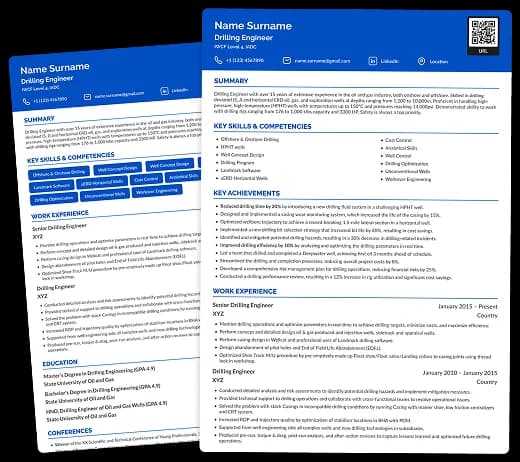
Resume Builder
Use proven engineering templates to build a job-winning resume in minutes.
CREATE RESUMEUsing Action Verbs and Clear Language
Start every bullet with a strong verb (e.g., designed, optimized, led, implemented, evaluated, achieved). Avoid vague phrasing like “worked on” or “helped with.”
Creating a Clean and Professional Layout
- Use consistent formatting, clear headings, and an easy-to-read structure.
- No photos or irrelevant personal details.
- Keep email and phone visible in the header for quick contact.
Cover Letter Recommendations
- Include cover letters when your resume needs context or you bring unique value not evident in your job history.
- Connect your expertise to company needs, recent projects, or KPIs.
- Explain any gaps, transitions, or specializations in your resume content.
More Professional Technical Skills and Competencies to highlight in Petroleum Engineer Resume:
- Pre & Post Processing
- Gridding & Upscaling
- GeoTesting
- Well Deliverability
- Sensitivity Analysis
- History Matching
- Multiple Realisation
- Petroleum Geology
- Geophysics
- Sedimentology
- Infill Driling
- Geological Modeling
- Reservoir Modeling
- Basin Modeling
- Production Performance
- Interpretation of 2D, 3D and 4D Acquired Seismic
- Fluid Property Quantification
- Array Design
- Application of Seismic to Geosteering
- Pore Pressure Prediction
- Fracture Gradient Assessment
- Reservoir Characterization
- Identify Stress-dependent Rock Properties
- Petrophysics
- Mineralogy
- Geomechanics
- Assess Stress-dependency
- Wellbore Stability Modeling
- Well Logging
- Open-hole & Cased Hole Well Logs
- Core Data & Rock Properties
- Pore & Pore Throat Network
- Core Cleaning
- Dean Stark Analysis
- Routine Core Analysis (RCA)
- Well Rate Calculation
- Core Imaging
- Design Coring Program
- Design Rock Characterization Program
- Ore Gamma
- CT Scanning
- SCAL Program
- Digital Rock Technology
- Reservoir Simulation Study
- Near Wellbore Testing
- Geochemistry
- AI Data Analytics
- Machine learning
- Short-term Pressure Transient Analysis (PTA)
- Pseudo-pressure Approach
- Pressure-squared Approach
- Drill-stem Test
- Estimate Volumetric Reservoir Properties
- Assess "very-near" Well Properties
- Rate Transient Analysis (RTA)
- Formation Tester Analysis (FTA)
- Water Alternating Gas (WAG) Techniques
- Reservoir Drive Mechanisms
- Concepts of Skin Factor
- Productivity Index
- Inflow Performance Relationship
- Material Balance Equations
- Predict Future Reservoir Performance
- Predict Ultimate Hydrocarbon Recovery
- Petrophysical Correlations
- Estimate of Porosity & Permeability
- Capillary Pressure & Relative Permeability
- Gravity-Capillary Equilibrium
- Predictive Simulation Runs
- DPDP Simulation Models
- Dual-porosity Models
- Dual-permeability Models
- N-porosity Models
- Modeling of Hydraulic Fracturing Process
- Phase Behavior (PVT)
- Molecular/Nano-Scale Phenomena
- Fractional Flow Theory
- Numerical Reservoir Simulation
- Waterflooding
- Gas Injection Principles
- Gravity Drainage Process
- Concepts of Mobility Ratio
- Decline Cure Analysis
- Pattern Surveillance Programs
- DCA
- Dimensionless Analysis
- Carbon Capture Utilization & Storage (CCUS)
- Gas injection
- Improved/Enhance Oil Recovery (IOR/EOR)
- Design Injectivity Tests
- EOR Pilot & Data Acquisition Program
- Transient Flow Interpretation
- Unconventional Reservoirs
- Well Development Strategy
- Well Completion Design
- Shale Gas Production
- Hydraulic Fracturing
- Field & Asset Management
- Petroleum Economics
- Estimation of Reserves
- Production Forecast
- Uncertainty Analysis
- Well, Reservoir and Facilities Management (WRFM)
- HYSYS
- MEERA
- ReservoirGrail
- JawelSuite
- PumaFlow
- IMEX
- GEM
- STARS
- Merlin
- VIP Lanrmark
- Nexus Lendmark
- tNavigator
- Tempest MORE
- ECLIPSE
- INTERSECT
- ResAssure
- Paradigm
- Dynamic
- BOAST
- MRST
- IFLO
- FLOW
- DuMu
- EXODUS
- EXOTHERM
- TWBS
- ECHELON
- DeepSim
- XXsim
- Petrel E&P Platform
- PROSPER
- GAP
- PVTP
- MBAL
- REVEAL
- RESOLVE
- HARDLOCK
Resume Examples
Below are three resume examples showcasing different career stages and situations for the petroleum engineer role.
For practical insights on how to tailor your engineering resume with real-world examples and detailed guidance, check out: Resume Example for Engineering Students | Free Templates
Senior Petroleum Engineer Resume Example
Mid-Level Petroleum Engineer Resume Example
Entry-Level/Graduate Petroleum Engineer Resume Example
To complement your resume with a strong online professional profile, consider creating an engineering video resume that can help you stand out from 90% of engineers in the hiring process.
Conclusion
Building a standout petroleum engineer resume is about more than listing duties. Tailor your resume to each job, include industry and software keywords, and quantify your results with specific metrics that recruiters, hiring managers, and ATS systems expect. Every section, from your summary to skills and education, should show your value through tangible achievements and technical expertise.
For each application, review your resume content, ensure it aligns with role requirements, and demonstrate how you will deliver maximum value as a petroleum engineer—whether you're seeking your first job, a mid-level advancement, or a senior leadership position.
FAQ / Q&A
What is the best resume format for petroleum engineers?
For experienced professionals, a reverse chronological format is best. Early-career or switching candidates benefit from a hybrid format that emphasizes skills, projects, and relevant education.
How do I quantify achievements in petroleum engineering resumes?
Use specific metrics like increased production rates, reduced costs per well, drilling days saved, improved safety records, or recovery rate uplift.
Which certifications are most valued in this field?
Certifications to include: IWCF Well Control, IADC, OSHA safety, software credentials (Petrel, Eclipse), and PE licenses.
How important are soft skills in a petroleum engineer resume?
Very important—combine technical proficiency with teamwork, leadership, problem-solving, and communication to stand out to recruiters and managers.
Should I include internships if I have limited experience?
Yes. Internships, academic projects, and field visits all demonstrate essential skills and readiness.
How can I tailor my resume for a specific basin or formation?
Reference targeted basin, project, or formation names. Match exact terminology (e.g., shale, Permian, or carbonate) from the job description.
Is a cover letter necessary for petroleum engineering jobs?
A cover letter is highly recommended if context, career transitions, or unique qualifications need explanation, or if the job description requires it.
In addition, for actionable tips on crafting cover letters that pair well with technical resumes, explore: Engineering Cover Letter Examples: Complete Guide
What are common mistakes to avoid on petroleum engineer resumes?
- Using vague or unquantified bullets (“worked on projects”)
- Failing to include technical and soft skills relevant to oil and gas industry
- Skipping certifications or omitting software proficiency
- Neglecting to proofread for errors or inconsistent formatting

Written by
Recent Posts

Pub: 25 Feb 2026 - Upd: 01 May 2026
58 min. read
Cable Technician Resume Examples & Guide: From Job Posting to Job Offer in 30 Days