Published · Updated · 12 min. read
R&D Engineer Resume: Prove Impact With Tests and Patents
An R&D engineer resume has to prove that your research turned into something: a working prototype, a passed test, a filed patent or a design that went to production. Write each project as the stage it reached and the evidence it left, not as a list of tools.
That's harder than it sounds. In research and development, there's often no revenue to point at. The project was confidential, it was stopped, or it wasn't finished when you left. I'm a Certified Professional Resume Writer (CPRW) and I've conducted 200+ job interviews from the hiring side. A page of tools with no outcome tells a hiring manager nothing about the engineer behind it.
Below: how to show the stage, the tests, the patents and the handoff, with a [bracket] template for each.
What an R&D Engineer Resume Has to Prove
A sales engineer can write revenue. A maintenance engineer can write uptime. An R&D engineer usually can't, so the reader of your resume needs four other kinds of evidence:
- how far each project got;
- what the prototype and the tests showed;
- what's left on paper: a patent, an application or a publication;
- what you handed over to production, and what happened to it.
Every bullet in your experience section should carry at least one of the four. Years of experience and a tool list don't show any of them.
Tools still matter, but they go inside the bullet. "Ran finite element analysis in ANSYS" is a task. "Ran finite element analysis in ANSYS that cut the prototype count from [X] to [Y]" is evidence. The same goes for data analysis in MATLAB or a simulation in SolidWorks: name the tool, then the result.
Data analytics works the same way. A dashboard or a regression model is a task until it changes a design. Write what the analysis showed and which design decision followed.
This guide is about the proof, not the layout. If you need the section-by-section structure (resume summary, work experience, education, technical skills), use our section-by-section layout of an R&D engineer resume. A research and development engineer resume needs both, and the proof is what gets you the interview.
One more thing before the bullets: keep the job description open. If it says SolidWorks, MATLAB or design of experiments, use those exact words where they're true.
And one thing for the summary line. Many R&D resumes open with the same two words: innovative and innovation. So many candidates use them that they prove nothing on their own. Show the innovation instead.
Resume summary
Innovative R&D engineer passionate about innovation.
Wrong
Resume summary
R&D engineer with [N] years in [batteries / medical sensors / your science and technology field]; took [N] products from proof of concept to production; co-inventor on [N] U.S. patents.
Right
Show How Far Each Project Got: Technology Readiness Levels
Most development projects never reach a customer, and that's normal. The trick is to say exactly where your project stopped. NASA's Technology Readiness Levels give you a ready scale for that. There are nine levels, from scientific research beginning at TRL 1 to a technology "flight proven" in a successful mission at TRL 9 (NASA).
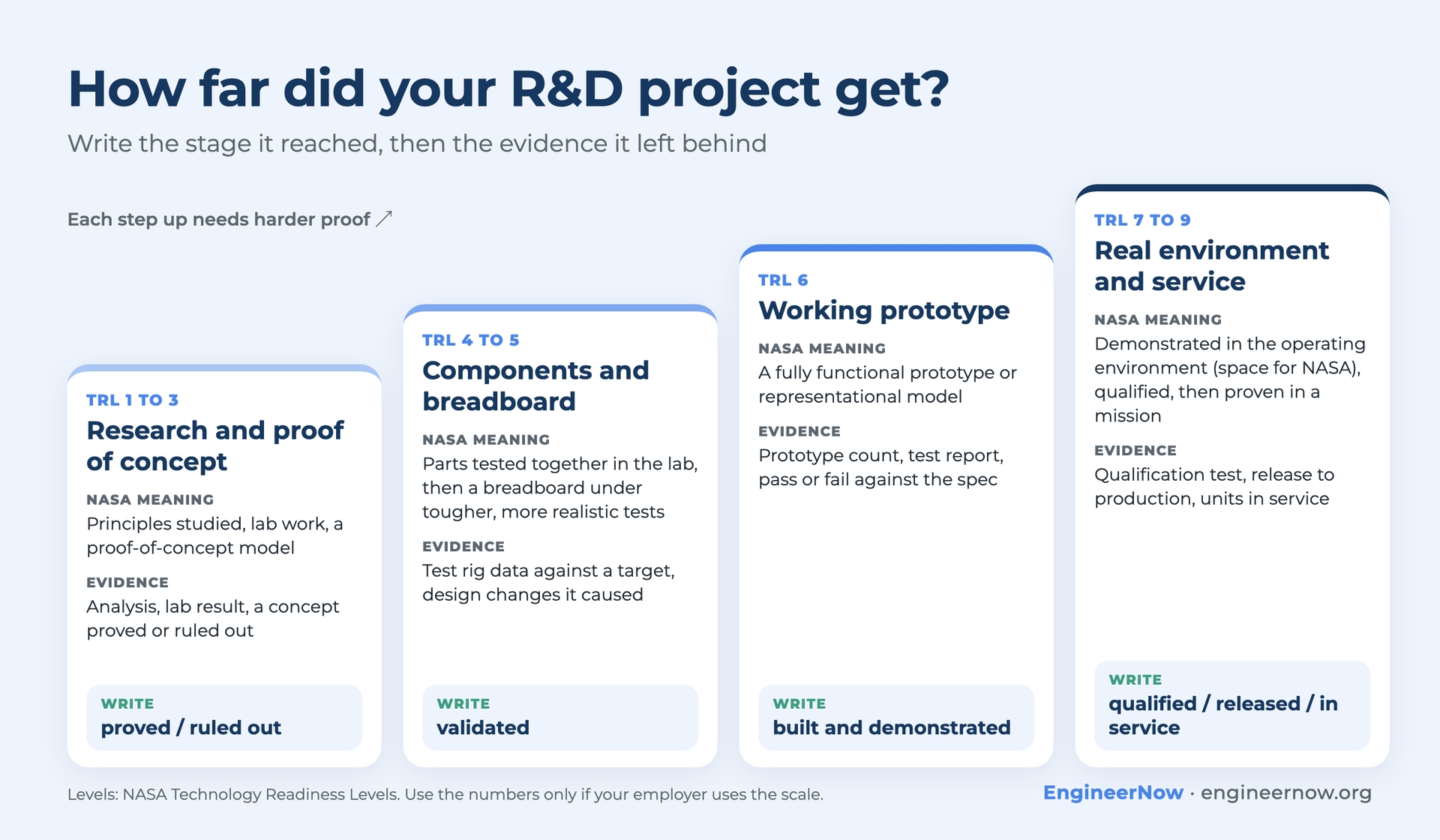
In between, the levels map well onto industrial R&D. At TRL 3, analytical and lab studies come in and a proof-of-concept model is often built. At TRL 4, components are tested together. TRL 5 is a breadboard that faces tougher, more realistic performance testing. TRL 6 is a fully functional prototype.
Be careful with the top of the scale. NASA's definitions are written for space: TRL 7 means a demonstration in a space environment, and TRL 8 means "flight qualified". So write the TRL number only if your company or industry uses it. Otherwise say it in words: "took a sensor housing from lab proof of concept to a working prototype".
Seniority shows here too. A junior engineer often owns one stage, usually testing. A senior research engineer or senior R&D engineer moves a project through several stages and decides when it's ready for the next milestone. The width of the range you carried a project across is your level.
Prototype and Test Bullets, Including Projects That Were Stopped
A test result is the closest thing R&D has to revenue. So each prototype bullet needs three parts: what you built, what the test showed against a target, and where the design went next. Below are two templates and two R&D engineer resume examples.
Template 1: Built [N] prototypes of [what] to test [requirement]; [test] showed [result] against a target of [X]; the design moved to [next stage].
Fictional example: made-up company and numbers. Built 4 prototypes of a mechanical seal for a pump maker. Ran each for 2,000 hours on a test rig; 3 of 4 stayed inside the leakage target, and the design moved to field trials.
Template 2 (stopped project): Ran [test / analysis] that showed [concept] could not meet [spec]; the program was stopped at [stage], saving [time / budget].
Fictional example: made-up company and numbers. Ran finite element analysis and 3 lab fatigue tests on a lighter polymer housing for a sensor startup. It missed the durability target, and the program stopped at proof of concept, before $200,000 of tooling was ordered.
The second template matters more than people think. A stopped project isn't a hole in your resume. Killing a weak concept early, with data, is exactly what R&D is paid for. Feasibility findings are results too. Write the finding and the decision it caused.
The same goes for an R&D test engineer or a medical device R&D engineer. Name the test protocol, the industry standards you tested to, the validation result and the report it fed. That's how quality control and design reviews see your work anyway.
From my own resume
This isn't R&D, it's rotating equipment, but the shape of the line is the same. I designed detuning plates, and vibration on critical vertical pumps fell from 31 to 3 mm/s rms. What changed, the number before and the number after: that's the whole bullet.
If a test or a prototype is still sitting in your notes as a task, our achievement generator turns it into one clean line.

How to List Patents and Publications on a Resume
To list patents on a resume, give each one its own line in a Patents section after work experience: number, title, year and your role. Patents are strong evidence, and they're also the easiest place to overstate, so the status matters, and so does your role.
| Status | What it means | How to write it on your resume |
|---|---|---|
| Granted patent | The patent was issued | U.S. Patent No. [number], [title], [year]. Inventor / co-inventor |
| Published application | USPTO publishes most nonprovisional utility applications after 18 months from the earliest filing date | U.S. Patent Application Pub. No. [number], [title], [year]. Inventor / co-inventor |
| Provisional application | Not examined on its merits, lasts 12 months, can't be extended, isn't published and won't become a patent without further filing | Provisional patent application filed, [year], [topic in plain words] |
| Filed, not yet published | The application isn't public yet | Patent application filed, [year], [topic in plain words] |
The publication rule comes from the USPTO's MPEP 1120, which also says provisional applications "shall not be published". The provisional rules are on the USPTO page about the provisional application. Never invent a number to make a line look complete: a made-up patent number can match someone else's real patent.
Your role is the second half. Write "co-inventor" only if your name is on the list of inventors. If you ran the tests behind a patent but aren't listed, say exactly that: "contributed test data to [N] patent applications". It's honest, and it still shows the work. Where the line sits between rounding and stretching is covered in what you can and can't stretch on a resume.
Publications work the same way: authors, title, journal or conference, year. Put patents and publications in their own short section after work experience, and mention the strongest one in the bullet of the project it came from.
Before you list anything unpublished, check with your employer. Your topic in plain words is enough.
Show the Handoff From Test to Production
The last proof is the handoff. Research and development ends when someone else can build the thing without you. So say what you handed over and what happened next.
What you handed over in the design transfer: released drawings, specifications, test reports, process documentation, training for the production team or a contract manufacturer, a list of suppliers. What happened next: series production, the first batch passed its test, units running in the field. This is where commercialization starts, and quality, purchasing and production take over the new product and its manufacturing processes. One line is enough:
Transferred [design] to [manufacturing / contract manufacturer] with [documents]; first [batch / unit] passed [test] at [result].
Name the teams too. In a large corporation, the handoff runs through cross-functional teams, marketing included. Say what each one got from you, such as test reports for quality or a feature and test summary for marketing. Cross-functional work with a named result shows engineering leadership, even without a manager title.
That's also where your story meets the next role. If you stay with the product once the design is in series production, you're writing a product engineer resume, and that's a different page. And if your work is closer to drawings and CAD software than to test rigs, the mechanical design engineer resume fits you better.
Write the stage the project reached and your part in it, not the size of the whole program.
Once your bullets carry a stage, a test result and a handoff, pick a clean single-column layout so the evidence is easy to find.


Every R&D project leaves evidence, even the ones that were stopped. If you can't measure it, you can't improve it, and a hiring manager can't judge it either. So put the stage, the number and your part in each bullet. Good luck, friends.
What if my R&D projects are confidential?
Write the stage, the type of product and the result, without the product name, the client or the numbers that identify them. "Took a medical sensor from proof of concept to a working prototype; passed [N] of [N] lab tests" says enough. If even that is too much, check your agreement and ask your manager what can be said in public.
Can I put a patent pending on my resume?
Yes, if an application is really on file and you're named on it. The USPTO says a provisional application allows the term "Patent Pending" while it's pending, but it isn't examined and won't become a patent without further filing within 12 months. So write the real status, "provisional patent application filed, [year]" or "patent application filed, [year]", not "patent", and only with your employer's agreement.
Should a failed R&D project go on my resume?
Yes, if you can show the decision it led to. Write what the test or analysis showed, the spec it missed and the cost and time the company saved by stopping. A failure with data behind it is a result. Good R&D kills weak ideas early. A bullet like that shows judgment, which is exactly what a hiring manager is trying to see.
Should I write TRL numbers on my resume?
Only if your employer or industry uses the scale. NASA's definitions are written for space hardware: TRL 7 and above mean demonstration in space, flight qualification and flight. In most companies, words work better: "from lab proof of concept to a working prototype". A recruiter outside aerospace may not know what TRL 5 means.
How much does an R&D engineer make?
The closest official figure is BLS data for mechanical engineers: a median annual wage of $104,110 in May 2025. About 7% of them work in scientific research and development services. Your pay depends on discipline, industry and level, so treat this as a starting point, not a rule.

Written by
Recent Posts



Pub: 10 Jul 2026 - Upd: 06 Nov 2026
12 min. read
Biomedical Engineer Resume: Prove Design Controls and V&V