

Published · Updated · 12 min. read
Biomedical Engineer Resume: Prove Design Controls and V&V
A biomedical engineer resume for a medical device role has to prove which design stages you owned, each with a document and a number. A hospital biomedical engineer resume proves something else: equipment that is safe, maintained and available.
In medical devices, design decisions end up in the design and development file, and an auditor can open it. So the person reading your resume looks for the stage you owned and the record behind it. A list of sixty skills doesn't answer that. I'm a Certified Professional Resume Writer (CPRW) and I've conducted 200+ job interviews from the hiring side.
Below is what each design stage should show (inputs, verification, validation, risk, transfer), a bullet template with [brackets] for your own data, and a short section for hospital roles.
What a Biomedical Engineering Resume Has to Prove
This is a small profession. The U.S. Bureau of Labor Statistics counts about 23,800 bioengineer and biomedical engineer jobs in 2025, with a median pay of $109,370 in May 2025 and about 1,200 openings a year. Employment is projected to grow 8% from 2025 to 2035, much faster than average, and a bachelor's degree is the typical entry point (BLS).
Few openings mean precise job descriptions. And one job title covers very different work. BLS shows 22% of these engineers in research and development, 10% in medical equipment and supplies manufacturing, 10% in healthcare and social assistance and 9% in education.
So decide in the first line of your resume summary whose side you're on. A medical device engineer resume talks about product development, design inputs, testing, documentation and quality assurance. A hospital one talks about medical equipment, maintenance and patient safety. Pharma and biotech (drug discovery, clinical trials) need a third kind of resume, and this guide doesn't cover it. If you're still choosing a major, here's how biomedical engineering ranks among engineering degrees.
Biomedical Engineer Resume Bullets for Each Design Stage
ISO 13485 splits design and development into stages: planning, inputs, outputs, review, verification, validation, transfer and changes. FDA's own training on the QMSR lists the same steps and says planning starts with risk (FDA CDRH, QMSR design and development).
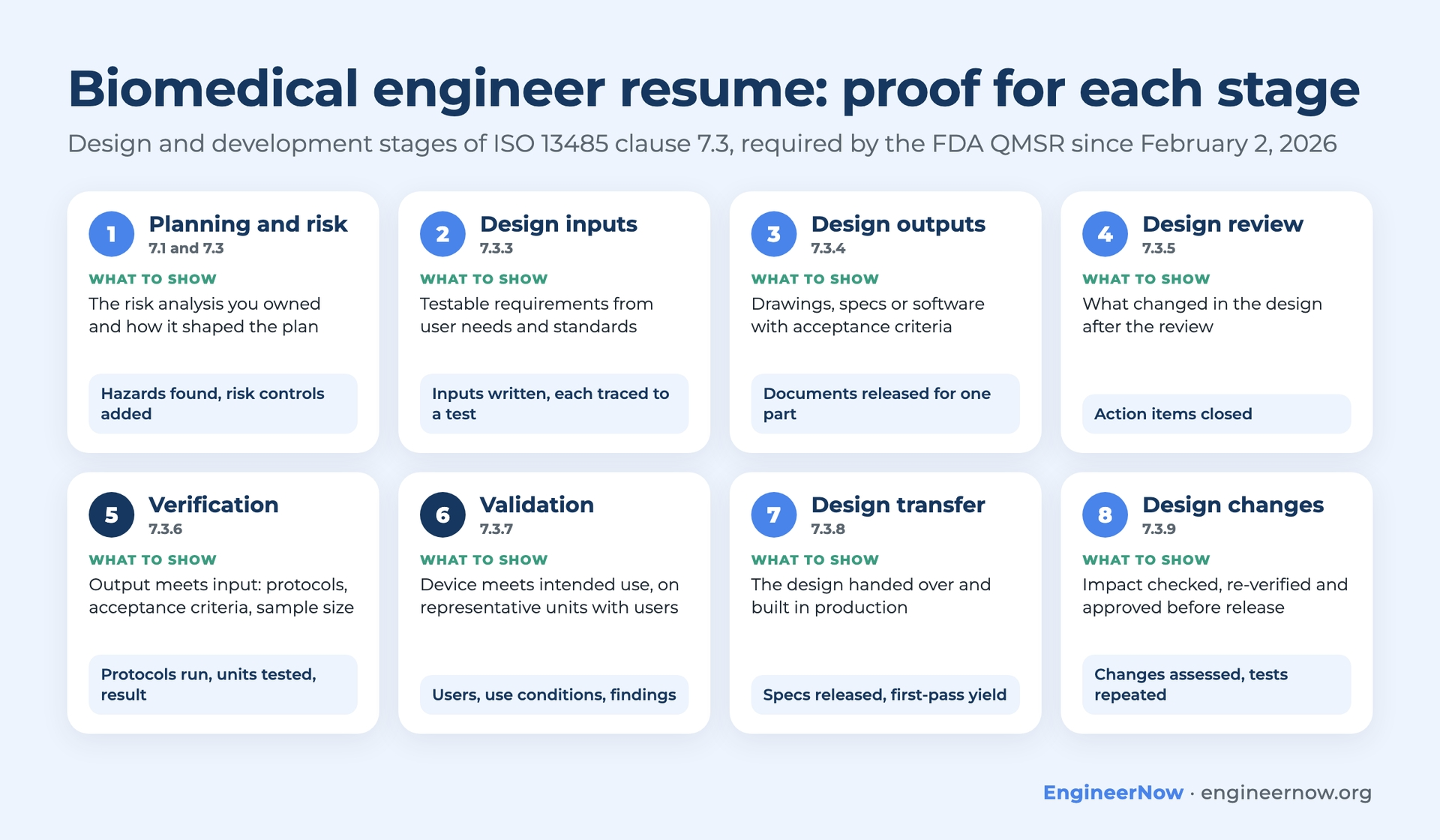
One strong bullet is one stage, the document you produced and a number. The number can be requirements written, test protocols, units tested, defects found or days saved. You don't need all eight stages. Two or three that you really owned are enough, and they're easier to defend when the hiring manager asks for details.
Keep each of these bullet points to one or two lines and start it with a verb that names the stage (wrote, verified, validated, transferred), as in the table below. That way employers see the stage before they reach the number.
| Stage (ISO 13485) | What the reader looks for | Bullet template |
|---|---|---|
| Planning and risk (7.1, 7.3) | You know risk drives the plan | Built the risk analysis for [device] with [N] hazards; [N] risk controls went into the design plan |
| Design inputs (7.3.3) | Complete, testable performance and safety requirements | Wrote [N] design inputs from user needs and [standard]; traced each one to a test in [tool] |
| Design outputs (7.3.4) | Drawings, specs or software with acceptance criteria | Released [N] drawings and specs for [part], each with acceptance criteria tied to an input |
| Design review (7.3.5) | What changed after the review | Presented [part] at [N] design reviews; closed [N] action items, including [change] |
| Verification (7.3.6) | Protocols, acceptance criteria, sample size | Wrote and ran [N] verification protocols on [N] units; [N] of [N] inputs met on first run |
| Validation (7.3.7) | Intended use, real users, representative units | Ran simulated-use validation with [N] users on production-equivalent units; [finding and fix] |
| Design transfer (7.3.8) | The design can be built | Transferred [part] to manufacturing; first-pass yield [X]% in the first [N] lots |
| Design changes (7.3.9) | Impact checked before release | Assessed [N] design changes; re-verified [N] and updated the risk file |
Traceability is the word that connects them. If your bullets show that a requirement led to a test and the test led to a result, the reader sees design controls before you even name them.
Design Verification vs Validation: Which One Did You Do?
Many resumes use the two words as synonyms. In medical devices they are different stages, and an interviewer will ask which one you mean.
FDA's QMSR training puts it simply. Verification means the output meets the input requirements: "I made the device correctly". Validation means the device meets the requirements for its intended use: "I made the correct device". Validation runs on representative product and has to be completed before release.
So bench testing against your spec is verification. "Validated the pump against the specification" is a verification bullet with the wrong verb, and an experienced reader may doubt that you've worked inside a design file.
Resume bullet
Validated the infusion pump design against the specification and ensured all requirements were met.
Wrong
Resume bullet
Verified [output] against [N] design inputs with [N] test protocols on [N] units; [result, for example all passed, or 2 failures closed by a redesign of X].
Right
If you did both, write two bullets. Verification shows you can plan and run a test. Validation shows you understand users, use conditions and intended use. For a hiring manager, those are two different skills.
Risk Management and ISO 13485 on a Resume
Risk is the stage most candidates hide in a skills list. ISO 14971 is the risk management standard for medical devices, and its current edition is ISO 14971:2019 (ISO). Under the QMSR, ISO 13485 clause 7.1 asks for documented risk management processes that include design and development, and design inputs have to account for the risk outputs.
On a resume, show the analysis and what it changed: a hazard analysis or FMEA, the number of risk controls, and a design change that came out of it. "ISO 14971" in a skills line proves you've heard of it. A bullet proves you used it.
The same goes for ISO 13485 and regulatory compliance. Write an action: a CAPA you closed, an internal audit you supported, a procedure you rewrote or a nonconformance you investigated to its root cause. Those are quality system tasks, and they read as experience, not vocabulary. If you're heading into production and process validation rather than design, our manufacturing engineering resume guide fits that path better.
Before you send the resume, check its words against the job description. One company writes design controls, another design and development, a third V&V. Use their exact terms where they're true.

Resume Scanner
AI scanner performs 15 essential checks to ensure your resume is optimized for the jobs you're applying to.
SCAN RESUMEHospital Biomedical Engineer Resume: A Different Kind of Proof
In a hospital, a biomedical engineer, clinical engineer or biomedical equipment technician (BMET) doesn't design devices. The work is healthcare technology management: keeping medical equipment safe and ready for patients. The proof comes from the equipment inventory and the work orders:
- planned maintenance done on time, in percent;
- equipment downtime and repair or troubleshooting turnaround;
- electrical safety tests, incoming inspections, recalls and incident investigations;
- clinical staff trained on new devices.
The AAMI Credentials Institute runs the Certified Biomedical Equipment Technician (CBET) and Certified Healthcare Technology Manager (CHTM) programs; the CBET exam costs $410 for members and $460 for non-members (AAMI). A biomedical equipment technician resume has more in common with our engineering technician resume guide than with an R&D page.
Biomedical Engineer Resume Examples
Here are two short biomedical engineer resume samples: a junior engineer in medical devices and an engineer in a hospital. Both are fictional, so take the structure, not the numbers. If you're a student with projects instead of jobs, start with a resume built on projects and coursework.
Fictional example: made-up company and numbers. Entry-level, medical devices.
Summary: Biomedical engineering graduate (Bachelor of Science) with a capstone on a wearable heart-rate patch and one internship in design verification. Writes test protocols, runs bench tests and keeps a traceability matrix.
Design Verification Intern, medical device start-up, summer 2025
- Wrote 6 verification protocols for a handheld glucose meter housing; ran drop and ingress tests on 30 units and logged 2 failures that led to a gasket redesign.
- Updated the traceability matrix for 48 design inputs, linking each one to a test.
Capstone project, wearable heart-rate patch
- Wrote 14 design inputs from interviews with 5 nurses; ran a simulated-use test with 8 students and changed the adhesive after 3 reported skin irritation.
Fictional example: made-up hospital and numbers. Hospital biomedical engineer.
Summary: Biomedical engineer in a 400-bed hospital, responsible for 2,100 devices across intensive care, surgery and diagnostic imaging. Plans maintenance, investigates incidents and brings new equipment into service.
- Raised on-time planned maintenance from 82% to 97% in 12 months by rebuilding the schedule by risk class.
- Investigated 15 infusion pump incidents with clinical staff; 1 was reported to the manufacturer and led to a software update.
- Ran incoming inspection and electrical safety tests on 120 new patient monitors and trained 60 nurses before go-live.
Neither sample lists soft skills or duties. The stages, records and numbers do that work.
Biomedical Engineer Skills Section Without the 60-Item List
A technical skills section in this field doesn't need dozens of entries. Three groups of four or five work better, each backed by a bullet in your work experience.
- design and analysis: SolidWorks or other CAD software, MATLAB for data analysis, Python programming, LabVIEW and lab instrumentation;
- testing: verification protocols, test method validation, electrical safety testing, usability testing;
- quality and regulatory: ISO 13485, ISO 14971, design controls, FDA 510(k) if you worked on a submission.
Write your skills in the words employers use in the job description. A skill that sits in the list but in none of your bullet points is the first thing an interviewer may ask you to explain.
Soft skills go into the achievements, not the list: a design review you presented, cross-functional teams you worked with, nurses you trained. Years of experience matter less than the stages you can name.
Show the stage, the record and the number, and the rest of the page gets easy to read. Then put it into a clean template where those numbers are easy to scan.


Good luck, friends.
Should an entry-level biomedical engineer resume mention design controls?
Yes, if you did the work. A capstone or internship with written requirements and tests is a small version of design controls. Name the stage honestly: "wrote design inputs", "ran verification tests". Don't claim validation or a 510(k) you only read about. The interviewer will ask what the protocol looked like, and one test explained well beats a list of standards.
Is it still "design controls" and "DHF" after the QMSR?
In job postings, yes. The regulation now points to ISO 13485 clause 7.3, "design and development", and the record is the design and development file (clause 7.3.10). Job postings and many internal procedures still use both terms. Write the term the posting uses and add the other once, for example "design controls (ISO 13485 7.3)".
What certifications help a biomedical engineer resume?
It depends on the side. In hospitals, AAMI's CBET and CHTM are the names to know. In medical device design, list training in ISO 13485 or ISO 14971 with the course name and year, next to the V&V bullets that show you applied it. Skip any credential you can't find on the issuing body's official site, because an unknown title costs trust instead of adding it.
Is a biomedical engineer resume one page or two?
One page for students and early career, two for senior engineers with several roles and real design or hospital results. Length isn't the test, though. If page two only repeats tools and duties, cut it. If it holds verification results, risk work or maintenance numbers that page one has no room for, keep it.
Is a biomedical engineer CV the same as a resume?
In the US, not quite. A resume is the short document for industry jobs, one or two pages. A CV (curriculum vitae) is the longer academic version, with publications, conference talks, grants and teaching. Outside North America, many employers say CV and mean a resume. In the US, for a medical device or hospital job, send a resume; for a research or university post, send a CV with your publications.

Written by
Recent Posts




Pub: 16 Jul 2026 - Upd: 06 Nov 2026
12 min. read
R&D Engineer Resume: Prove Impact With Tests and Patents