

Published · Updated · 11 min. read
Pros and Cons of Working Abroad as an Engineer (5 Countries)
The main pros and cons of working abroad as an engineer come in pairs. You get faster career growth and more money left at the end of the month. You pay for it with another language, family far away and a visa that usually ends with your job.
I spent most of my life in Siberia, and I never liked the weather there. Since my last years at school, I wanted an international career somewhere warm, by the sea.
I'm Alex, a Chartered Mechanical Engineer with 18+ years in engineering. I've worked for Shell and Saudi Aramco, from -50°C to +50°C, and I've helped 100+ engineers get jobs abroad. After Aramco, I kept living and working abroad, in four more countries: Cyprus, Iraq, Turkmenistan and Spain. So here are the advantages and disadvantages of working abroad as I see them, each one with its price.
According to the UN, 304 million people were international migrants in 2024 (outside their country of birth or citizenship), about 3.7% of the world's population.
| Area | What you get | What it costs | Check before you sign |
|---|---|---|---|
| Career | International teams, bigger projects, faster growth | You start again without a name or connections | The real role and who you report to |
| Money | Higher salary, sometimes lower taxes | Flights home, deposits, the first weeks before payday | What the package covers: housing, school, flights |
| Language | English at work, a new language to learn | Accents at work, a local language outside it | Which language the job and daily life need |
| Culture | New traditions and a wider view of the world | Culture shock, new rules for daily life | Local laws and customs for you and your family |
| Family | A new life together, or a good income on rotation | Someone is always far away | Family visas, schools, the rotation schedule |
| Status | A contract with clear terms | Your residence permit is tied to the job | What happens to your visa when the contract ends |
You Grow Faster Abroad, but You Start From Zero
The biggest professional benefit of working abroad is growth. You work in diverse international teams, on bigger projects, with people from different backgrounds. I've worked with dozens of different nationalities.
International work experience develops skills that are hard to get at home, and it can change your whole career path. Personal growth comes with it, because a new country takes you out of your comfort zone every day.
Every new employer is also a new work environment: other standards, other procedures, other habits in meetings. It's uncomfortable at first, and it's exactly where you learn the most.
Before Saudi Aramco, I was head of a maintenance department at Shell, with a team of 50+ people, and held Shell Technical Authority Level 3 in rotating equipment. Then I consciously went back to an engineer's role for an international career.
At Aramco, I supported offshore gas fields and led a BOM project that raised BOM connectivity from 45% to 85%.
But here's the cost. In a new country, nobody knows you. Your old reputation stays at home, and your professional network starts from scratch. You build your network again, one project at a time. Expect to prove yourself again with each new employer.
You can start building it before the move. Connect with engineers who already work in the country you want to work in, on LinkedIn or at industry events. My own job invitations came through job sites and LinkedIn.
My opinion, and you don't have to agree: engineers with US or Canadian passports often get better conditions when working overseas.
More Money, but Count What the Offer Leaves Out
Higher salaries are why many engineers decide to work abroad, and you really can earn more. At Saudi Aramco, my tax rate dropped from about 40% to zero, and my income grew about tenfold.
But a big salary on paper isn't the money you keep. Moving abroad is expensive, and it has costs that no offer shows:
- flights home for the whole family;
- a deposit for a flat and the first weeks before your first salary;
- school fees if the package doesn't include them;
- the cost of living in the new country.
Before you compare offers, consider what each one really leaves you after these costs. That's the real financial benefit.
Travel is a bonus on top. From your new home, other countries are often a short flight away. Count it as a perk, not as part of the salary.
Accents at Work and a New Language Outside It
In international companies, English is usually the working language, with colleagues from around the world. That's the easy part. The hard part is that every country has its own English, and it takes time to adjust and understand everyone.
Each nation has its specific English accent, which you'll also need to get used to.
Outside work, it's different. Shops, banks, doctors, schools and paperwork use the local language. There you need the local language, and paperwork in another language is hard. Cultural differences at work show up in emails and meetings too.
Right now I'm learning Spanish, because I live in Spain.
How long does a new language take? The US Foreign Service Institute expects about 30 weeks of full-time study for Spanish and French. German takes about 36, Russian and Turkish about 44, and Arabic 88 weeks (State.gov). That's for native English speakers, with 23 hours a week in class. Most engineers can't study like that, so plan for years.
Culture Shock Is Real, Even in a Comfortable Life
Expat life looks easy from the outside. But culture shock isn't only about big challenges. It's the small rules you never thought about: shop hours, holidays, dress, what's polite at work.
In Saudi Arabia, shops close during prayers, so even a supermarket run had to fit around prayer times.
My advice for every new country: respect the local traditions and customs. You adapt faster when you learn the rules before you arrive.
Expat Family Life: Someone Is Always Far Away
This is the part most lists skip. Working abroad with family is a choice between two models, and I've lived both.
From the field
With Saudi Aramco, my wife, our two sons and I lived together in a compound on the Gulf. On rotations, the family lived in Cyprus and Spain, mostly 28/28. My longest hitch was 6 weeks, and honestly, I can't imagine working for months.
So whichever model you choose, someone is far away. With the family next to you, your home country is far. On rotation, your wife and kids are far for a month at a time. Homesickness, loneliness, missed birthdays and different time zones are real costs in both.
Decide on the family model before you accept the offer, not after. It changes which jobs abroad make sense. Before you choose rotation, read my pros and cons of rotational work.
Your Visa Usually Ends With Your Job
Working in another country rarely means you live abroad forever. If you move abroad to work, your status usually depends on the contract. In many countries, your residence permit is tied to your job and your employer.
Take the UAE. The official government portal says that, normally, only the sponsor can cancel your residence visa. A dependent's visa can't expire later than the sponsor's, and the sponsor cancels the family's visas before his own. After cancellation, there are grace periods of up to 6 months, depending on the resident category (u.ae). Rules differ by country, so check the official portal of yours.
I've moved between countries several times. Each time I changed jobs, it was my own decision to leave.
Abroad, your residence permit is often part of your job. Plan for the day the contract ends.
If you want a permanent home and a second passport, that's a different plan. Read where it's better to immigrate as an engineer.
Pros and Cons of Working Abroad: Is It Worth It for You?
I chose it, and I'm still abroad, so you know my answer. The benefits of working abroad are real, but it isn't for everyone. Think about your future in five years, not just the first salary. Here's a simple check before you decide.
One more thing. Many lists of the pros and cons of working abroad are written for teaching English, a gap year or a work and travel program. Engineering careers abroad work differently. The employer hires you for a specific role, and the visa usually comes with that job. So judge each offer as an opportunity for your career, not as a trip.
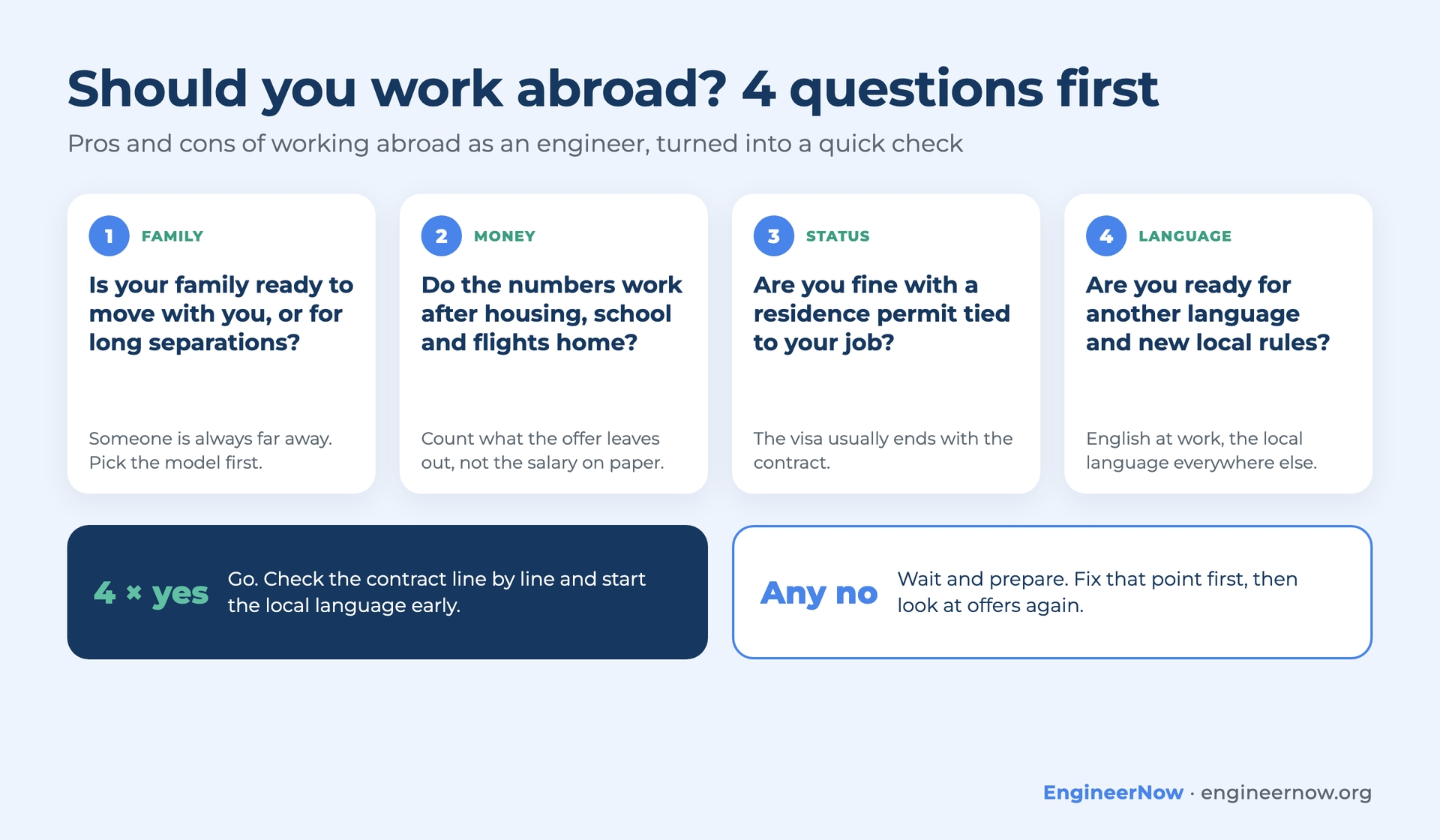
Working abroad suits you if:
- you want faster growth and you're ready to start again without connections;
- your family is ready to move with you, or ready for long separations;
- you're fine living abroad on a contract;
- you're ready for new work hours and a different work-life balance, like 12-hour shifts offshore.
It's better to stay, or wait and prepare, if:
- the offer doesn't cover housing and school and the numbers don't work;
- your family isn't ready for either model;
- you need a permanent home right now.
Opportunities abroad come to those who prepare. If you're still at the stage of finding a job, here's how I got my first job abroad after 300 resumes with zero replies.
If you don't knock, the door won't open. Good luck, friends.
If you want my personal advice on your move, book a consultation.
Is working abroad worth it for an engineer?
In my opinion, yes, if you know the price. You usually get faster growth, international experience and more money left after costs. You pay with a new language, distance from family and a visa tied to your job. Check the package line by line, decide your family model first, and the move is much more likely to pay off.
What is the hardest part of working abroad?
For me, it's distance from family. In Saudi Arabia, my family lived with me in the compound. On rotation, with the family in Cyprus and Spain, every hitch meant weeks without my wife and kids, and honestly, I don't like rotation. Language and culture shock usually get easier with time and practice.
How long does it take to learn the local language?
It depends on the language. The US Foreign Service Institute expects 24 to 30 weeks of full-time study for languages close to English, like Spanish, French or Italian. German takes about 36 weeks, Russian and Turkish about 44, and Arabic, Japanese, Korean and Chinese 88 weeks. Part-time learners need longer, so start before you move.
What happens to my residence visa if I lose my job abroad?
In many countries, it's cancelled with the job. In the UAE, the official portal says only the sponsor can normally cancel your residence visa, and your family's visas are cancelled before yours. Grace periods reach up to 6 months, depending on the category. Check your country's official rules before you sign the contract.

Written by
Recent Posts


Pub: 23 Aug 2025 - Upd: 01 May 2026
9 min. read
Expat Job Scam Alert How to Avoid Fraud When Seeking Work Abroad
Pub: 31 Jul 2025 - Upd: 01 May 2026
12 min. read
Time Management for Engineers: How to Be Productive Without Burning Out
Pub: 29 Aug 2025 - Upd: 01 May 2026
5 min. read
Local or Expat Engineer. What's the Difference and Which is Better?