

Published · Updated · 10 min. read
How to Get a Job Abroad as an Engineer: My 10-Year Road
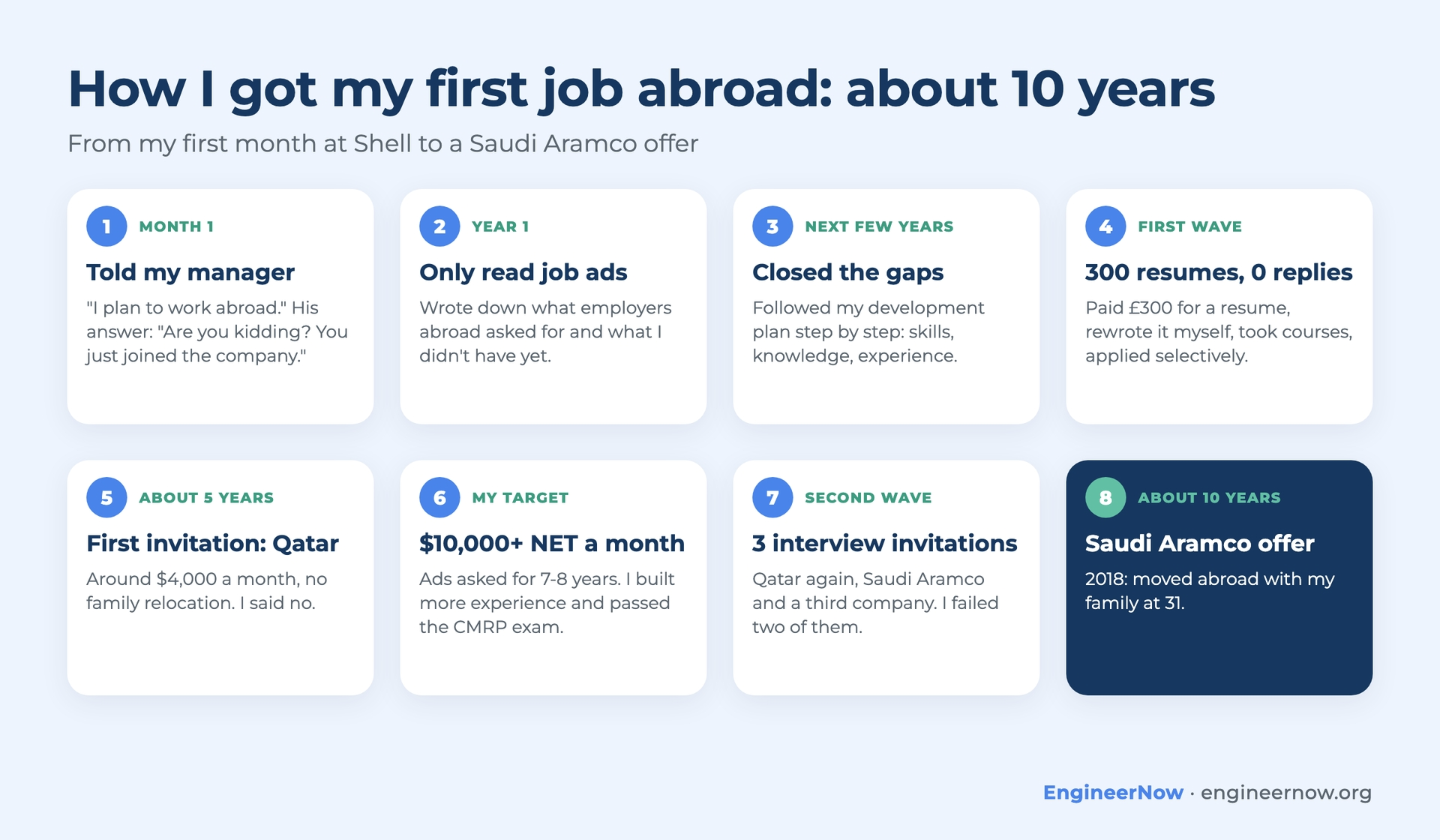
Here's how to get a job abroad as an engineer: read job ads in the country you want and close the gaps they list. Only then apply, with a resume tailored to each role, and expect years, not months. From the start of my career to my Saudi Aramco contract, it took me about 10 years.
My first 300 resumes got zero replies. So I know how far away engineering jobs abroad can look from the outside.
I'm Alex, a Chartered Mechanical Engineer. I've worked for Shell and Saudi Aramco, from -50°C to +50°C, and I've helped 100+ engineers get jobs abroad. Below is the order of steps I went through, and what I'd check at each one.
Step 1: Read Job Ads Abroad Before You Send a Single Resume
I grew up in Siberia and never liked the cold. I was drawn to warm weather and the sea, and I wanted to work on offshore platforms in the Persian Gulf. I joined Shell right after university, and in my very first month I told my manager I planned to work abroad. He looked at me and said: "Are you kidding? You just joined the company."
So for my whole first year, I only read job ads. Positions abroad in my field, in the countries I wanted. I didn't apply anywhere. I analyzed what each ad asked for and made a list of my weak points. That list became my development plan, and closing it took a few years.
You can start the same way as a mechanical, electrical or civil engineer. Collect ads for your role in the country you want, then write down what repeats:
- years of experience;
- professional status and certifications;
- the standards and equipment they name;
- local language requirements.
Do this research for a few weeks before you apply anywhere. The job market abroad is different from the one at home. A foreign employer usually wants to hire people who already match the key requirements, because bringing an expat from another country takes time, documents and money.
Whatever repeats in most ads is your real target, not the job title. If you're interested in the Gulf, I wrote about where engineers find a job in the Middle East.
Step 2: Close the Gaps Employers Ask For
The biggest gap is usually experience, and you can't fake it. Aramco's US recruitment page says it directly: to be considered for a role overseas, "five to ten years of experience is generally required for most positions" (Aramco).
My own path fits that range. My first interview invitation from abroad came after about five years of experience. But my target was $10,000+ per month, and the ads for jobs at that level asked for 7-8 years of experience. So I kept working, built more experience and passed the CMRP exam.
Experience, skills and certificates are what a foreign employer can check from far away, so professional certifications are valuable abroad. In many Arab countries and companies, candidates with professional certifications are preferred, and you can see it written in many job descriptions. Check your degree too. Programs accredited under the Washington Accord are recognized by its other signatories, and WES evaluates foreign degrees for jobs and licensing in the US and Canada.
In my video below, I go through the certificates that help engineers get hired overseas.
Step 3: Fix Your Resume Before You Send 300 of Them
After a few years, with some of my gaps closed, I started sending resumes. The first wave was a complete failure: out of the first 300, I didn't get a single reply.
I didn't give up, but I changed the approach. I took courses on resume writing, read lots of articles and guides, and started applying more selectively. It takes time, but a strong resume shows your expertise and key skills in the first lines. Each resume was tailored to the specific job and to the resume screening systems (ATS) that read it first.
From my own job search
I even paid £300 to a British company to write my resume. Honestly, I was disappointed with the result and reworked it myself. To make this easier for other engineers, I created EngineerNow, a platform that helps engineers build professional resumes.
My rule since then: send fewer resumes, and make each one fit the job.
Before you send yours to an employer abroad, run it through the scanner and compare it with the ad:

Resume Scanner
AI scanner performs 15 essential checks to ensure your resume is optimized for the jobs you're applying to.
SCAN RESUMEWhere Engineering Job Offers Abroad Come From
My interview invitations came through job websites and LinkedIn. I applied more selectively, only to roles where I matched most of the ad. So keep your LinkedIn profile current, with the same key skills as your resume, and keep networking in your industry and connections in your industry.
What happens after you apply depends on the employer. Some global companies with offices around the world publish their application process for international job seekers.
Aramco's US page describes it like this. You apply or join their talent community and take tests if the role requires them. Then come a phone interview and an on-site or video interview. A conditional offer follows, and it may depend on a medical exam, a background check, housing, school enrollment for children and Saudi government visa approval (Aramco).
So with an employer like this, you don't need visa sponsorship before you start. The visa is part of the offer process. If a "recruiter" asks you to pay for a visa or skips the interviews, read how to spot a fake job offer abroad before you reply.
Set Your Minimum Before the First Offer Arrives
For me, the goal was clear: either move permanently with my family, or work on rotation with a good income. My number was at least $10,000 per month NET.
Expat packages differ a lot. Family relocation, housing and school are the benefits that make life in a new culture much easier. The first invitation, from Qatar, was around $4,000 a month without family relocation, in a country with a high cost of living. I turned down that first offer from Qatar. I knew what was missing between that offer and my number: more years of experience and stronger qualifications.
Saying no to a weak first offer is also a step, if you know exactly what you're still missing.
Expect to Fail Interviews Abroad, Even in the Second Round
With more experience and the CMRP behind me, I applied again to several roles and got three interview invitations: from Qatar again, from Saudi Aramco and from a third company. I didn't pass the interviews in Qatar and at the third company.
Saudi Aramco made me an offer. I moved with my family at 31 and worked on offshore gas fields in the Persian Gulf. One offer is enough.
Since then, I've worked in four more countries, so the first job abroad was a start, not the finish line.
How to Get a Job Abroad: A Checklist Before You Apply
If you're wondering how to find a job overseas, here's the whole route as a checklist. Use it before each wave of applications, not once, whether you look for a job overseas in the Gulf or in Europe. Opportunities for working abroad are real, but the process is long.
| Check | What to look for | Why it matters |
|---|---|---|
| Job ads | Ads for your role in your target country, collected over weeks | Shows the real requirements, not your guess |
| Experience | Years asked in most ads vs your years | Often the gap you can only close with time |
| Certifications | Titles and certificates named in the ads | Employers abroad read them as proof of your level |
| Degree | Washington Accord program or a credential evaluation | Some employers and licensing boards check it |
| Resume | One version per job, checked against the ad and ATS | 300 generic resumes can bring zero replies |
| Channels | Job websites, LinkedIn, company career pages | Where real invitations come from |
| Your minimum | Salary NET, family relocation or rotation | Lets you say no to a weak first offer |
| Red flags | Requests for money, no real interview | Fake offers target people who want to move |
Opportunities exist, but they come to those who are prepared for them. Good luck, friends.
By the way, if you're thinking about an international career or want my personal advice, join my Engineer-Millionaire course.
Can I get an engineering job abroad without experience?
It's possible, but don't expect a top company at the start. Big employers like Aramco usually ask for more. I know young engineers who received expatriate job offers with just 2-3 years of experience. It wasn't Saudi Aramco, but service companies with a decent salary. Entry-level engineers can gain experience at home first and read the ads in their target country meanwhile.
Will my engineering degree be recognized abroad?
Check whether your program is covered by the Washington Accord. Accredited engineering programs from one signatory are recognized by the others, and there are currently 25 full signatories. If yours isn't covered, a credential evaluation helps: WES evaluates degrees for education, immigration, licensing and employment in the US and Canada. My master's degree was verified by WES.
Do I need a work visa before I apply for a job in another country?
Usually not. You apply and interview first, and the employer starts the work visa and residence permit process after the offer. At Aramco, for example, Saudi government visa approval is one of the conditions of the offer. If someone asks you to pay for a visa before any real interview, treat it as a red flag and check the company first.
Should I apply through job websites or LinkedIn?
Use both. My own interview invitations came through job websites and LinkedIn. What mattered more than where I applied was the resume: generic resumes brought me nothing, and tailored ones brought invitations. Also check the career pages of the companies you want, because big employers publish their open positions and recruitment process there.

Written by
Recent Posts



Pub: 25 Dec 2025 - Upd: 01 May 2026
7 min. read
Engineering Video Resume: How to Stand Out From 90% of Engineers in 2026
Pub: 13 Feb 2026 - Upd: 01 May 2026
7 min. read
How to Succeed in Any Job Interview | My 10 Golden Rules