Published · Updated · 11 min. read
How to Prepare for a Job Interview: An Engineer's Checklist
Here's how to prepare for a job interview: turn the job description into a list of likely questions. Then back each one with a short story from your work that ends in a number, and check your setup an hour before you join.
I'm Alex, a Chartered Mechanical Engineer and career coach for engineers. I've sat on both sides of the table: 200+ interviews as the interviewer and 50+ as the candidate. Some of my own interviews went well, others not so much, but every time I learned something new.
My examples come from engineering, so this is also how I'd prepare for an engineering interview. And it all leads to one question: "Tell me about yourself." Believe me, this is where most candidates either shine or fail, and preparation decides it, not talent.
What the Interviewer Is Actually Scoring
Most candidates prepare for questions. I'd prepare for the score sheet.
In a structured interview, the questions come from the job itself. The US Office of Personnel Management (OPM) describes interview questions "based on specific job competencies identified through job analysis". Answers are scored "according to benchmarks of proficiency", usually by a panel where each member rates you individually first (OPM).
Behavioral questions ask what you did in the past, because, as OPM puts it, "past behavior is the best predictor of future behavior".
From my side of the table, interviewers care about real results: numbers, KPIs, reliability improvements, cost savings, safety outcomes. A list of duties tells me what your job was. A result tells me what you did.
The job description is your exam ticket. Your past results are the answers.
A Week Before: Research the Job, the Company and the Country
This stage starts several days or even weeks before your interview.
Read the job description carefully, not once, but three or four times. Highlight the key responsibilities, the required skills and qualifications, and the areas where your experience aligns with the role. Then imagine what problems they might be facing right now and how you could help.
For engineers, look for names: standards, equipment, software. If the job mentions API 610 pumps or a type of gas turbine, expect a question on each one and pick an example for it.
Then research the company. Read the "About Us" page on the official website: products or services, recent projects, mission and values, the industry they work in. Companies love it when a candidate shows real understanding of their business.
Do this research about the company before the interview process starts, ideally on the day you apply. Then a first call from a recruiter won't catch you off guard.
If the job is abroad, look up the country too. Who is the president or king? What's the capital? Where is it on the map? It takes 10 to 15 minutes, but it shows respect and genuine interest.
And reread your own resume. Every line on it can come up in the interview. Here's what you can and can't stretch on a resume.
From the field
My first interview abroad was in Qatar, after about five years of experience. The offer was around $4,000 a month without moving my family, and I said no. Later I had three interviews: Qatar again, Saudi Aramco and one more company. Two said no, and Saudi Aramco made me an offer. Here's how I got my first job abroad.
Prepare 3 to 5 Stories With Numbers
Match each main requirement from the job description with a story from your work. Three to five stories usually cover most behavioral questions, because one good story can answer several of them. Choose different areas: a technical problem you solved, a difficult situation with people, your leadership, your ability to handle change.
Build each one with the STAR method: Situation, Task, Action, Result. Keep the situation short, focus on what you did, and finish with what you achieved in numbers.
Also prepare answers to the most common questions: Why do you want to work here? Why are you looking for a job right now? Why should we hire you?
Here's the difference, on one of my own results.
Achievement answer
I was responsible for maintenance of the pumps and did root cause analysis.
Wrong
Achievement answer
Our gear pumps were failing every three months. I led a detailed investigation, and after it the time between failures went from three months to five years.
Right
The first answer describes a job. The second one demonstrates a result. Find your numbers in advance, not in the interview: maintenance records, reports, old performance reviews.
Your stories and your resume must tell the same thing. If your resume still lists duties instead of accomplishments, start there.


Your Answer to "Tell Me About Yourself" and Your Questions for Them
Your answer to "Tell me about yourself" is your pitch. Not your work history in chronological order, but why you're the right choice for this job.
The U.S. Department of Labor suggests you be ready to summarize your experience "in about 30-60 seconds" and describe what you bring to the position (DOL). In my opinion, two minutes is the absolute maximum, and it should be about work, not family or hobbies. I cover this and other common interview questions in the questions I ask mechanical engineers.
Then prepare questions to ask them. Two or three are enough. Ask about current projects, the team's goals and the challenges they're working on right now. It shows genuine interest, and you learn what the job really is. If you don't ask, you won't get it.
The best ones are questions that show you read the job description. If it mentions a new project, ask what stage it's at and what problems the team is facing.
Avoid asking about salary first. But if they ask, be ready: here's how to negotiate a job offer.
The Day Before: Say Your Answers Out Loud
Reading your answers and saying them are two different things. On paper, a story looks great. Out loud, it takes three minutes and loses the number at the end.
One of my clients, an experienced mechanical engineer, had been looking for a job abroad for over a year. Technically, he was doing almost everything right, but his answers felt robotic and disconnected. The problem wasn't his skills, it was how he told his story. Once we adjusted his preparation, he landed a job offer in less than two months.
So practice your responses out loud, with a friend or in front of a mirror. And if your interview is tomorrow, don't panic. Just go through everything today. It's still worth it.
Don't learn your answers word for word, though. Treat the interview as a conversation, not an exam. When interviewing candidates, I'm not waiting for a perfect speech. I want to talk with an engineer about real work.
If you have nobody to practice with, rehearse your answers out loud with Interview Now.
One Hour Before an Online Interview: Check Your Setup
Virtual interviews go wrong on small things, so check everything an hour before. You don't want to freeze in the middle of an important answer.
Give yourself a buffer, too. Don't book another call or errand right before the interview, and join a few minutes early.
Here's my list:
- A quiet, clean environment. DOL also suggests a space free of distractions and a headset if you have one.
- The background. I say this half-jokingly, but seriously: no rainbow flags, no political posters, no messy laundry and no unmade beds behind you.
- Camera and microphone. Poor sound or video can ruin even the best answer.
- Light in front of you. Natural light works great, a soft lamp is fine too.
- A stable internet connection.
- Professional attire: simple, clean, neutral clothes without logos.
- Phone on airplane mode, unnecessary browser tabs closed.
- Nobody walks in. No kids, no dogs, no cats jumping on your desk.
These video interview tips look obvious, but your first impression on interview day depends on them.
How to Prepare for a Job Interview: My Checklist
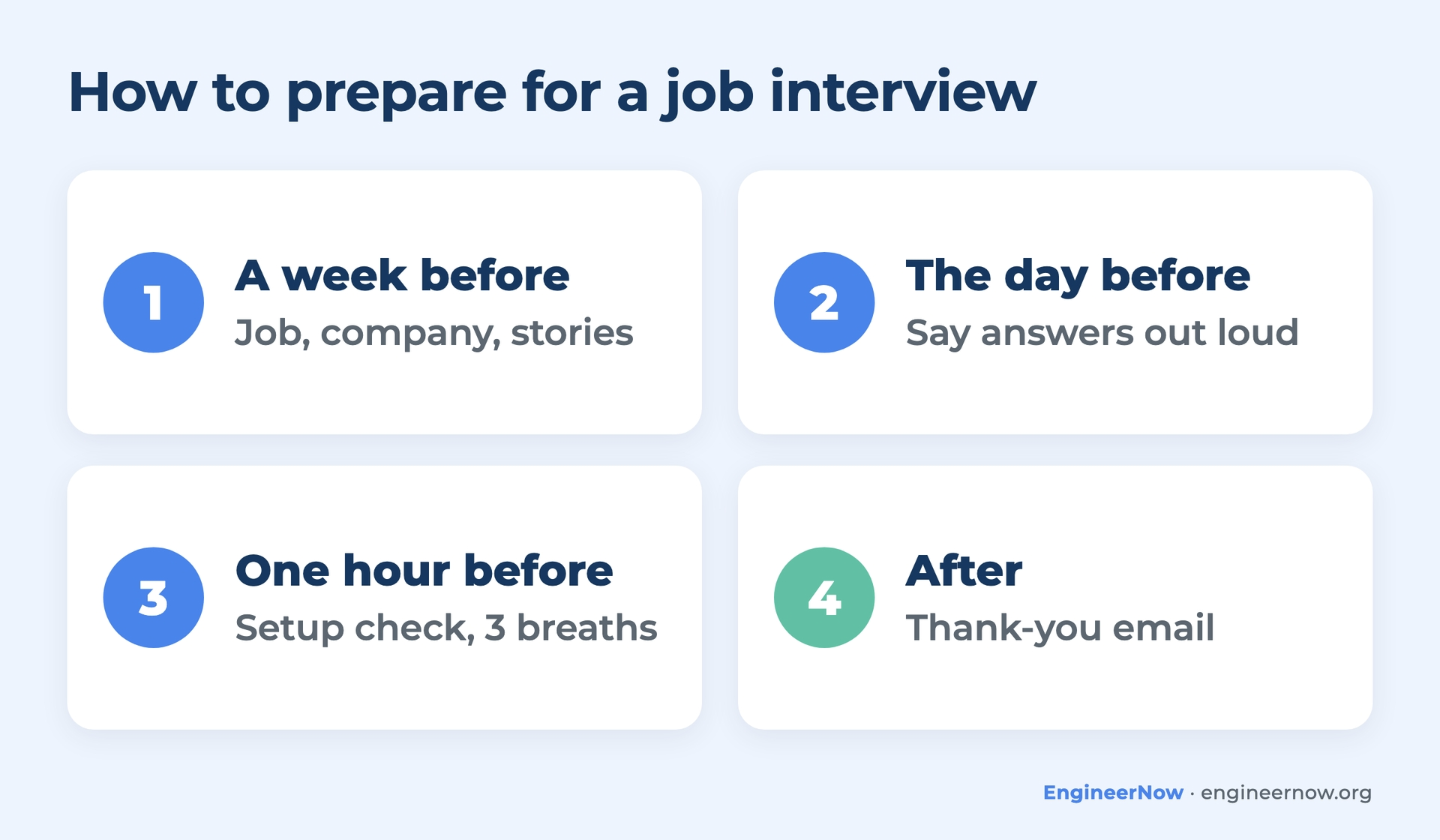
Create your own interview preparation checklist and go through it before every interview:
- A week before: the job description, the company, the country, your resume.
- Then: 3 to 5 stories with numbers, your pitch and 2 or 3 questions for them.
- The day before: every answer out loud.
- One hour before: room, background, camera, light, internet, clothes, phone. In person: your route, printed copies of your resume, and plan to arrive early (DOL).
- After: a thank-you email, anything they asked for as soon as possible, and a follow-up if you haven't heard back within the agreed timeframe (DOL).
Preparation doesn't remove nerves completely, but it gives you control. And control is what interviewers feel as confidence.
And after every interview, good or bad, write down the questions they asked and where you got stuck. That's real learning. In my own 50+ interviews as a candidate, every time I learned something new.
Interviews are not about being perfect. They're about being real, being prepared and showing that you care.
Good luck, friends.
I walk through both stages of this preparation, the deep research and the final check, in my video:
How long should you prepare for a job interview?
Ideally several days or even weeks. That's enough to understand the job description, the company and the country, prepare your stories and practice them out loud. If your interview is tomorrow, don't panic. Go through everything today, starting with the job description and your three strongest stories. One evening of focused preparation is still much better than none.
How do you prepare for an engineering interview?
The same way as for any job interview, plus the technical part. List the standards, equipment and software in the job description and prepare a concrete example for each one, so you can discuss them clearly. Then build 3 to 5 stories with measurable results: availability, failures, downtime, cost or safety. Hiring teams evaluate what you changed, not what you were responsible for.
What should I bring to a job interview?
For an in-person interview, the U.S. Department of Labor suggests a few printed copies of your resume and a clean, neutral-colored folder with a pen and notepad. DOL also says to plan to arrive early. It also helps to have your questions for the employer written down. For an online interview, keep the same notes next to your screen, but don't read your answers from them.
How do I calm my nerves before an interview?
Prepare well, because preparation gives you control, and control is what interviewers feel as confidence. Right before the call, try my simple trick: three deep, slow breaths, in through the nose and out through the mouth. Some nerves are normal. You don't need to be perfect to be confident. You need to communicate clearly why you're the right person for the job.

Written by
Recent Posts

Pub: 16 Jan 2026 - Upd: 05 Nov 2026
10 min. read
How to Get a Job Abroad as an Engineer: My 10-Year Road