

Published · 10 min. read
Mechanical Engineer Interview Questions: What I Listen For
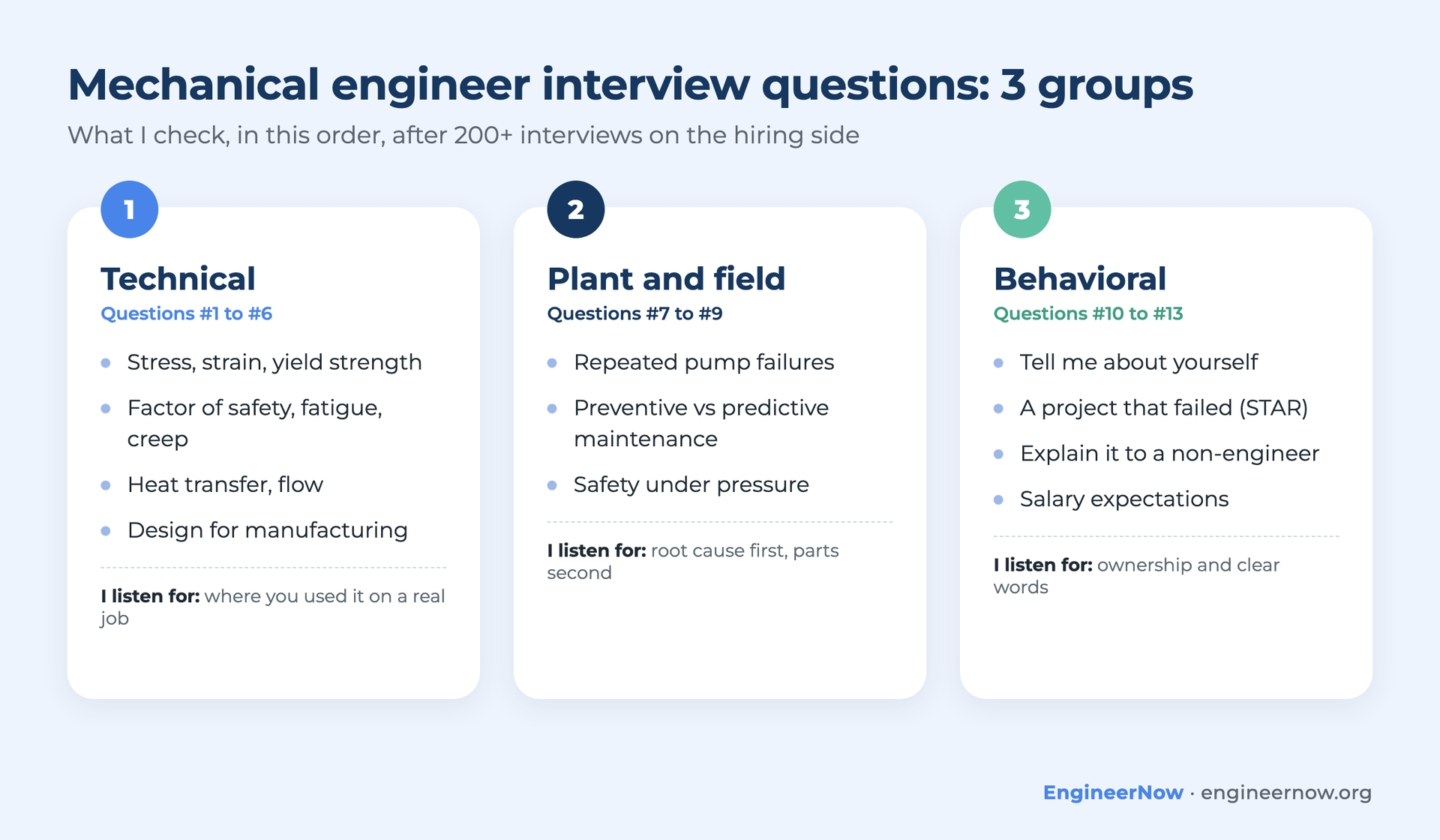
Most mechanical engineer interview questions fall into three groups: technical fundamentals, your real projects and plant experience, and behavioral questions about failure, teamwork and pressure. If you can explain the basics in plain words and tell two or three project stories with real numbers, you are ready for most of them.
I've sat on both sides of the table. I ran more than 200 interviews as the person asking the questions, and I passed more than 50 as the candidate, including the one that got me into Saudi Aramco. So for every question below I also tell you what I'm actually listening for.
What a Mechanical Engineering Interview Really Tests
Whatever the role, I check three things, in roughly this order:
- Can you think like an engineer? This is your core knowledge.
- Have you really done the work? Projects, equipment, numbers.
- Can I trust you in my team when something goes wrong?
Here is what most candidates miss. A textbook definition gets you maybe half the points. I want to hear where you applied that concept on a real job.
Technical Mechanical Engineer Interview Questions
These six common questions come up in some form in most technical rounds. Answer in one or two sentences, then give an example.
#1 What is the difference between stress and strain?
Stress is the internal force per unit area. Strain is how much the material deforms compared to its original length, so it has no units. In the elastic zone, stress divided by strain gives you Young's modulus, and yield strength is where permanent (plastic) deformation begins.
My take: after the definition, tell me which material you selected for a part and why.
#2 What is a factor of safety, and how do you choose one?
It's the ratio between the load a part can carry and the load you expect. You choose it based on how well you know the loads and material properties and what a failure would cost, in money and in risk. And of course on what the code or standard requires.
My take: the word "standard" is what I'm waiting for. Nobody picks it out of the air on a real project.
#3 What is the difference between fatigue and creep?
Fatigue is failure from cyclic loading, often well below the yield strength. Creep is slow deformation under a constant load over time, and it gets serious at high temperature.
My take: if you've seen a cracked shaft or a support that failed from vibration, tell me. Real failure stories beat formulas.
#4 What are the three modes of heat transfer?
Conduction, convection and radiation. The second law of thermodynamics adds the direction: on its own, heat flows from hot to cold.
My take: bring it back to equipment you have touched, like a cooler with poor performance every summer.
#5 How do you tell laminar from turbulent flow?
By the Reynolds number, the ratio of inertial to viscous forces. Low values mean laminar flow, high values mean turbulent flow. In a pipe there is a transition zone between them, not one magic number.
My take: I don't need the exact number. Tell me why it matters in a real pipe, for pressure drop and heat transfer.
#6 How do you make a design cheap to build and easy to maintain?
In mechanical design, think about manufacturing from day one: standard parts and tolerances the shop can actually hold. Name your CAD software and how you checked the model.
My take: I spent years in maintenance, so I listen for one thing: did you ask the people who will build and repair it?
Plant and Oil and Gas Questions Most Lists Skip
Most lists online are written for product design jobs. But many mechanical engineers work in plants and offshore, like I did. I spent about ten years at Shell and became head of the mechanical maintenance department with more than 50 people. The challenges there are different.
#7 A pump keeps failing. What do you do?
Don't start by replacing parts. Collect the data first: failure history, vibration, operating conditions and what changed. Then identify the root cause and solve that, not the symptom.
My take: candidates who say "I'd replace the seal" lose me. The seal is often the victim, not the reason. At Shell, one detailed investigation took our gear pumps from failing every 3 months to running 5 years between failures.
#8 What is the difference between preventive and predictive maintenance?
Preventive maintenance is done by the calendar or running hours. Predictive maintenance is done by condition: vibration analysis, oil analysis, thermography. A good plant uses both. The skill is knowing where each approach pays off, based on how critical the equipment is.
My take: the word I wait for is "criticality". Putting sensors on every small pump rarely pays off.
#9 Production wants the unit back early. Do you skip a safety step?
No. And you need to explain it calmly to people who are under pressure too.
From the field
I've worked shutdowns from 6 am until 10 or 11 pm for two weeks straight. Everyone is tired and wants to finish. That's exactly when shortcuts look attractive, and exactly when I want an engineer who says "no" politely and firmly.
Behavioral Interview Questions and How to Answer Them
Many behavioral questions start with "Describe a time when…", and at least one is usually about teamwork, like a time you disagreed with a colleague. Use the STAR method: Situation, Task, Action, Result. Keep each answer under two minutes and finish with a number if you have one.
#10 Tell me about yourself
In the US, it's your one minute to prove you fit the job. In the Middle East and Asia, it's often just a way to start. Either way, talk about the job, not your hobbies. More in the engineering interview questions almost everyone gets and in my video 5 interview questions and how to answer them.
#11 Tell me about a project that failed
Pick a real one, with specific details. Say which part was your fault, what caused the problem and what you changed after. If you blame everyone else, the interview is over for me. Here I show the STAR formula step by step:
#12 How would you explain this design to someone who isn't an engineer?
Use a simple comparison, drop the jargon and explain the complex part last. Operators and managers will ask you this every week, so I want to see it in the interview.
Reading answers won't prepare you for someone pushing back. Say them out loud in a mock interview first:
The Salary Question That Ends Interviews Early
This one looks simple, but I've seen it end an interview faster than any technical question.
#13 What salary do you expect?
Let's be honest, we all work to earn a living. But timing matters. When I was head of the discipline, one candidate cut me off at the very beginning and said he wouldn't accept anything below $3,000. I wished him good luck in his job search, and that was it.
Salary answer
I'm telling you right away, I won't accept anything below $3,000.
Wrong
Salary answer
Based on what I've seen for this role and location, I'm looking at [your range]. But first I'd like to understand the full package and the scope of the job.
Right
Talk about money at the end, when they ask. Know your market first: in the US, the median pay for mechanical engineers was $104,110 in May 2025, according to the Bureau of Labor Statistics. Then give a range you can explain. More in how to negotiate salary at the right moment and the things I'd never say in a job interview.
Which Questions Should You Prepare First?
Which mechanical engineering interview questions to prepare first depends on your level. This is where I would start:
| Level | Prepare first |
|---|---|
| Entry level or fresher | #1 to #6, your final-year project, #10 |
| Experienced engineer | 2 or 3 project stories with numbers, #7 to #9, #11 |
| Senior or lead | Cost, budget, risk and safety decisions, people and conflicts, #9, #13 |
My take
After I got my UK Chartered Engineer status and passed the CMRP exam, I got three interview invitations. I didn't pass two of them. Saudi Aramco made me an offer. The whole story is in how I landed my first job abroad.
Certificates get you into the room. Preparation gets you the offer.
FAQ
Three more questions engineers often ask me before an interview.
How do I prepare for a mechanical engineering interview?
Start with the job description and match every requirement with a real story from your work. Then revise the basics from this list, practice your answers out loud with a timer and prepare two questions for the interviewer. Ask a friend to play the hiring manager and interrupt you. It feels awkward, but it works.
What is the hardest question in a mechanical engineering interview?
For most candidates, it's an open problem like "a part failed in the field, what do you do?" There is no single right answer. I'm checking your problem-solving process: what information you collect, what you rule out first and when you ask for help.
What skills do interviewers look for in a mechanical engineer?
Solid core knowledge, practical experience with real equipment or designs, CAD and analysis tools, the ability to communicate clearly and a safety mindset. In my experience, communication matters more than people expect. A strong engineer who can't explain a problem to the team is hard to hire.
Interviews are a skill, and skills can be trained. I failed interviews too, and it still worked out. By the way, if you're aiming for an international role like my Aramco job and want my personal advice, join my Engineer-Millionaire course:
Good luck, friends.

Written by
Recent Posts



Pub: 17 Apr 2026 - Upd: 01 May 2026
8 min. read
The Main Advantages, Disadvantages, and Salaries of Engineers