

Published · 10 min. read
Reliability Engineer: What They Do, Salary and How to Start
A reliability engineer makes sure plant equipment like pumps, compressors and turbines keeps running without unplanned failures. They find out why machines fail, remove the root cause and set the maintenance strategy, so the same failure doesn't come back.
This is the industrial job, not the software site reliability engineer. Why do some plants replace the same pump seal every few months for years? Usually because nobody owns the "why". I'm Alex, a CMRP and Chartered Mechanical Engineer. I did this work for years at Shell, then worked as an offshore maintenance engineer at Saudi Aramco.
What Is a Reliability Engineer?
A reliability engineer is an engineer responsible for how long equipment runs between failures and how available it is when the plant needs it. In simple words, reliability is the chance that a machine does its job, in its conditions, for the time you need it. You'll find these engineers in oil and gas, power, manufacturing and chemical plants. In job ads the same role is often called a maintenance and reliability engineer.
Their focus is equipment performance over the whole life of the asset: how it's designed, how it runs and how it's maintained. When it drops, the plant loses production and money.
If you came here from IT: a site reliability engineer (SRE) keeps websites and cloud systems online. The only thing in common is the word reliability. Everything below is about physical equipment.
What Does a Reliability Engineer Do?
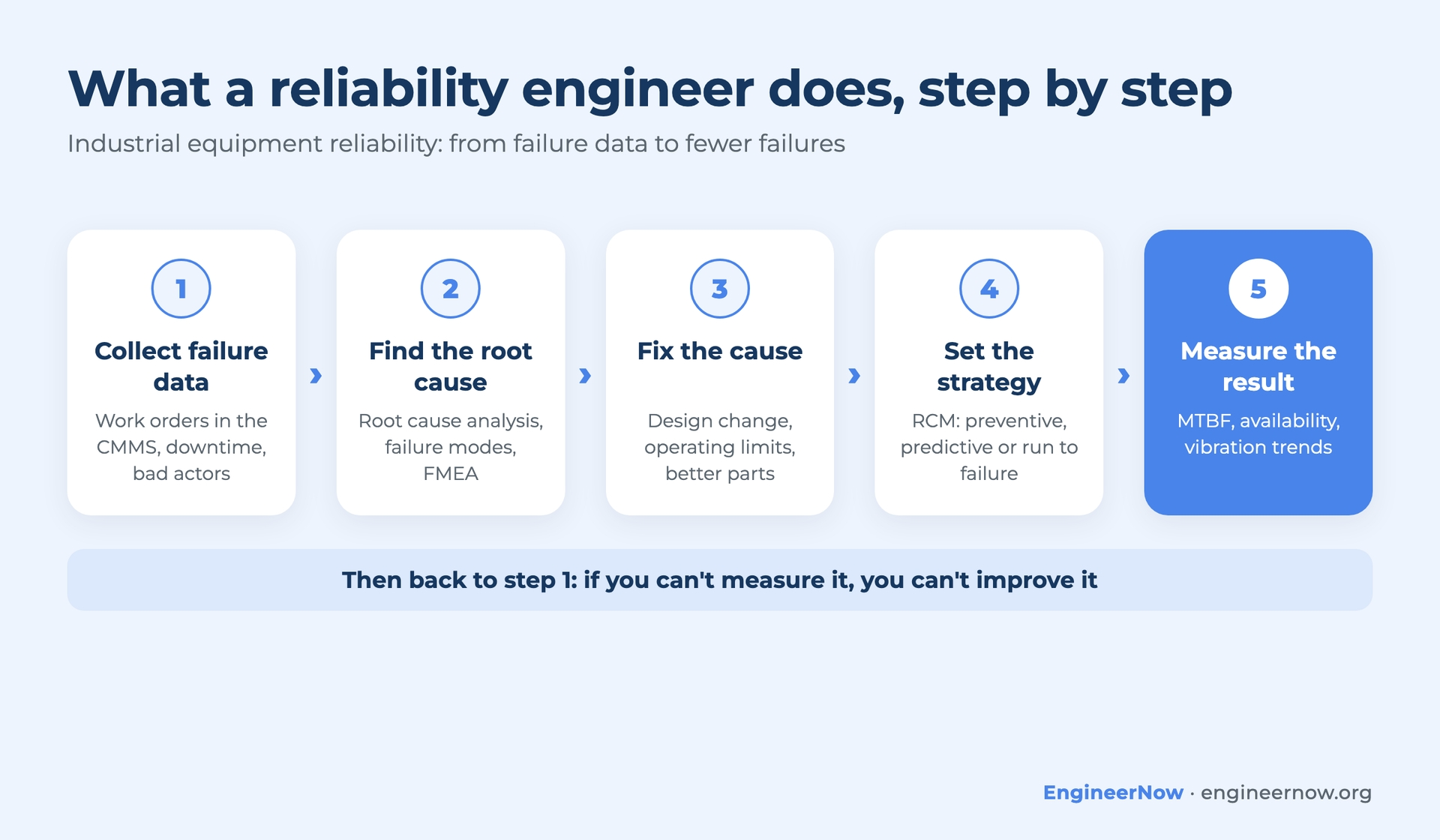
A reliability engineer analyzes failure data and changes how equipment is designed, operated and maintained, so the plant has less downtime and fewer safety incidents. The responsibilities in a typical reliability engineer job description include:
- root cause analysis of failures and the "bad actors", the machines that fail most;
- FMEA (failure modes and effects analysis) and criticality ranking;
- maintenance strategy: RCM, optimizing preventive and corrective tasks, predictive condition monitoring with vibration and oil analysis;
- tracking metrics like MTBF, MTTR and availability;
- working with data in the CMMS (for me it was SAP PM);
- design reviews and testing on new projects, so problems don't get built in;
- spare parts: which critical spares the store must hold in inventory for each machine;
- making the fix stick with operations and maintenance.
A good fix changes the design or the strategy, not just the part. They prevent the next failure instead of reacting to it. In one of my lead roles, critical vertical pumps were vibrating at 31 mm/s rms. I designed detuning plates, and vibration dropped to 3 mm/s rms.
From the field
At Shell our main gas compressors were available only 68% of the time. We did a proper root cause analysis, and availability rose to 95%.
All of this runs on information. The CMMS (computerized maintenance management system) holds the work orders, failure codes and repair history. If a job is closed with "pump repaired" and nothing else, the data quality is too poor to identify a pattern. So you spend real time making sure people record what failed and why.
The same goes for spare parts. At Saudi Aramco I led a BOM (bill of materials) project, and BOM connectivity went from 45% to 85%. A good BOM links each machine to its parts, so inventory matches what the machines really use and the planner finds the right part fast.
From Reactive to RCM: Maintenance Strategies Compared
The job is to move a plant from "fix it when it breaks" to a strategy based on risk. Here's how the four main approaches compare on one centrifugal pump:
| Strategy | When you act | Example on a pump | The reliability engineer's role |
|---|---|---|---|
| Reactive (run to failure) | After it breaks | Seal leaks, pump trips, you replace the seal | Decides where run to failure is acceptable: cheap, spared, no safety risk |
| Preventive | On a calendar or running hours | Bearing change at fixed intervals | Removes low-value tasks and sets intervals from failure data |
| Predictive (condition-based) | When data shows degradation | Vibration trend and oil analysis show bearing wear | Designs the vibration and lubrication program, sets alarm limits |
| RCM | Per failure mode | FMEA ranks seal, bearing and coupling failures by consequence | Picks the right mix for each asset |
On a real site you'll use all four. RCM simply tells you where each one belongs. At Shell I ran condition-based maintenance, vibration and lubrication programs, so I've seen each approach at work.
Reliability Engineer vs Maintenance Engineer
The maintenance engineer owns today's work: the plan, the repairs, the shutdown and the contractors. The reliability engineer makes sure the same failure doesn't come back next month. I lived on both sides, as Lead Rotating Mechanical Maintenance and Integrity Engineer and later Head of Field Mechanical Maintenance and Integrity at Shell. Here's more on what a maintenance engineer does day to day.
On your resume, show reliability work as results:
How to show reliability work on your resume
Responsible for vibration monitoring and repairs of pumps as required.
Wrong
How to show reliability work on your resume
Designed detuning plates for critical vertical pumps and cut vibration from 31 to 3 mm/s rms.
Right

Reliability Engineer Salary
BLS doesn't count reliability engineers separately. O*NET lists "Reliability Engineer" as a job title under validation engineers, which belong to industrial engineers. So the two nearest BLS lines are:
- industrial engineers: median $102,440 a year (May 2025), growth 12% from 2025 to 2035, about 23,100 openings a year;
- mechanical engineers: median $104,110, growth 11%, about 17,800 openings a year.
Your real pay depends on the industry and the country. Oil and gas and jobs abroad are a different story from a small factory.
How to Become a Reliability Engineer
There's no shortcut, but the path is clear. You need technical skills, analytical thinking and communication, because you'll collaborate with operations and maintenance every day.
- Get an engineering degree. BLS lists a bachelor's degree as the typical entry-level education for both industrial and mechanical engineers.
- Spend years in maintenance or operations. You can't improve equipment you don't understand. I joined Shell right after university and grew into lead and then head of maintenance roles.
- Learn the tools and best practices. Root cause analysis, FMEA, RCM, Weibull analysis, vibration analysis, lubrication and your CMMS.
- Get certified. CMRP or CRE, see below. Here are the certifications for mechanical and rotating equipment engineers I'd look at.
If you're still deciding on mechanical engineering itself, read about what a mechanical engineering career looks like.
CMRP or CRE?
CMRP from SMRP covers five pillars: business and management, manufacturing process reliability, equipment reliability, organization and leadership, and work management. CRE from ASQ needs eight years of experience, three of them in a decision-making role, and goes deeper into reliability statistics. I hold CMRP and wrote about how I passed the CMRP exam.
Check the requirements on the ASQ page before you apply. For the Certified Reliability Engineer (CRE) certification, a bachelor's degree waives four of the eight years, and a master's waives five. The computer-based exam has 165 questions in 4 hours 18 minutes, and it's open book. The fee is $550, or $100 less for ASQ members.
Is Reliability Engineering a Good Career?
In my opinion, yes, and the potential is big. Maintenance and reliability engineers are in huge demand globally, because every company with equipment and processes wants fewer failures, fewer incidents and lower costs. And the work is measurable: if you can't measure it, you can't improve it. With MTBF and availability, you always know if you're winning.
It also never ends. Every new failure goes back into the strategy, and the list of bad actors keeps changing. That's continuous improvement in practice, and it's why the job never gets boring.
By the way, if you want to take your engineering career international, I share everything I learned in my course.
Do you need a degree to be a reliability engineer?
Usually yes. Employers expect an engineering bachelor's degree, and BLS lists it as the typical entry-level education for the nearest occupations. For CRE, ASQ counts some degrees toward the eight years of experience it requires.
What KPIs does a reliability engineer track?
The main ones are MTBF, MTTR, availability and the list of bad actors. For our gear pumps at Shell, MTBF went from about 3 months to 5 years after we fixed the root cause. That's the kind of number managers remember.
Can a maintenance technician become a reliability engineer?
Yes, but it takes work. You need an engineering degree or strong certification, and you need to get comfortable with failure data. CMRP has no education or experience prerequisites, so it's a realistic first step for an experienced technician.
What comes after reliability engineer?
Usually a senior reliability role, then leadership roles in maintenance and asset integrity. Reliability certifications help you get there faster. At Shell I grew from lead engineer to Head of Field Mechanical Maintenance and Integrity, leading more than 50 people.
Good luck, friends. Find the root cause, and the machines will thank you.

Written by
Recent Posts




Pub: 17 Apr 2026 - Upd: 01 May 2026
8 min. read
The Main Advantages, Disadvantages, and Salaries of Engineers