Published · 9 min. read
Commissioning Engineer: What the Job Really Involves
A commissioning engineer proves that new equipment and systems are installed correctly and work safely as designed, then hands them over to operations. They do it through tests, start-up and a lot of documents, from the factory floor to the day the plant runs on its own.
Every start-up is a moment of truth for a project. I'm Alex, a Chartered Mechanical Engineer with 18+ years in oil and gas, including Shell and Saudi Aramco. I'm not a full-time commissioning engineer, but I work at both ends of the job. I witness factory and site acceptance tests for rotating equipment, and I know the operations side that takes the plant over.
What Is a Commissioning Engineer?
A commissioning engineer is the specialist between construction and operations, responsible for making the plant run safely and efficiently. Construction says the equipment is installed. The commissioning engineer checks that it's installed right, runs it, proves it meets the design and only then signs it over.
There are a few types, depending on the systems:
- mechanical commissioning engineers: pumps, compressors, turbines, HVAC;
- electrical commissioning engineers: switchgear, transformers, motors, power systems;
- instrumentation and controls engineers: loops, trips, control systems;
- process commissioning engineers: whole units running on product.
In building commissioning and data centers you'll also see titles like commissioning agent or commissioning authority. For example, the AABC Commissioning Group certifies Commissioning Authorities.
Your degree usually decides where you start. With a degree in mechanical or electrical engineering, you begin on the systems you studied and learn the neighboring ones on site.
What Does a Commissioning Engineer Do? From FAT to Handover
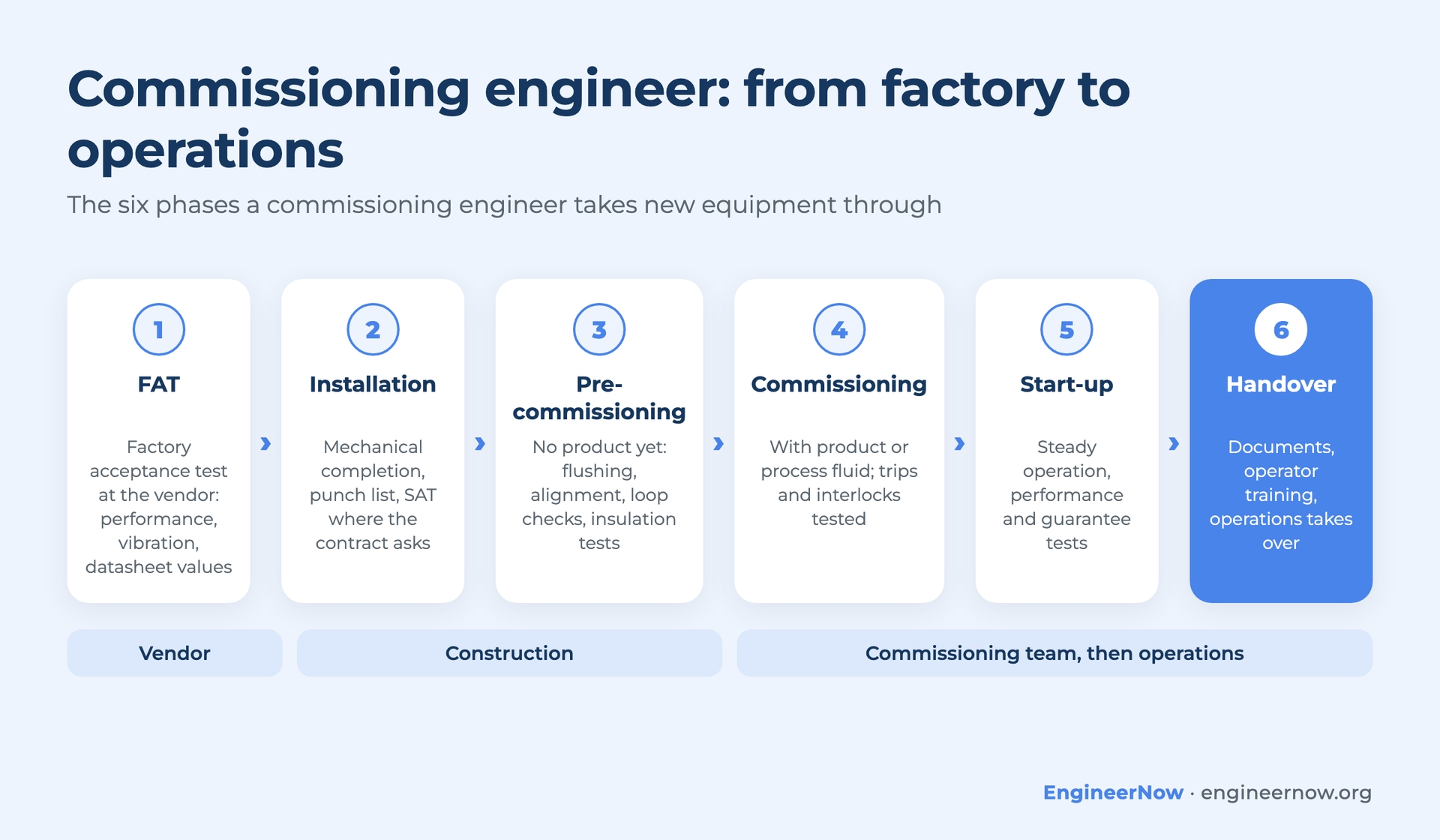
The job follows the equipment through six phases. It starts at the vendor's factory with a FAT, a factory acceptance test, where you check performance, vibration and datasheet values while the machine is still on the test bench. Then come the installation of equipment, pre-commissioning without product, commissioning with product, start-up and finally handover to operations.
As I wrote in my article about a mechanical engineering career, on a big project the work is split by equipment: one mechanical engineer starts the turbines, another the pumps, a third the ventilation system and a fourth the pipelines.
From the field
In my current role I witness FAT and SAT for rotating equipment. Before that, as lead rotating equipment engineer on a large gas project, I did design reviews, 3D model reviews and HAZOP with the EPC contractor. On that project I also designed detuning plates that cut vibration on critical vertical pumps from 31 to 3 mm/s rms. Every problem you catch on the test bench or in the drawings is one less problem on start-up day.
Commissioning Engineer Job Description
A typical commissioning engineer job description includes:
- writing test procedures and checklists;
- witnessing factory and site acceptance tests (FAT and SAT);
- pre-commissioning checks: flushing, alignment, loop checks, insulation tests;
- leading start-up and performance tests;
- investigating problems and repairing faults with vendors and contractors;
- providing technical support to the client and operations staff;
- running the punch list until every item is closed;
- training operators and preparing the handover documents and reports.
Most of the tasks are checking and overseeing, not designing. But you need to know the equipment better than anyone on site.
You also need communication skills and leadership skills, because you coordinate vendors, contractors and operators against project deadlines.
Your responsibilities also change with the phase. Before start-up, most of your day is testing, checklists and paperwork. After start-up, it's performance runs, closing the punch list and training the operators who take over.
Where the Demand Is: Data Centers, Power and Process Plants
Demand is strong wherever new capacity is being built, and commissioning engineer jobs exist at every level, from field engineer to senior commissioning manager. US Google searches for "commissioning engineer" grew about 30% in the last year, and searches for "data center commissioning engineer" roughly tripled (keyword data, October 2026). You'll also find these roles in power plants and grids, oil and gas, chemicals and wind. If data centers interest you, my guide to the data center engineer resume will help you prepare.
Commissioning Engineer Salary
BLS doesn't track commissioning engineers as a separate occupation, and O*NET has no occupation by that name either. Its closest matches are energy, validation and mechanical engineers. So here are the nearest lines, which are engineering pay in general, not commissioning pay:
| Occupation (BLS) | Median pay | Outlook 2025 to 2035 | Why it's relevant |
|---|---|---|---|
| Mechanical engineers | $104,110 | 11% | Mechanical commissioning, rotating equipment, HVAC |
| Electrical engineers | $120,630 | 10% | Electrical commissioning, power, data centers |
| Electronics engineers, except computer | $130,220 | 4% | Controls and instrumentation |
In practice, pay depends on the industry, your experience, travel and rotations. Start-ups mean long hours, and many commissioning jobs work on a rotation, like the ones I describe in rotation work and its pros and cons. Figures are from the BLS Occupational Outlook Handbook pages for mechanical engineers and electrical and electronics engineers.
How to Become a Commissioning Engineer
There's no single entry point, and the requirements depend on the industry. Most people follow a similar path, and the practical skills matter as much as the formal qualifications:
- Get an engineering degree. BLS lists a bachelor's degree as the typical entry-level education for mechanical and electrical engineers.
- Get work experience in construction, with a vendor or in operations. QA/QC on construction, service engineer at an equipment manufacturer, or a maintenance and operations role all work.
- Learn the equipment deeply. At Shell I led overhauls of compressors, gas turbines and large pumps. When you know how machines fail, you know what to check before you start them.
- Know safety cold. Permits to work, isolations and lockout are part of every test.
- Put FAT, SAT and start-ups on your resume with numbers: systems, equipment, dates met.
Most people grow from field commissioning engineer to commissioning lead or manager, or move into operations and projects. Chartered status helps you grow, especially abroad. Before you apply, run your resume through a scanner, because commissioning ads are full of specific terms.

Resume Scanner
AI scanner performs 15 essential checks to ensure your resume is optimized for the jobs you're applying to.
SCAN RESUMEIs Commissioning Engineering a Good Career?
It's a great school. You learn a plant faster than anyone, and that experience is valuable later in operations and projects. But let's be honest, it's hard.
In my article on the engineering jobs I'd think twice about, I put construction and commissioning engineers second. The responsibility for starting up multi-million-dollar equipment falls on you, the hours are irregular, and you're on site constantly and travel a lot.
The locations are part of the deal too. Plants get built where the resources and the grid connections are, not where you'd like to live. I've worked in temperatures from -50 to +50 °C, at sea, in deserts, swamps and forests. Believe me, I know what I'm talking about.
Do you need a degree to be a commissioning engineer?
Usually yes, an engineering bachelor's degree in mechanical, electrical, chemical or instrumentation. Some people come in from technician roles with years of hands-on experience, especially in building systems, but for oil and gas and power projects most employers expect an engineer.
What is the difference between pre-commissioning and commissioning?
Pre-commissioning happens before any product goes in: flushing, alignment, loop checks, insulation tests, running motors uncoupled. Commissioning starts when systems work together with product or process fluid, and you test trips, interlocks and performance.
Which certification is best for a commissioning engineer?
It depends on the industry. In buildings and data centers, look at ASHRAE BCxP, ACG's Certified Commissioning Authority or NEBB's building systems commissioning certification. In oil and gas and power there's no single one, and solid equipment experience matters more.
Do commissioning engineers travel a lot?
Yes. The work happens where the plant is being built, so expect long site assignments or rotations. It's hard on families, so think about it honestly before you choose this path.
So if you like being where things start, this job is for you, friends. Good luck!
By the way, if you want to build an international engineering career, I share everything I learned in my course.

Written by
Recent Posts


Pub: 22 Oct 2026 - Upd: 23 Oct 2026
11 min. read
Reliability Engineer: What They Do, Salary and How to Start