Published · 10 min. read
Maintenance Engineer: What the Job Really Looks Like
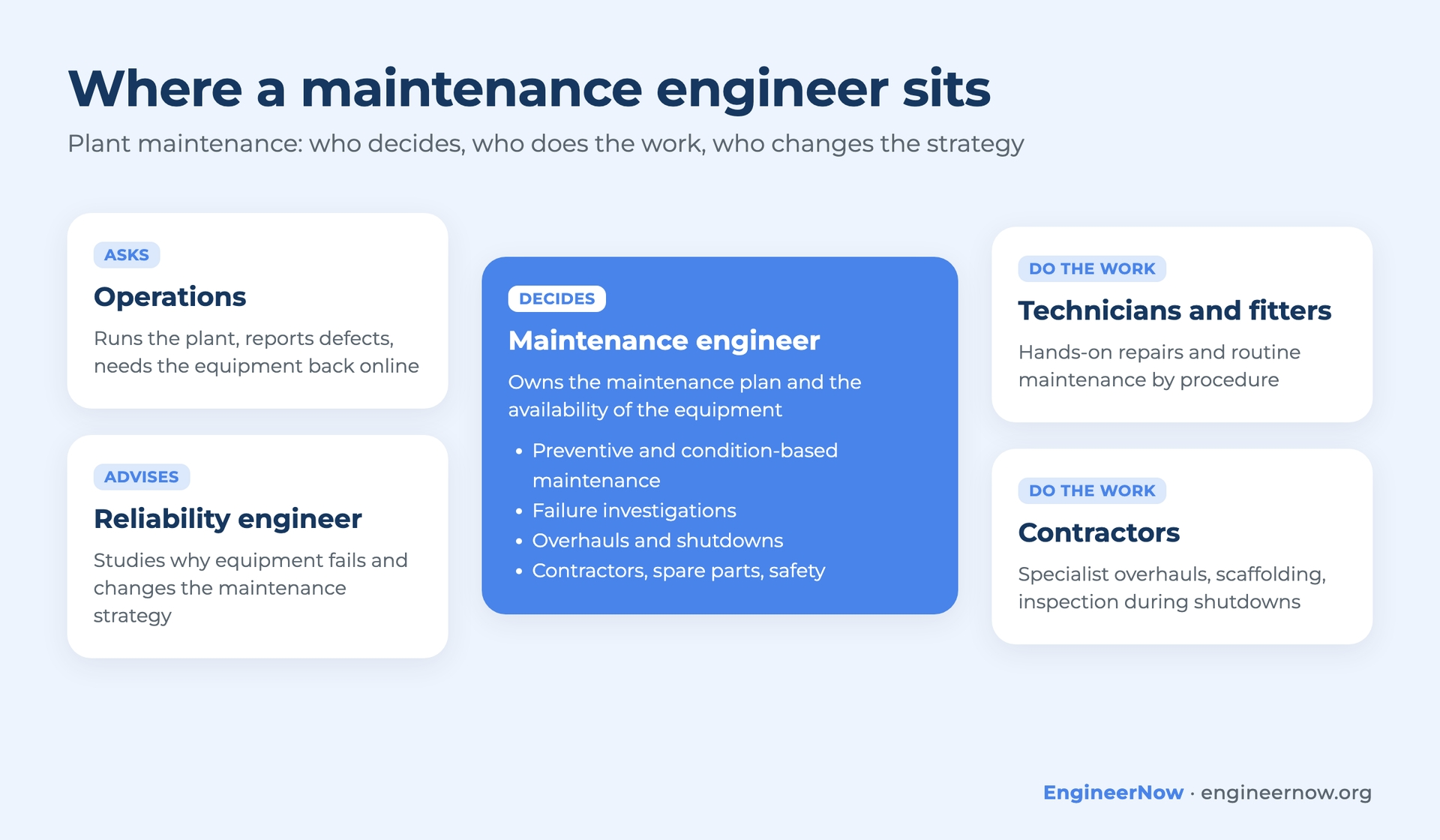
A maintenance engineer is the engineer who decides how a plant's equipment is maintained: what gets done, when, why it failed and how to stop it from failing again. Technicians and fitters do the hands-on work, while the maintenance engineer owns the plan and the availability of the equipment.
Many people think maintenance engineering is just fixing broken machines. Let's be honest, if you're only fixing things after they break, you're doing it wrong. I'm Alex, and at Shell I was Head of Field Mechanical Maintenance and Integrity. My team had more than 50 engineers, technicians and fitters.
What Is a Maintenance Engineer?
A maintenance engineer keeps industrial equipment running safely and reliably at the lowest reasonable maintenance costs. On a typical plant that means pumps, compressors, turbines, motors, valves, pressure vessels and the control systems around them. The goal is simple: prevent failures, cut downtime and improve the performance of critical equipment across production, energy and other industries.
There's one important catch. In the US, "maintenance engineer" is also a common job title in hotels, apartment buildings and hospitals. O*NET, the US Department of Labor database, lists it among the typical titles of general maintenance and repair workers, people who fix boilers, plumbing and lighting in buildings. That's an honest trade, but it's a different job, and this article is about the plant maintenance engineer: manufacturing, power generation, oil and gas.
The other difference is engineer versus technician. Maintenance technicians follow maintenance procedures and do the repairs. The engineer writes those procedures, helps diagnose faults and problems, and decides what to repair now and what can wait. That takes knowledge, practical expertise and the ability to say no to the wrong quick fix.
What Does a Maintenance Engineer Do?
Maintenance management on a large site is a long list of maintenance tasks. A maintenance engineer job description usually includes:
- planning preventive maintenance (some say preventative maintenance) in a CMMS, for me it was SAP PM;
- predictive and condition-based maintenance: vibration, lubrication and oil analysis;
- investigating failures and finding the root cause;
- planning and leading overhauls and shutdowns;
- writing the scope of work and managing contractors;
- deciding which spare parts the site must keep;
- health and safety: permits to work, isolations, environmental and safety compliance.
On a big site, you also manage people and budgets. In my last Shell role that meant more than 50 people and 8 maintenance contracts. Technical skills get you the job, but communication and problem-solving keep you in it. On my sites the technical core was vibration analysis, root cause analysis, SAP PM and reading API standards.
All these maintenance engineer responsibilities come down to one thing: ensuring the equipment is available when operations need it. Maintaining a pump costs money. A pump that trips in the middle of production costs much more.
Mechanical Maintenance Engineer
A mechanical maintenance engineer looks after rotating and static equipment and their components: compressors, gas turbines, API pumps, heat exchangers. That's my specialty, and electrical engineering colleagues cover motors and power. You work with standards like API 610 for pumps and API 617 for compressors, and you learn to read vibration data like a doctor reads an X-ray.
CMMS Software and the Spare Parts Inventory
A big part of the job happens on screen. CMMS software holds the work orders, the equipment history and the spare parts inventory. If the data in it is wrong, the plant doesn't run smoothly. You find out at the worst moment: the pump has failed and the part isn't on the shelf.
At Saudi Aramco I led a BOM project. A bill of materials (BOM) links each piece of equipment to its spare parts, and we raised BOM connectivity from 45% to 85%. Boring work? Maybe. But it's essential if you want the right part ready when you need it.
A Normal Shift vs a Shutdown
Most of the year, the work is routine maintenance and decisions: which defects to fix now, which can wait for the next shutdown, what the contractors need. On most sites the maintenance engineer is also on call when critical equipment trips. Then the shutdown comes, and life changes completely.
| Normal shift | Shutdown | |
|---|---|---|
| Hours | A regular working day; offshore at Saudi Aramco, 12-hour shifts | About two weeks, from 6 am to 10 or 11 pm |
| Main focus | Maintenance plan, defects, inspections | Overhauls of compressors, gas turbines and large pumps |
| People | Your own team | Your team plus contractors |
| Biggest risk | A defect nobody noticed | Missing the start-up date or a safety incident |
| Typical decision | Repair now or wait for the shutdown | What to do when you find more than you planned |
On most of my sites I worked rotations, mostly 28 days on and 28 off, sometimes 21/21 or 35/35. If you're thinking about that lifestyle, read my honest take on rotation work and its pros and cons.
Maintenance Engineer vs Reliability Engineer
The maintenance engineer gets today's work done. The reliability engineer asks why the equipment keeps failing and changes the strategy with data, RCM and FMEA. On small sites one person does both, and at Shell I did both too: I ran the overhauls and also led root cause analysis and our condition monitoring programs. Here's what a reliability engineer actually does in more detail.
In my opinion, real maintenance efficiency comes from this second part. At Shell, root cause analysis raised the availability of our main gas compressors from 68% to 95%. You don't get that by repairing faster. You get it by stopping the same failure from coming back.
If you run a plant, don't treat maintenance as a cost to cut. Remember those gear pumps that failed every 3 months. Every repeat failure costs your business parts, labor and often production.
Maintenance Engineer Salary: What the Numbers Really Say
If you search for a maintenance engineer salary, you'll see anything from about $20 an hour to six figures. The reason is the title mix: building technicians and plant engineers share the same name.
BLS doesn't publish a maintenance engineer line, so here are the nearest ones (median annual pay, May 2025, and projected growth from 2025 to 2035):
- Mechanical engineers: $104,110, growth 11%;
- Industrial engineers: $102,440, growth 12%;
- industrial machinery mechanics and maintenance workers (technicians): $64,100, growth 14%;
- general maintenance and repair workers (buildings): $49,590, growth 4%.
So the salary of a maintenance engineer depends on the job behind the title. In a plant, look at the engineering lines. In a hotel or hospital, the general maintenance line is closer. Check the industry and the duties in the job ad, not just the title.
Abroad the picture changes again. My first pay at Shell was $500 a month. After I moved to Saudi Aramco, my income grew about 10 times.
How to Become a Maintenance Engineer
The path has three steps, and none of them is fast.
- Get the degree. The educational requirements are clear: BLS lists a bachelor's degree as the typical entry-level education for mechanical and industrial engineers.
- Get years of experience on site. Learn the equipment, the CMMS and the people. I joined Shell right after university and grew through four grades in six years.
- Add qualifications. CMRP is the best-known credential for maintenance and reliability, and I wrote about how I passed the CMRP exam. Chartered Engineer status helps if you want to work abroad.
That's the career path most employers recognize. CEng and CMRP got me three interview invitations, and one of them ended with an offer from Saudi Aramco. If you want to know what a career in mechanical engineering looks like beyond maintenance, I wrote about that too.
Your resume should show results, not duties. Write "raised availability" or "extended pump MTBF from 3 months to 5 years", not "responsible for maintenance".

Is Maintenance Engineering a Good Career?
In my opinion, yes, and the career prospects are good if you're ready for it. Shutdowns are long, the responsibility is real, and I've worked at sea, in deserts, swamps and forests, from −50°C to +50°C. But every plant needs maintenance engineers as long as it runs, the opportunities are wide, and your experience travels with you from country to country.
Maintenance careers also don't lock you in one box. After my maintenance roles at Shell, I moved to offshore rotating equipment work at Saudi Aramco, and later worked as a lead rotating equipment engineer on a large gas project. The same equipment knowledge works in maintenance, reliability and project roles.
By the way, if you want to build an international career in engineering, I share everything I learned in my course.
Do you need a degree to be a maintenance engineer?
For an engineering role, yes. BLS lists a bachelor's degree as the typical entry-level education for mechanical and industrial engineers. Technicians can start with a high school diploma and on-the-job training, but the engineer title usually needs the degree.
How much does a mechanical maintenance engineer make?
BLS doesn't count it separately. The nearest line, mechanical engineers, had a median of $104,110 a year in May 2025, about twice the $50,980 median for all workers. Offshore and international jobs are a different story: they often pay more and come with rotations and lower taxes.
Is maintenance a hard job?
Sometimes, yes. During a shutdown I worked about two weeks from 6 am to 10 or 11 pm. But the results are visible: when the plant starts up safely and runs, everyone knows who made it happen.
Do maintenance jobs train you?
Big operators usually do. Shell spent around $50,000 on my training in my first five years, with four or five trips a year to the Netherlands. Smaller companies expect you to learn on the job.
So keep the equipment running and keep learning, friends. Good luck!

Written by
Recent Posts

Pub: 22 Oct 2026 - Upd: 23 Oct 2026
11 min. read
Reliability Engineer: What They Do, Salary and How to Start