

Published · Updated · 11 min. read
How to Negotiate a Job Offer as an Engineer, Line by Line
Here's how to negotiate a job offer: wait until it's in writing and take a day or two. Then check every line of the package and send one polite counter with a number and a reason. As an engineer, the lines around the salary, like rotation, relocation and training, can matter as much as the base.
I have negotiated every offer I've received, and each time the number went up, sometimes only a little. I've also sat on the other side of the table: 200+ job interviews as the interviewer, and 50+ passed myself.
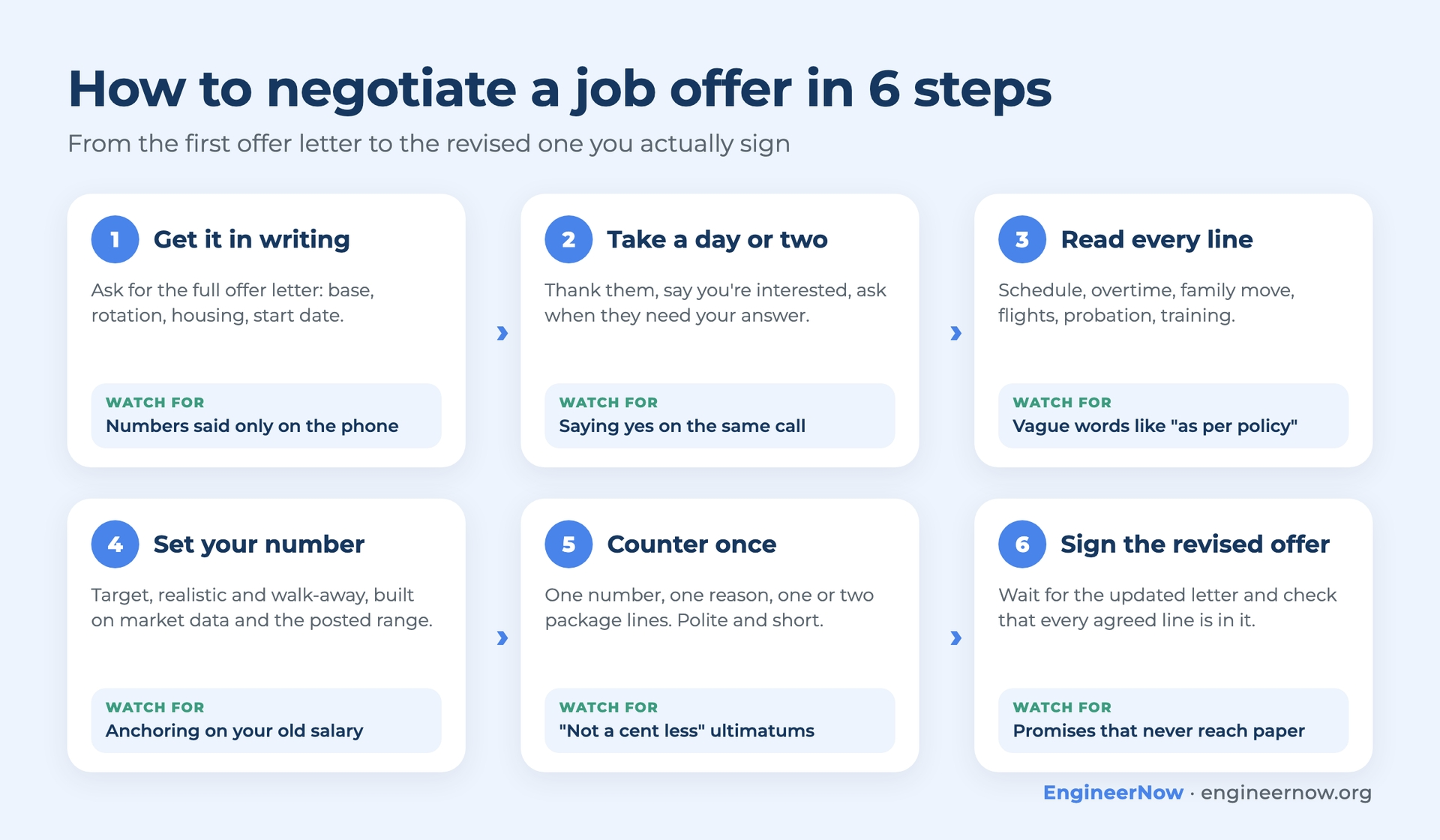
Here's the whole negotiation process in six steps, then the details.
Every day, you're negotiating with your spouse, kids, parents, friends, with colleagues, bosses. Negotiation skills help you persuade people or at least reach a compromise.
When to Negotiate Salary: After the Job Offer Is in Writing
Salary negotiation starts when you receive an offer, not in the first interview. By the final stage, the company has invested a lot of time in you during the interview process: several interviews, maybe a flight for a face-to-face meeting. For them, it's easier to add something to your package than to start the hiring process again with a new candidate.
So don't push money into the early conversation. If it comes up anyway, here's what to say if they ask about money in the interview.
When the offer comes, thank them, say you're excited about the role and ask when they need your answer. Don't accept immediately on the call. Harvard's Program on Negotiation calls rushing to "yes" the first common mistake. It says "a day or two may be sufficient" to plan your answer (PON Harvard). If they only told you the numbers by phone, ask for the full offer letter with all the details.
Read Every Line of an Engineering Job Offer
Office guides talk about base salary, vacation and maybe retirement. An engineering offer has more lines, and some of them cost you more than a lower base. Consider the whole package before you think about a counteroffer. Each line below is a reason to ask, or a reason to walk away.
| Line of the offer | What to check | Worth asking? |
|---|---|---|
| Base salary | Gross or net, currency, per month or per year | Yes, with a reason |
| Rotation and schedule | Days on and off, are travel days work or rest, who can change it | Yes, often easier than base |
| Overtime and shutdowns | Paid, or "included in salary"; shift length during turnarounds | Ask how it's paid |
| Housing and relocation | Allowance or company housing, family status, shipping, first weeks in a hotel | Yes, especially for a family move |
| School | Fully covered, capped or not covered; which schools | Yes, if you have kids |
| Flights | Home flights per year, for whom, which class | Yes |
| Leave | Annual leave days, public holidays, when you can take them | Sometimes |
| Probation and notice period | Length, notice on both sides, do you repay relocation if you leave early | Ask for clear terms |
| Bonus or sign-on | Guaranteed or discretionary, when it's paid, any clawback | Yes, when base is fixed |
| Training and certifications | Course budget, exam fees, paid time off for study | Yes, cheap for them |
| Title and grade | The grade often drives future raises and benefits | Yes, before you sign |
The schedule line is where I've been strict all my career. A good base with a bad rotation is still a bad job for a family.
From the field
I've never accepted jobs with long or unequal rotations like 45/15 or 60/30. My very first offer abroad, from Qatar, was around $4,000 a month without family relocation. I turned down that offer from Qatar because the package didn't work for my family.
Know Your Number Before You Counter
Before you ask for more money, know your worth. Look at the market for your industry, country and years of experience. For the US, the Bureau of Labor Statistics puts the median annual wage for architecture and engineering occupations at $99,520 (May 2025). For all occupations, it's $50,980 (BLS). Glassdoor helps too, but treat it as rough data.
The posted salary range is often public now. In California, an employer with 15 or more employees must include the pay scale in any posting for a job that may be filled in California. Any employer must give it to an applicant on reasonable request and can't seek your salary history (California Labor Commissioner). In New York State, employers with four or more employees must show a pay range in job ads (Labor Law § 194-b). Employers also can't make your salary history a condition of an interview or offer (§ 194-a).
In the EU, the Pay Transparency Directive 2023/970 requires countries to give job seekers a right to pay information before employment and to ban questions about salary history. Countries had to bring it into national law by 7 June 2026, so check whether yours has done it (European Commission).
Then write down three numbers: your target, a realistic number and your walk-away point. If someone still asks what you earn now, you don't have to invent anything. Say: "I'd rather talk about the range for this role." It's honest and keeps the conversation on the role.
By the way, growing an engineering income across countries is what my Engineer-Millionaire course is about.
How to Counter Offer Salary Without Losing the Offer
Make one counter, not a series of demands, and don't expect a yes to every line. Give a number and a reason. Never send an ultimatum like "I won't accept less than [your number]". Imagine they offered [X] and you answered "[2X] or nothing". They may simply not come back, even if they were ready to give you something in between.
A colleague once told me he'd been through three separate interviews at the same company. After the first two offers, he asked for more and got no answer at all. The third time, he didn't want to risk it and accepted without negotiating. I don't know how he asked, so I won't guess what went wrong. The lesson I took: make your one request count, with a number and a reason.
The reason should be your value, not a comparison. When I started, I earned $500 a month for a 2-week hitch, and others earned much more. I didn't go to my manager with "they get more than me". I collected proof: what I improved, what I optimized, how much money I saved the company. I did that three times over 4 years and got three extra raises of 5-10% on top of the standard annual increase.
My rule: bring proof, not comparisons.
In a job offer negotiation, that proof is your experience, a certificate the role needs, a result from your last project or market data for the position. If you have another written offer, you can mention it, but only if it's real.
Can you lose a job offer by negotiating salary? The bigger risk is the tone, not the request, so stay positive and respectful.
How to Negotiate a Job Offer by Email
Email works well: the hiring manager can forward it to whoever approves the budget, and it leaves a record. Keep it short. Here's a salary negotiation email you can adapt. Change the [brackets] to your own details.
Subject: [Position] offer
Dear [Name],
Thank you for the offer for the [position] role. I'm excited about this opportunity and the [project or team], and I'd like to make this work.
Based on my [X years] in [equipment or field], my [certificate] and the market range for this position, I'd like to ask for a base salary of [your number].
I'd also like to clarify two lines: [rotation, for example 28/28 instead of the offered schedule] and [family relocation or school support].
If the base is fixed, I'm open to discussing [sign-on bonus, training budget or a salary review date] instead. Could we talk this week?
Best regards, [Your name]
If the Base Salary Won't Move
Sometimes the budget is fixed, especially in companies with grades. Then negotiate the rest of the compensation package and benefits: rotation, family relocation, a sign-on bonus, training and certifications, the start date, or a written salary review date after probation. Courses and exam fees count as professional development and cost the employer little, so they're worth asking for.
Whatever you agree on the phone, the result only counts in the revised offer letter. Read it again, line by line, before you sign. If the whole package is still far below your walk-away number, read when a low salary is a real reason to leave and keep looking. One offer is one deal; how to grow your income over the years, not just in one offer is a longer game.
Use AI to Read the Offer, Not to Write Your Demands
AI tools are good at one part of this: reading a long offer and finding what's vague or missing. They're bad at telling you how much more to ask for, because they don't know your market or your value. So use them as a second pair of eyes, then decide the number yourself.
Don't paste your full name, passport or salary slips into a chat. The offer text without them is enough.
So, friends, if you don't ask, you won't get it. Ask once, politely, with a reason, and get the answer in writing. Good luck.
If you have an offer on the table and want a second opinion on your number or your email, book a personal consultation with me.
Can you lose a job offer by negotiating salary?
It can happen, so control what you can: tone and timing. Ultimatums, a list of demands or endless rounds of back-and-forth make a no more likely. Thank them, express interest in the role, give one number with a reason and leave the door open. A polite request rarely hurts the relationship. If they say no, you can still accept the initial offer.
How much more should I ask for than the offer?
There's no fixed percentage, and every situation is different. Start from the posted salary range, market data for your role and country, and your own three numbers: target, realistic and walk-away. Ask for your target if you can justify it with experience or results, and know the lowest number you're willing to accept. A higher amount without a reason is easy to refuse.
Should I negotiate a job offer by email or by phone?
The best approach is both, in the right order. A short call keeps it human and shows you're interested in the role. Then confirm everything by email, because the person you talk to often needs approval from someone else, and an email is easy to forward. The final terms only count in the revised written offer.
Can I negotiate a relocation package as an expat?
Yes, and for engineers moving abroad it's often easier than moving the base. Ask about family status, housing allowance, school tuition, home flights and shipping. Get each item in the offer letter with a number or a clear rule. "As per company policy" means you should ask for the policy before you sign.

Written by
Recent Posts


Pub: 05 Dec 2025 - Upd: 01 May 2026
8 min. read
Mechanical Engineer Career What to Expect & Is It Worth Studying?

Pub: 11 Dec 2025 - Upd: 01 May 2026
7 min. read
Expat Job Search Secrets: How to Find Jobs in Canada, Europe, and Australia