

Published · Updated · 10 min. read
Mechanical Engineering Career Path: Design, Field or OEM?
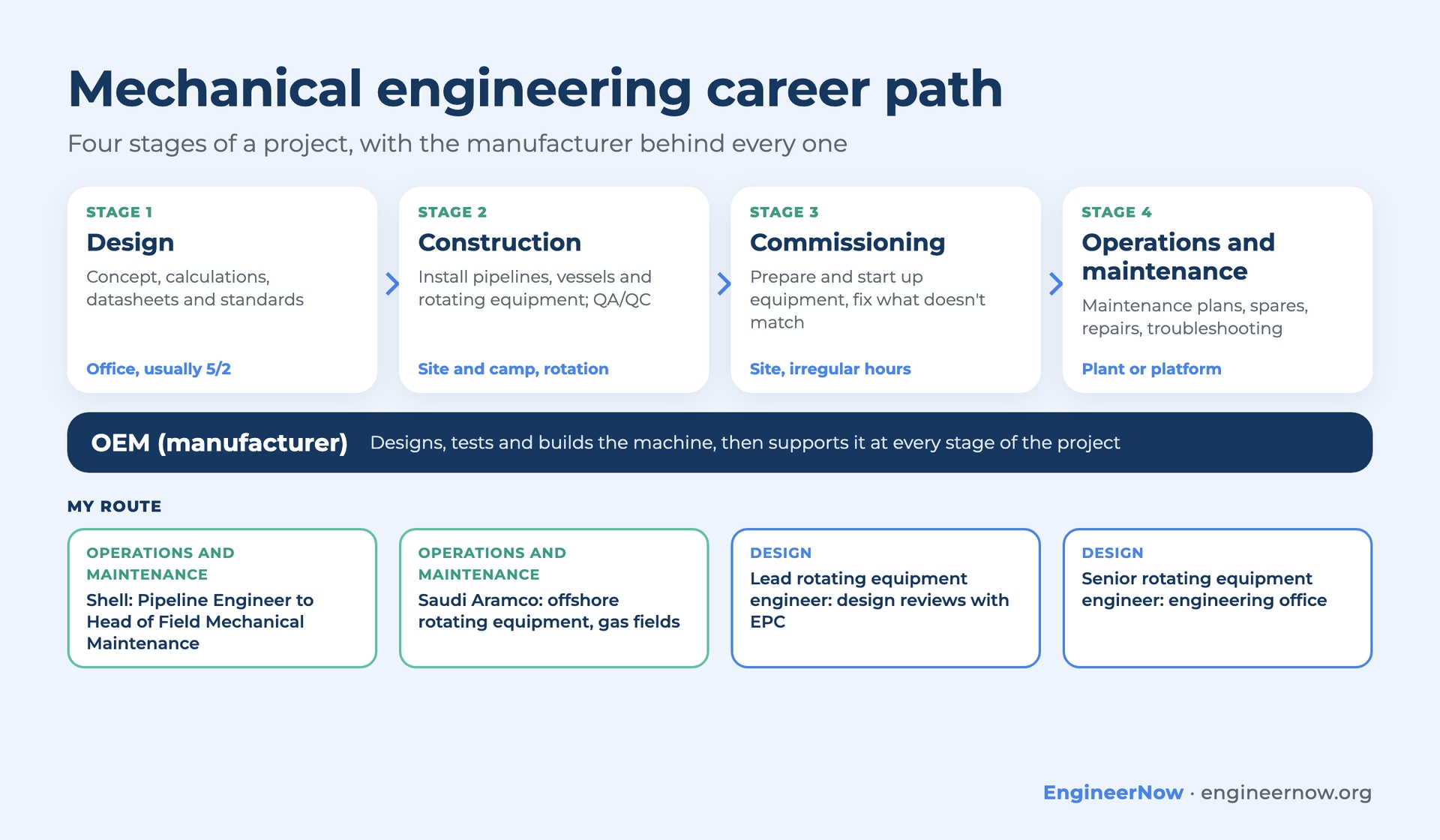
A mechanical engineering career path usually follows the life of a project: design, construction, commissioning, then operations and maintenance, with the equipment manufacturer (OEM) behind every stage. Design gives you regular office hours, the site gives you rotations and more risk, and the manufacturer gives you the deepest knowledge of the machine.
I'm Alex, a Chartered Mechanical Engineer with 18+ years of experience, including Shell and Saudi Aramco. I've worked at sea, in deserts, swamps and forests. Most of my career was in operations and maintenance, and today I work in an engineering office. Below are the types of mechanical engineering jobs by project stage, what each one costs you, and the route I took.
Growing into an expert, a manager or a business owner is a separate, vertical choice. Here I only cover where in a project you work.
Design Engineering: The Office Path
It all starts with design: concept, feasibility studies, calculations, datasheets and standards. In oil and gas, design engineers specify pumps, compressors, turbines, tanks and heat exchangers: the mechanical systems and components a plant depends on.
According to the BLS, mechanical engineers work mainly in offices and occasionally visit worksites where a problem or a piece of equipment needs their attention. Among their top industries, the highest median pay is in scientific research and development: $132,040 in May 2025.
Today I work on the design side, reviewing specifications and taking part in factory and site acceptance tests.
When I say design, I don't mean drawing in CAD all day. There are many specializations inside design, especially in research and development, where engineers create new equipment and products. Design is the path for people who want their evenings and weekends with family.
Still, computer aided design and simulation software are the daily tools here. Learn them well, but remember that the tool isn't the job. The calculation and the decision behind it are.
Construction and Commissioning: The Site Path
After design, the project has to be built. Construction mechanical engineers install pipelines, vessels and rotating equipment, and a QA/QC mechanical engineer runs quality control against the design. Projects are often remote, so people live in camps and work on rotation.
I've never been a construction engineer. I worked alongside construction teams from the maintenance side, and we did a lot of joint work. Construction brings its own problems: design mistakes, missing materials and discrepancies you solve on site.
In 2024, the US recorded 5,070 fatal work injuries, and 1,032 of them were construction and extraction workers, according to the BLS Census of Fatal Occupational Injuries. Only transportation and material moving occupations had more (1,391).
Commissioning comes next. Mechanical engineers prepare the equipment for operation and start it up, and this stage shows where design and reality don't match. Nobody wants to break a multi-million-dollar machine at start-up, and the hours are irregular. I wrote separately about what a commissioning engineer really does.
Operations and Maintenance: Where I Spent Most of My Career
Once the plant runs, operations and maintenance engineers keep production going. They write maintenance plans, order spare parts, run repairs and troubleshoot failures, on a rotation or a regular 5/2.
I joined Shell as a Pipeline Engineer right after university, then moved into rotating equipment maintenance. Later I became Head of Field Mechanical Maintenance and Integrity, with a team of 50+ engineers, technicians and fitters. Root cause analysis raised the availability of our main gas compressors from 68% to 95%.
The price is the schedule. My rotations were mostly 28/28, also 21/21 and 35/35, and a shutdown meant about two weeks from 6 am to 10 or 11 pm. At Saudi Aramco, I supported offshore gas fields: a helicopter to the platform on Sunday, back on Thursday, 12-hour shifts. Failure analysis is the core of the reliability engineer role.
From the field
Offshore in the Persian Gulf, I was exposed to hydrogen sulfide, and it could have been fatal. OSHA lists loss of smell at 100 to 150 ppm, so your nose won't warn you. At 700 to 1,000 ppm, people collapse within 1 to 2 breaths. The romanticism of working at sea, in the desert or in the forest wears off quickly.
The OEM Path: Learn the Machine From the Inside
The fifth path sits behind all the others: the original equipment manufacturer, or OEM. Here mechanical engineers design the product, develop and test prototypes and oversee the manufacturing processes, all duties the BLS lists for the occupation. Machinery manufacturing employs 14% of US mechanical engineers, with a median wage of $98,620 in May 2025.
OEM engineers also work outside the factory. The US Department of Energy career map describes how, in the wind industry, mechanical engineers may work for the OEM or the operator once the plant runs. They keep the machines' performance to specification, find root causes and work with the customer on solutions.
Renewable energy shows this well. Wind turbines are machines too, and someone has to take them from research, design and testing to production and then keep them running.
I've never worked for a manufacturer. I've dealt with OEMs from the customer's side, for example at factory acceptance tests. But I still believe this is where real expertise is built. You know how the machine is made, where its weak points are and how to improve it. Designers, maintenance teams, service crews and clients all come to you for answers.
Manufacturers also have a side branch: technical sales. Engineers there use their technical knowledge to show a client why this pump or compressor fits the process. It suits people who like both machines and talking with people.
How I Moved From the Field to the Design Office
My route went across the project stages. Field maintenance at Shell, offshore rotating equipment at Saudi Aramco, design reviews with an EPC contractor, and now an engineering office.
One skill went with me through every stage: project management. Design, construction, commissioning and maintenance all have a schedule, a budget and other teams to agree with.
Switching industries is harder. If you've spent 10 years as an automotive mechanical engineer, it's unlikely you'll move smoothly into nuclear or oil and gas, because the equipment and technologies are too specialized.
Each path also asks for different certificates: API inspection certificates in construction and inspection, CMRP and vibration analysis in maintenance and reliability, software skills in design. In my video below, I go through them field by field, and here's a longer list of mechanical engineer certifications.
Is Mechanical Engineering a Good Career?
By the numbers, yes. The BLS reports a median annual wage of $104,110 for mechanical engineers in May 2025. The lowest 10% earned less than $73,990, and the highest 10% earned more than $164,340.
The mechanical engineer job outlook looks solid too: about 298,500 jobs in 2025, 11% projected growth from 2025 to 2035 and about 17,800 openings a year. So where do mechanical engineers work? Mostly in architectural, engineering and related services (20%), machinery manufacturing (14%) and transportation equipment manufacturing (10%). Most of the opportunities are in engineering offices and at manufacturers, with industrial sites only part of the picture.
My opinion: it's a good career if you pick your path on purpose. If you're still choosing a degree, see how engineering degrees rank by pay and growth.
| Path | Where you work | Schedule | Main risk | Who it suits |
|---|---|---|---|---|
| Design | Engineering office | Usually 5/2, regular hours | Can get boring if all you do is draw | People who like calculations, standards and datasheets |
| Construction | Site and camp, often remote | Rotation and long shifts | Site hazards and schedule pressure | People who want to see a plant being built |
| Commissioning | Site, from project to project | Irregular hours and frequent travel | Responsibility for starting expensive equipment | People who stay calm when a start-up goes wrong |
| Operations and maintenance | Plant, platform or field | Rotation or 5/2 | Hazards of a live plant, shutdown weeks | People who like machines and troubleshooting |
| OEM (manufacturer) | Office, factory, test shop and customer sites | Mostly office and shop | Fewer jobs than in engineering services (BLS: 14% vs 20%) | People who want to know one machine inside out |
Which Mechanical Engineering Career Path I Recommend
My advice to beginners is simple: go straight to an OEM. You learn one machine inside out, and everyone in the project needs that knowledge.
If you're still a student, start before graduation. Ask your university careers service which manufacturers hire interns and entry level engineers, and take courses on the equipment you'd like to work with, such as pumps, compressors or turbines.
If regular hours and evenings with your family matter most, choose design. Construction, commissioning and maintenance teach you a lot about real plants, but you pay with rotations, long shifts and risk. I paid with years of rotations myself.
Switching paths? Your resume has to speak the language of the new role:


Let's be honest: no path is perfect. Pick the one that fits your life. Good luck, friends.
By the way, if you want my personal advice on your career or an international move, join my Engineer-Millionaire course.
What is the best career path for a mechanical engineer?
There's no single best one, because it depends on what you want from life. My advice to beginners is to go straight to an equipment manufacturer, where you learn one machine inside out. Design suits people who want regular hours. Construction, commissioning and maintenance teach you real plants, but they usually come with rotations, long shifts and more risk.
Do mechanical engineers travel a lot?
It depends on the path. The BLS says mechanical engineers mainly work in offices and only occasionally visit worksites. Site paths are different: commissioning engineers move from project to project, and offshore roles mean regular trips to the platform. At Saudi Aramco, a helicopter took me offshore every Sunday and brought me back on Thursday, with 12-hour shifts in between.
Can I move from maintenance or site work into design later?
Yes, I did. I spent most of my career in operations and maintenance at Shell and Saudi Aramco, then moved into design reviews with an EPC contractor and later into an engineering office. Switching industries is harder than switching stages, so stay close to equipment you know.
Will AI replace mechanical engineers?
I don't think so, at least not soon. The BLS still projects 11% employment growth for mechanical engineers from 2025 to 2035. I use AI tools myself, together with equipment data such as oil analysis results, to assess the condition of machines. For me, it's a tool in the hands of an engineer who understands the equipment, and the future still needs that engineer.

Written by
Recent Posts

Pub: 28 Nov 2025 - Upd: 04 Nov 2026
11 min. read
How to Negotiate a Job Offer as an Engineer, Line by Line
Pub: 11 Dec 2025 - Upd: 01 May 2026
7 min. read
Expat Job Search Secrets: How to Find Jobs in Canada, Europe, and Australia

Pub: 25 Dec 2025 - Upd: 01 May 2026
7 min. read
Engineering Video Resume: How to Stand Out From 90% of Engineers in 2026