Published · Updated · 12 min. read
How to Find Visa Sponsorship Jobs Abroad as an Engineer
To find visa sponsorship jobs abroad, search where the employer has already said yes to a foreign hire. That means official job banks with a filter for candidates from abroad, government registers of licensed sponsors and company career pages. Big job boards rarely tell you whether the visa is included.
From my first month at Shell to my Saudi Aramco offer, it took me about 10 years. I always hoped to find one magical website with all the filters I needed in one place. It doesn't exist.
I'm Alex, a Chartered Mechanical Engineer. I've worked for Shell and Saudi Aramco, and I've helped 100+ engineers get engineering jobs abroad. So here's how to find jobs with visa sponsorship, country by country, through official government portals, and how to verify the employer before applying.
What Visa Sponsorship Means for Jobs Abroad
A visa sponsor, or sponsoring employer, is an employer that the government allows to hire and employ foreign skilled workers. So for a sponsored work visa, the order is the same: first the job offer, then the visa.
Companies that sponsor visas work inside clear rules, and the UK shows it well. For a Skilled Worker visa, you must work for an employer approved by the Home Office and get a certificate of sponsorship from them. The official page puts it plainly: "You must have a confirmed job offer before you apply for your visa."
That's how it worked for me, too. With Saudi Aramco, the visa was part of the offer process. With an employer like Saudi Aramco, you don't need a sponsor before you apply. You need the right employer. I described the whole path in how I got my first job abroad.
So don't search for a visa. Find companies that sponsor visas, with job requirements that match your work experience and profession.
Canada: Use Job Bank's Filter for Foreign Candidates
For Canada, start with the official Job Bank. It has a separate page, Foreign candidates from outside Canada. There you can "search jobs from employers who are recruiting foreign candidates from outside Canada."
That's exactly what a job search in Canada for foreigners needs. Type your job title in the keyword search of this section, not in the general search. Then the results come from employers who are recruiting candidates from abroad.
The same page lists three steps: confirm your eligibility, check if your qualifications are recognized, then search and apply. For engineers and other professionals, don't skip the second step. If you haven't applied for one of the immigration programs or a work permit yet, Job Bank sends you to Immigration, Refugees and Citizenship Canada (IRCC) for information first.
UK: Check the Register of Licensed Sponsors First
If you remember the advice to search for "Tier 2 visa sponsorship", it's out of date. The UK government says the Skilled Worker visa "has replaced the Tier 2 (General) work visa".
The UK register of licensed sponsors is the most useful tool for UK visa sponsorship jobs. It's the official list of organisations licensed to sponsor workers on the Worker and Temporary Worker routes. You download it as a CSV file and search this database by company name. At the time of writing, the last update was 12 November 2026.
For most UK Skilled Worker jobs, the minimum salary is £41,700 a year or the going rate for your occupation, whichever is higher (gov.uk). There are exceptions, and rules change, so check that your offer meets the current rate before you apply.
The order for the UK: find the job, find the company in the register, then apply. If the company isn't on the list, it cannot sponsor you for a Skilled Worker visa, however good the ad looks.
Australia: Look for the 482 Visa in the Job Ad
Australia's main employer-sponsored visa for skilled work is the Skills in Demand visa (subclass 482). Home Affairs describes it simply. This visa "lets an employer sponsor a suitably skilled worker to fill a position they can't find a suitably skilled Australian to fill".
So when you look for visa sponsorship jobs in Australia, review each job ad carefully for the visa name: "482" or "Skills in Demand". Older ads and guides may still say TSS 482. That's the old name: the Temporary Skill Shortage page on Home Affairs now redirects to the new visa.
If the ad doesn't clearly state that sponsorship is available, ask the employer in your first message whether they're willing to sponsor a foreign candidate for this visa. One email saves weeks of interviews for a job that can't hire you.
The Netherlands and the Rest of Europe: Recognised Sponsors and EURES
In the Netherlands, the immigration service IND keeps a public register of recognised sponsors. A recognised sponsor is a company the IND has recognised, and it can apply for residence permits for its employees. You can use the register to check a company before you apply, and the IND updates it once a month.
For jobs in Europe for foreigners, the official portal is EURES, the European Employment Services, managed by the European Labour Authority. It has job opportunities and a job search across European countries, plus European Job Days, recruitment events for jobseekers and employers.
For engineers with a degree, Germany has the EU Blue Card. You need a concrete job offer for at least six months that matches your qualification. In 2026, the minimum gross salary is €50,700 a year (Federal Employment Agency). For shortage occupations, including academic STEM professionals, it's €45,934.20, and the agency must approve the job.
A software engineer without a degree can still qualify for the Blue Card. The rule asks for three years of academic-level IT experience in the last seven years, plus the lower salary.
In Ireland, look for the Critical Skills Employment Permit. According to enterprise.gov.ie, it's designed to attract highly skilled people. Its Critical Skills Occupations List covers several engineering disciplines: civil, mechanical, electrical and chemical engineers. Software development professionals are on it too.
For listed roles with a relevant degree, the minimum salary is €40,904 a year. The job offer must be for at least two years.
Both work like the Skilled Worker visa in the United Kingdom: first the job offer, then the permit. Salary limits change, so check the official pages before you apply.
My own experience with Europe: I've had offers from Sweden, Italy and Spain at around €7,000 a month. But European employers rarely offered relocation support for the family, so housing and school came out of the salary.
I'm learning Spanish right now because I live in Spain.
| Country | Where to search | What to search or filter | How to check the employer |
|---|---|---|---|
| Canada | Job Bank | Your occupation in "Foreign candidates from outside Canada" | Job Bank listing, then IRCC rules |
| UK | Employer career pages, job sites | Your job title and the company name | Register of licensed sponsors (CSV) |
| Australia | Job ads and employer career pages | "482" or "Skills in Demand" in the ad | Ask the employer to confirm sponsorship |
| Netherlands | Employer career pages, EURES | Your job title | IND public register of recognised sponsors |
| Germany, Ireland | Employer career pages, EURES | Your job title | EU Blue Card or Critical Skills Employment Permit rules |
| Other EU countries | EURES | Your job title and country | The country's official immigration site |
| Gulf countries | Company career pages, LinkedIn | Your job title at major employers | The company's own recruitment page |
The Gulf: Company Career Pages and LinkedIn
In the Gulf, big employers explain their hiring process on their own career sites. Saudi Aramco's recruitment page lists Saudi government visa approval as one of the conditions of the offer.
So for the Gulf, target companies directly. Research the main employers in your industry, visit their career pages and apply there. Direct applications also help you avoid fake recruitment agencies. For Gulf job boards and what salary to expect there, read how engineers can find a job in the Middle East.
LinkedIn matters too. Keep your profile current, keep networking in your industry and connect with recruiters who hire for international roles and positions in your field.
From my own job search
In my first year, I only read job ads abroad. Many ads at my target level asked for 7-8 years of experience. My interview invitations came through job websites and LinkedIn.
Why "Visa Sponsorship" Searches on Big Job Boards Mislead You
Searching "visa sponsorship" on big job portals and platforms looks like the fastest way. But a word in job postings isn't a sponsor licence, and it isn't employer sponsorship. Sometimes companies mention sponsorship in the description, but it's rare and inconsistent. Many ads say nothing at all, and some accept only candidates who can work without sponsorship.
So always verify the employer with the official tools above. And one rule without exceptions: never pay for a visa or a "guaranteed" job abroad. Here's how to spot a fake job offer abroad before you reply to one.
How engineers usually search
"mechanical engineer visa sponsorship" in a big job board, then apply to every result.
Wrong
A better way to search
Job Bank, Foreign candidates, [your occupation]. Or: [company from the ad], then a search in the UK sponsor register, then apply on the company's careers page.
Right
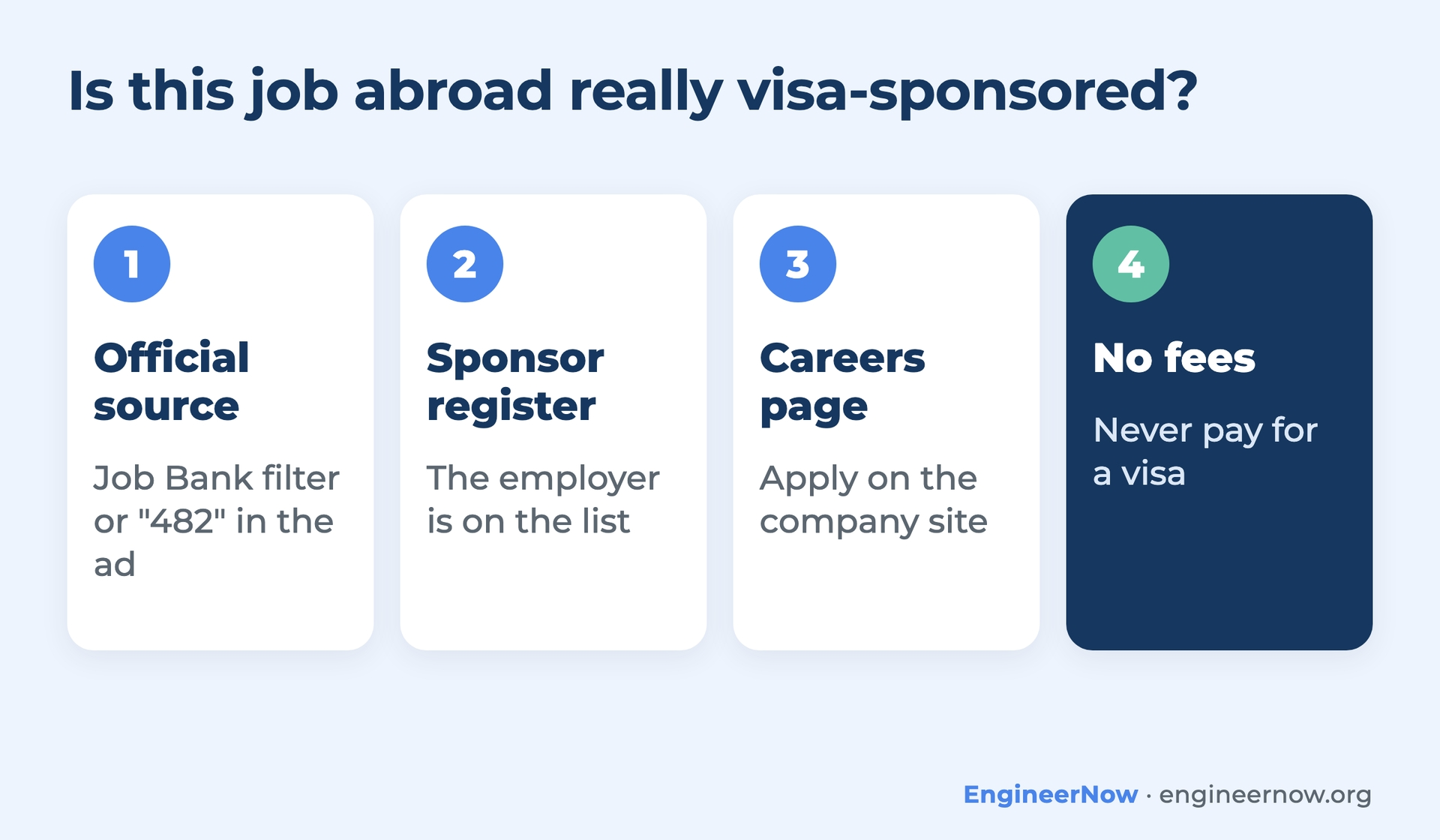
Here's the whole check in four steps.
Finding an employer that can sponsor you is half the work. Then tailor your resume to the job requirements and highlight your relevant experience. Generic resumes brought me nothing. Tailored ones brought invitations. And don't count on the cover letter: when I asked 10 recruiter friends in the Middle East and Africa, only two said they even look at them.


If you don't ask, you won't get it. Ask each employer about sponsorship early, and check the answer in the official register. That's the whole strategy, whatever country is your goal. And before you sign, read the pros and cons of working abroad as an engineer.
If you want my personal advice on your situation and where to look, book a consultation. Good luck, friends.
How do I know if a company will sponsor my visa?
Check the official list for that country. In the UK, the company must be in the Register of licensed sponsors. In the Netherlands, check the IND public register of recognised sponsors. In Canada, look for the job in Job Bank's section for foreign candidates. Being on a list doesn't mean a company is hiring you, so ask whether they offer visa sponsorship for the role in your first message.
Is Tier 2 still a UK work visa?
No. The UK government says the Skilled Worker visa has replaced the Tier 2 (General) work visa. You need a confirmed job offer from an employer approved by the Home Office and a certificate of sponsorship. For most jobs, the salary must be at least £41,700 a year or the going rate, whichever is higher. Check gov.uk for the current rules.
How long does visa sponsorship last?
It depends on the country and the visa. In the UK, a Skilled Worker visa "can last for up to 5 years before you need to extend it". You must also update it if you change jobs or employer. Check the official visa page of your country for its rules.
What is the 482 visa in Australia?
It's the Skills in Demand visa (subclass 482). According to Home Affairs, it lets an employer sponsor a skilled worker for a position they can't fill with a suitably skilled Australian. Older guides call it the Temporary Skill Shortage (TSS) visa, and the old Home Affairs page now redirects to the new one.
Should I pay an agency to find me a visa sponsorship job?
In my opinion, no. A legitimate employer hires you through applications and interviews, and the visa follows the job offer. If someone asks you for money for a visa or a "guaranteed" position, stop and check the company in official sources first.

Written by
Recent Posts

Pub: 05 Dec 2025 - Upd: 14 Nov 2026
10 min. read
Mechanical Engineering Career Path: Design, Field or OEM?
Pub: 25 Dec 2025 - Upd: 01 May 2026
7 min. read
Engineering Video Resume: How to Stand Out From 90% of Engineers in 2026
Pub: 28 Nov 2025 - Upd: 04 Nov 2026
11 min. read
How to Negotiate a Job Offer as an Engineer, Line by Line