Published · Updated · 13 min. read
GCP Data Engineer Resume: One Sample and Six Reviewer Notes
A GCP data engineer resume gets interviews when every Google Cloud service on it is tied to a result. Show what you built with BigQuery, Dataflow or Pub/Sub, at what scale, and what it saved. Below is one sample resume and my review of it, with six numbered notes you can check against your own page.
I'm a Certified Professional Resume Writer (CPRW), and I've conducted 200+ technical interviews from the hiring side of the table. So here I show you how a reviewer reads your page.
I've been on the other side too. Out of the first 300 resumes I sent, I didn't get a single reply. So I studied resume writing more deeply and started tailoring each resume to each job.
The Sample GCP Data Engineer Resume
This is a mid-level profile: five years in data, the last three on Google Cloud, with a move from on-prem Hadoop to BigQuery. I picked a migration story on purpose, because it shows scale, cost and judgment in one place. If you're just starting out, the page looks different, and our guide to the entry-level data engineer layout and projects fits you better.
The candidate is fictional and so are the numbers. The marks [1] to [6] are my review notes, and I go through each one below.
Sample resume: fictional candidate, numbers are for illustration only.
JORDAN LEE
GCP Data Engineer | BigQuery · Dataflow · Pub/Sub · Cloud Composer [1]
Austin, TX · jordan.lee@example.com · linkedin.com/in/your-name · github.com/your-name
SUMMARY
Data engineer with 5 years in e-commerce and logistics data, the last 3 on Google Cloud. Moved an on-prem Hadoop warehouse to BigQuery and cut monthly query spend by 35% without slowing a single dashboard. [2]
SKILLS
Google Cloud: BigQuery, Dataflow (Apache Beam), Pub/Sub, Cloud Composer (Airflow), Dataproc, Cloud Storage
Languages: SQL, Python, Java (basic)
Data modeling and quality: dbt, partitioning and clustering, data quality tests
Delivery: Terraform, GitHub Actions, Looker
EXPERIENCE
Data Engineer, online retailer, Austin, TX | 2023 to present
- Led the move of 40 TB from an on-prem Hadoop cluster to BigQuery in 7 months; switched off 22 Hive jobs and the cluster after a 4-week parallel run. [3]
- Built a Pub/Sub to Dataflow streaming pipeline for about 2 million order and click events a day, landing in BigQuery under 1 minute after the event. [4]
- Partitioned and clustered the 6 largest BigQuery tables and rewrote the top 30 scheduled queries; bytes processed fell by 60% and monthly query spend by 35%. [5]
Junior Data Engineer, logistics company, Dallas, TX | 2021 to 2023
- Wrote and maintained 40+ Airflow DAGs for daily batch loads from 12 source systems.
- Added row-count and freshness checks to every load; broken reports flagged by users dropped from weekly to about once a quarter.
- Moved 8 Spark jobs to Dataproc as the first step of the company's Google Cloud pilot.
PROJECTS
Personal project: weather events streamed through Pub/Sub and Dataflow into BigQuery, deployed with Terraform, with a budget alert. github.com/your-name/weather-stream
CERTIFICATIONS
Professional Data Engineer, Google Cloud | Earned May 2025, valid until May 2027 [6]
EDUCATION
B.S. in Computer Science | 2020
What a Reviewer Checks in the First Scan
A reviewer doesn't read a resume from top to bottom on the first pass. A reviewer looks for a few signals first, and if they're missing, the detailed reading never starts. These are the six places I'd check on this page.
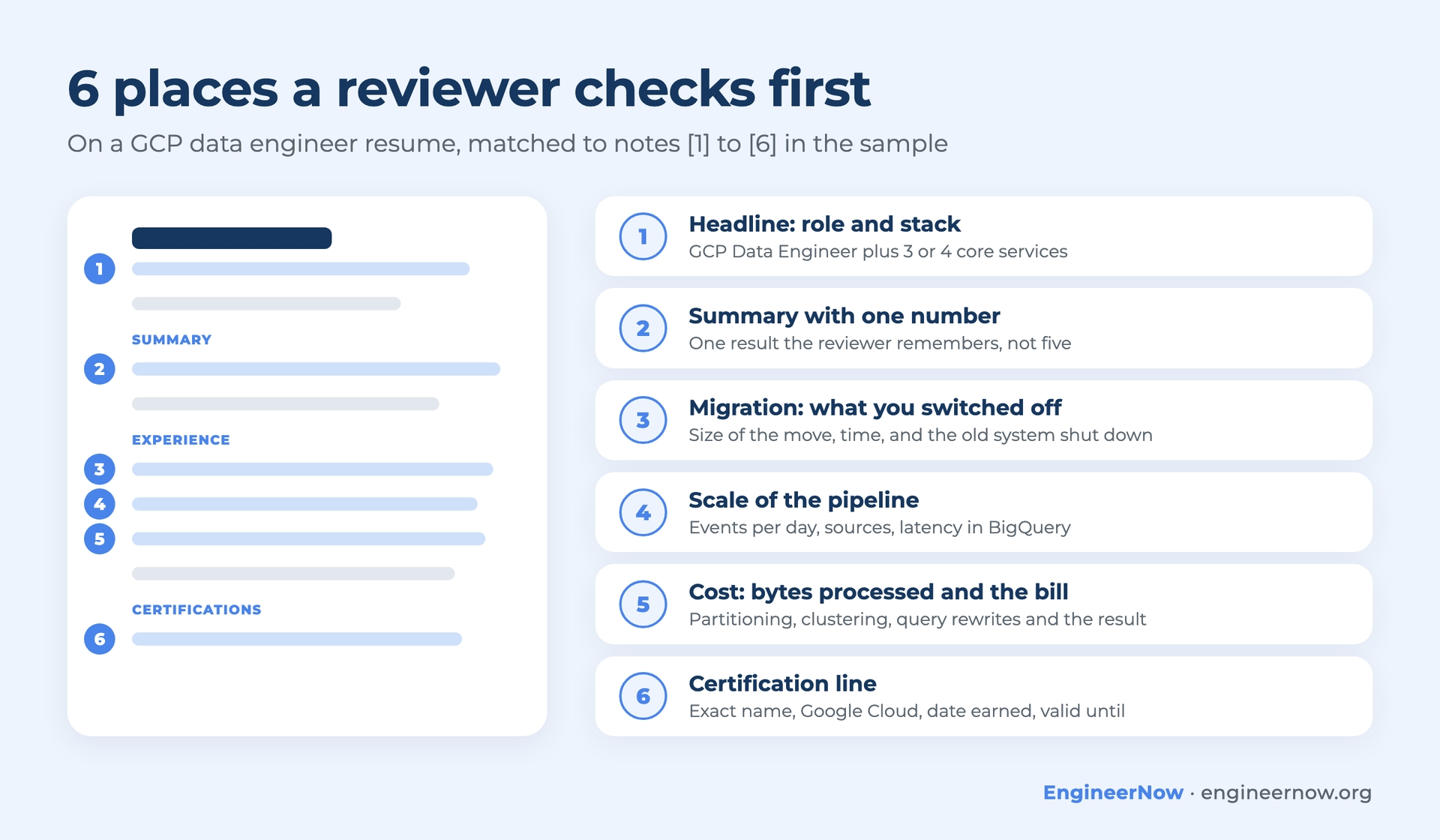
[1] Headline. "GCP Data Engineer" plus three or four services tells a reviewer in two seconds that you belong in the GCP pile. A plain "Data Engineer" makes them search for the cloud.
[2] Summary with one number. One result is enough. Five numbers in a summary read like a sales brochure, and none of them sticks.
One more thing about the first scan. If a recruiter does it, it is often a word match: the service names in the job posting against the words on your page. So use the posting's terms in the headline and Skills, and repeat them in your bullets.
For data engineers, a generic developer resume often falls short here. A developer page lists languages, frameworks and features. A reviewer for a data role wants the data side.
Name the source systems and databases, data volume per day, how fresh the result is and who uses it. That's where your expertise shows.
Notes [3], [4] and [5] sit in the bullets, so they get their own section. Note [6] is the certification line, which comes after that.
How to Write GCP Bullets That Prove Depth
On my own resume, one line says that root cause analysis raised the availability of the main gas compressors at Shell from 68% to 95%. Result first, method second. The same rule works for a BigQuery bullet.
A strong bullet on a Google Cloud data engineer resume has four parts: scale, service, decision and result. "Worked with BigQuery" has none of them. It tells a reviewer you opened the console, not what you did there.
Experience bullet
Worked with BigQuery and Dataflow pipelines. Responsible for data quality and performance.
Wrong
Experience bullet
Partitioned and clustered the [N] largest BigQuery tables and rewrote the top [N] scheduled queries; bytes processed fell by [X%] and monthly query spend by [Y%].
Right
The same fix works for the familiar line "Designed and implemented scalable ETL processes." Any candidate can write it. Swap each vague word for a fact: how many sources, how many rows or TB a day, how long a load runs, and what broke less often after your change. If you can build data pipelines, prove it with those metrics, not with adjectives.
Cost Bullets for BigQuery
For a GCP role, in my opinion, cost is the clearest proof that you understand the platform. With on-demand pricing, Google charges for the bytes a query processes. Its documentation says partitioning can "control costs by reducing the number of bytes read by a query" (BigQuery partitioned tables).
So show the lever and the effect: which tables you partitioned or clustered, how bytes processed changed, and what happened to the bill. That's note [5]. If your company pays for capacity (slots) instead, write about slot usage rather than bytes.
Migration Bullets
A migration bullet needs three things: what you moved, how big it was, and what you switched off at the end. People forget the last part. "Migrated to BigQuery" sounds like a project that might still be running. "Switched off 22 Hive jobs and the cluster" sounds finished. That's note [3].
Note [4] is about scale. Events per day and how fast data lands in BigQuery tell a reviewer the size of the problem you solved. The table below gives a starting line for each core service.
| Service | What the bullet should prove | Starting line (your numbers in brackets) |
|---|---|---|
| BigQuery | Data model, cost control, query speed | Partitioned [N] tables; bytes processed down [X%], spend down [$X] a month |
| Dataflow (Apache Beam) | Batch or streaming at a stated volume | Built a Dataflow pipeline for [N] events a day, latency under [X] min |
| Pub/Sub | Event ingestion, reliability | Ingested [N] events a day from [N] sources through Pub/Sub |
| Cloud Composer (Airflow) | Orchestration, failure handling | Ran [N] DAGs with retries and alerts; failed loads down from [X] to [Y] |
| Dataproc | Spark or Hadoop jobs moved to the cloud | Moved [N] Spark jobs to Dataproc, runtime from [X] to [Y] |
| Cloud Storage | Data lake layout, lifecycle | Set up a [N] TB landing zone with lifecycle rules, storage cost down [X%] |
One more detail. Google is renaming some services. Cloud Composer is becoming Managed Service for Apache Airflow, and Google's own comparison table now lists Dataproc as Managed Service for Apache Spark. Use the name from the job posting, and add the other one once in Skills so both the ATS and the reviewer find it.
What Changes on a Senior GCP Data Engineer Resume
The sample above is a mid-level page. At senior level, the bullets still need scale and results, but a reviewer also looks for decisions. A senior GCP data engineer resume shows why the platform looks the way it does, because a reviewer assumes it runs.
Add lines of four kinds:
- cloud architecture: which design you chose, what you compared it with (for example, streaming in Dataflow or hourly batch loads) and why;
- data security: who can access which datasets, how sensitive fields are protected, and what you reviewed or changed;
- ownership metrics: pipeline uptime, the monthly cloud spend you're responsible for, how many teams use your tables;
- people: engineers you mentored, design reviews you ran, standards the team adopted.
Keep the rule from the bullets: name the decision and show the result. "Owned the data platform" says little. "Chose streaming over hourly batch for order events; report delay fell from [X] hours to [Y] minutes" says a lot.
How to List the Google Cloud Professional Data Engineer Certification
Write the exact name and the issuer, "Professional Data Engineer, Google Cloud", then the date you earned it and the date it expires. "GCP Certified" on its own says nothing, because it doesn't tell a reviewer which exam you passed.
The certification is valid for 2 years, so the dates matter. Mention it twice at most: once in the headline or summary, and once in full under Certifications. That's note [6].
Be ready to prove it. In my own career, I was never asked to show certificates for most short courses, but I was asked for proof of my Chartered Engineer status and my CMRP. Serious employers check professional credentials, so list only what you actually hold.
And remember, the certificate doesn't replace experience. Google itself recommends 3+ years of industry experience, including 1+ years designing and managing solutions on Google Cloud. A reviewer knows that, so your bullets still carry the weight.
Certified but No Production GCP Work Yet?
It happens a lot: you passed the exam, but at work you run on AWS, Azure or on-prem servers. Don't put lab work under a job title. Put it under Projects, label it "Personal project", and add a GitHub link and one number, like events per second or cost per month.
My rule here is simple: if you have zero experience in some software, don't lie about it. You'll be found out at the first technical question. Where the line is: What Can You Lie About in a Resume?.
If your real experience is on another cloud, keep the real service names in your work bullets. Then show that you know the Google Cloud equivalent in your Skills and Projects. Honest transfer reads better than a renamed job. If Azure is your main stack, see the same review for Azure stacks.
The same logic works if your background is data warehousing, ETL, Informatica and on-prem SQL. That experience still counts: data modeling, load logic, data quality. Keep Informatica in the bullets where you really used it. Then add one honest line about using cloud tools, for example a personal project or a work pilot that rebuilt one workflow in Dataflow or Cloud Composer.
Pick a clean layout before you rewrite the bullets. A plain template with clear section names works best for a page like the sample above.


Final Check Before You Send It
Go through your page one more time before you apply:
- every Google Cloud service in Skills appears in at least one bullet with a result;
- the summary has one number, not five;
- the certification line has the exact name, the issuer and both dates;
- personal projects sit under Projects, not under a job;
- you can talk about every service on the page for ten minutes.
That last point is my interviewer's test. Every word on your resume is a possible question, and I've asked plenty of them. If you're applying for a lead role, the page also needs people and decisions, so read our notes on leading a data team.
Then run your resume through our scanner and fix what it flags.

Resume Scanner
AI scanner performs 15 essential checks to ensure your resume is optimized for the jobs you're applying to.
SCAN RESUMEA reviewer doesn't need to know Dataflow better than you. They need to see, in a few seconds, that you used it to get a result. Good luck, friends.
Is the Google Cloud Professional Data Engineer certification worth putting on a resume?
Yes, if you hold it and it's current. It confirms the words in your Skills section. Still, a reviewer weighs it together with your experience, not instead of it. Write the full line under Certifications, add it to the summary if it's a key requirement, and let your bullets prove the rest.
Does the GCP Professional Data Engineer certification expire?
Yes. It's valid for 2 years. Google lets you renew with the standard exam or a shorter renewal exam (1 hour, 20 questions, $100). You can also finish designated courses and skill badges in the last year of your certification. If it has already expired, you take the standard exam again. Write the valid-until date on your resume.
How many Google Cloud services should I list on my resume?
There's no official number. List only the services you can explain in an interview, grouped in one Skills line. Then make sure each core service shows up in at least one bullet with a result. The sample above has six Google Cloud services, and every one of them is backed by a bullet or a project.
Should I mention AWS or Azure on a GCP data engineer resume?
Yes, if it's real experience. Many teams run more than one cloud, and a reviewer sees transferable skills straight away. Don't relabel AWS or Azure work as Google Cloud; the interview will show it. Add your Google Cloud side through Skills, Projects or the certification line.

Written by
Recent Posts

Pub: 09 Sep 2025 - Upd: 25 Jul 2026
14 min. read
Engineering Internship Resume Examples: 5 Samples That Get Hired in 2026
Pub: 18 Sep 2025 - Upd: 01 May 2026
14 min. read
Engineering Student Resume Examples | Samples & Guide to Land Jobs
Pub: 03 Sep 2025 - Upd: 01 May 2026
42 min. read
Manufacturing Engineering Resume: 5+ Real Samples and the Ultimate Writing Guide for 2026