

Published · Updated · 12 min. read
Building Engineer Resume: 5 Numbers a Chief Engineer Reads
A building engineer resume has to prove that the building ran well on your shifts. Show which building systems you operated, how fast work orders closed and how much preventive maintenance got done on time. Add which life safety tests passed and what happened to energy use, and the reader has what they need. Duties without numbers read like the job ad.
I'm a Certified Professional Resume Writer (CPRW) and I've conducted 200+ job interviews from the hiring side. My own background is maintenance and reliability in oil and gas (I'm also a CMRP), not office towers. So the building facts below come from the BLS, the EPA and ENERGY STAR.
Below are five numbers worth counting, a bullet template for each with [brackets] for your own data, the license lines and two short examples.
One more thing: "building engineer" means two jobs. This guide is for the engineer who runs a building after handover. If you design or build them, our structural engineering resume guide is the right one.
That other resume, often written as a CV, lists construction projects including design, site supervision and systems engineering for new buildings. It has a different reader and different numbers.
What Does a Building Engineer Do, and What Does the Resume Have to Show?
A building engineer operates and maintains the systems of a working building: an office tower, a hospital, a campus or a residential high-rise. That means mechanical and electrical systems, plumbing systems and life safety systems. In many buildings the team reports to a chief engineer, with tenants sending in service requests and maintenance requests all day.
There is no single job code for this title. The closest one in the U.S. data is stationary engineers and boiler operators, and O*NET lists Operating Engineer and Stationary Engineer among its job titles (O*NET). It's also the closest public data to a building engineer salary.
The Bureau of Labor Statistics counts about 31,200 jobs in 2025 and a median pay of $78,620 in May 2025. It projects about 3,200 openings a year and 3% growth from 2025 to 2035 (BLS). Entry is usually a high school diploma plus long-term on-the-job training. Hospitals employ 18% of these engineers and educational services 16%.
BLS also lists what the job leaves behind: logs of operation, maintenance and safety work, and routine checks of safety devices. That's your raw material.
So who reads the resume? A chief engineer, or a manager from property management. They look at the top of the page for the building type, its size, the systems and your license. If you want a wider view of the field first, here's what maintenance engineering involves.
Five Numbers That Belong on a Building Engineer Resume
Most building engineer resume examples online list duties: "maintained HVAC systems", "performed routine maintenance", "responded to tenant requests". Every candidate did that. The difference is in the numbers, and a building gives you plenty of them because almost everything goes through a work order system or a CMMS.
Resume bullet
Responsible for maintenance of HVAC, plumbing and electrical systems and responding to tenant requests.
Wrong
Resume bullet
Closed [N] tenant work orders a month across HVAC, plumbing and electrical, with an average response time of [N] minutes and [N]% done on the first visit.
Right
The table below gives one template for each of the five numbers.
| Number | What to count | Bullet template |
|---|---|---|
| 1. Building and systems | Square feet, floors, tons of cooling, boilers, chillers, cooling towers, air handling units, the BMS platform | Operated [N] chillers ([N] tons), [N] boilers and [N] air handlers in a [N] sq ft, [N]-floor [office / hospital] building |
| 2. Work orders | Work orders a month, average response and close time, repeat calls | Closed [N] work orders a month with an average response time of [N] minutes; cut repeat calls on [system] from [N] to [N] |
| 3. Preventive maintenance | PM tasks completed on time, in percent; equipment moved from run-to-failure to a schedule | Raised on-time preventive maintenance from [X]% to [Y]% in [N] months by [what you changed] |
| 4. Life safety tests | Generator, fire pump, fire alarm and sprinkler tests: how many, with what result | Ran [N] monthly generator load tests and [N] fire pump tests; [N] inspections closed with no findings |
| 5. Energy | ENERGY STAR score before and after, kWh or therms, what you changed in the BMS | Reset BMS schedules and setpoints on [N] air handlers; ENERGY STAR score from [X] to [Y] in [N] months |
One strong line is one system, one action and one number. You don't need all five numbers. Three or four that you really own are enough, and you can explain each one when the chief engineer asks how you counted it. If a number came from the work order system, say so in the interview. It sounds like someone who kept accurate records, because you did.
The same rule works for a building maintenance engineer resume and for the work experience section of any role in building operations. The titles differ by employer, the proof doesn't. Before you send it, check that the words in your bullets match the job posting: one employer writes BMS, another BAS, a third building automation.

Resume Scanner
AI scanner performs 15 essential checks to ensure your resume is optimized for the jobs you're applying to.
SCAN RESUMEBMS, Energy and ENERGY STAR on a Resume
"BMS" in a skills list says almost nothing. Building management systems and building automation systems are where a building engineer changes something, so write the platform you used and what you changed in it: schedules, setpoints, alarms, trends. A line like "rebuilt alarm priorities on [N] points, cutting nuisance alarms by [X]%" shows control systems work that a recruiter and a chief engineer both understand.
Energy management is the other place for numbers. For eligible property types, the EPA's ENERGY STAR score runs from 1 to 100 and compares a building with others of the same primary use across the country. A score of 50 is median energy performance, and 75 or higher marks a top performer that may be eligible for ENERGY STAR certification. The score comes from benchmarking in Portfolio Manager (ENERGY STAR).
Write "score from [X] to [Y]" only if you really moved it, and add what you did. If the building's energy belongs to a manager above you, write your part: the schedule you changed, the leak you found, the meter data you collected. If you design HVAC systems rather than run them, our HVAC engineer resume guide fits you better.
Stationary Engineer License, EPA 608 and BOC: How to List Them
BLS notes that many employers ask for licenses or company exams, so put yours near the top. Three are worth knowing in the US.
- EPA Section 608. Technicians who maintain, service, repair or dispose of equipment that could release refrigerants must be certified (EPA). There are four types: Type I for small appliances, Type II for high and very high pressure appliances, Type III for low pressure appliances and Universal for all of them. The credential does not expire.
- Stationary engineer license. Some state and local governments require one. Applicants usually have to meet experience requirements and pass a written exam (BLS). Check the rules of your state and city, and write the license exactly as it's named there.
- Building Operator Certification (BOC). A training and certification program for building engineers and maintenance personnel, run by the Smart Buildings Center Education Program in partnership with Building Potential (BOC).
If a stationary engineer resume has the license buried on page two, it may never get read. Put it in the header or right under the summary.
These three are United States credentials. If you work in another country, list the licenses and permits your country uses, with the same details.
Education goes below the licenses. A trade program, an HVAC certificate or a degree all count. For this job, the chief engineer cares more about your license than whether you studied at a community college or at Harvard University.
From Assistant to Chief Engineer: How the Resume Changes by Level
The building stays the same as you move up. The evidence changes.
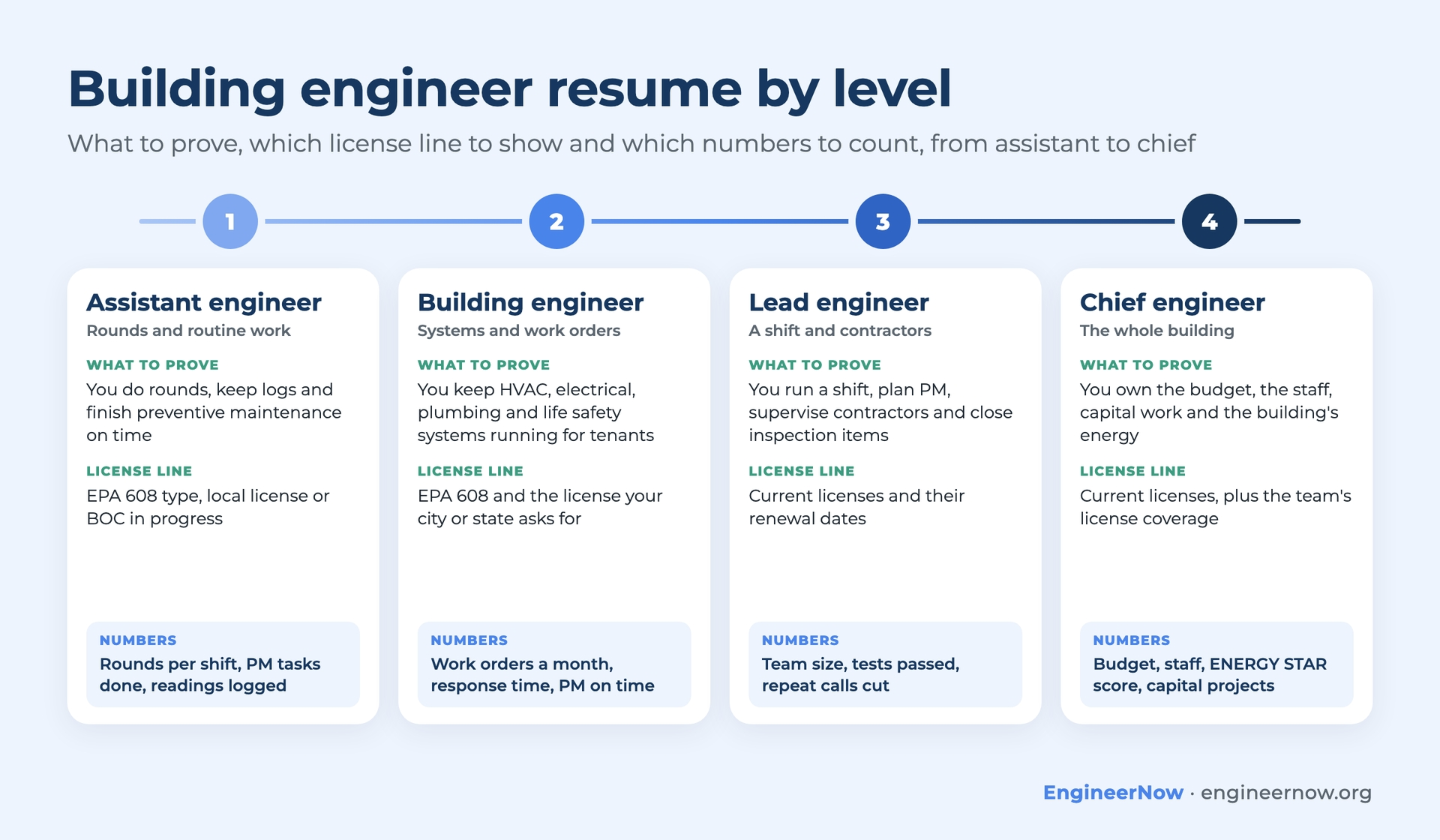
An assistant or junior engineer proves rounds, logs and PM done on time, with a license in progress. A building engineer proves systems and work orders. A lead engineer adds a shift, contractors and vendors, and inspection items closed. A chief engineer resume talks about the budget, the maintenance staff, capital work and the building's energy, because that's what the chief answers for to the owner.
So if you apply for an assistant chief engineer job, add one or two lines that already sound like the next step. A contractor you supervised, a budget line you tracked or a training you ran for the team will do.
At the top, the chief engineer's job is closer to engineering management than to repairs. Show engineering leadership with facts: the department or team you ran, the budget and the contractors. A senior engineer applying for that role should also write about the people they trained, next to the systems they fixed.
Building Engineer Resume Examples
Here are two short building engineer resume samples: an assistant engineer early in the career and an engineer who's ready for a lead or chief role. Both are made up, so copy the layout and put your own building's numbers in.
Fictional example: made-up company and numbers. Assistant building engineer.
Summary: Assistant building engineer with 2 years in a 20-floor office building after an HVAC technician program. Does rounds, keeps equipment logs and completes preventive maintenance on chillers, pumps and air handlers. EPA Section 608 Universal.
- Completed 95% of assigned PM tasks on time over 12 months, tracked in the CMMS.
- Logged readings on 2 chillers and 3 cooling towers every shift; flagged a bearing temperature rise that led to a planned pump repair.
- Assisted on 12 monthly generator load tests and the annual fire alarm test.
Fictional example: made-up company and numbers. Building engineer moving to lead.
Summary: Building engineer with 7 years of experience in a 600,000 sq ft hospital and a 30-floor office tower. Runs HVAC, electrical and plumbing systems, supervises contractors on nights and owns the BMS schedules. EPA Section 608 Universal, stationary engineer license ([city or state]).
Skills: BMS schedules and alarms, chiller and boiler operation, PM in a CMMS, generator and fire pump testing.
- Closed 140 work orders a month with an average response time of 20 minutes; cut repeat hot and cold calls by a third.
- Raised on-time preventive maintenance from 78% to 94% by moving 40 assets from run-to-failure to a schedule.
- Reset BMS schedules on 18 air handling units; the ENERGY STAR score went from 61 to 74 in 14 months.
Neither sample lists soft skills, and each resume summary fits in three lines. The numbers show teamwork, care and reliability better than adjectives do. Put them into a clean template where they're easy to scan.
List your skills in one short line under the summary, the way the second sample does: platforms, equipment and tests, not adjectives.


Show the building, the systems and the numbers, and your resume reads like proof, not like the job ad. Good luck, friends.
Is a building engineer the same as a facilities engineer?
Often the jobs overlap, but the focus differs. A building engineer usually runs one building and its systems shift by shift. A facilities engineer more often looks after a site or campus and spends more time on planning and projects. If the posting leans that way, see our facilities engineer resume guide.
Do you need a license to be a building engineer?
It depends on where you work. BLS says some state and local governments require licensure for stationary engineers, usually with experience requirements and a written exam. Separately, EPA Section 608 certification is required if you service or dispose of equipment that could release refrigerants. Check your state and city rules, then list what you hold near the top.
What's the difference between BMS and BAS on a resume?
In many job postings the two mean the same thing: the system that controls and monitors HVAC, lighting and other building equipment. Use the term the posting uses, add the other once, and name the platform you worked on. What matters more is the change you made in it, such as schedules, setpoints or alarm cleanup.
How do I write a building engineer resume with no experience?
Start with what you can prove: an HVAC or technician program, an apprenticeship, internship rounds, PM tasks you did under supervision, and EPA Section 608 if you passed it. BLS notes that most people in this field learn on the job, so employers expect training, not years. Don't invent percentages; real small numbers read better.

Written by
Recent Posts

Pub: 18 Sep 2025 - Upd: 01 May 2026
14 min. read
Engineering Student Resume Examples | Samples & Guide to Land Jobs
Pub: 11 Oct 2025 - Upd: 28 Oct 2026
13 min. read
Big Data Engineer Resume: 5 Bullet Examples That Prove Scale
Pub: 12 Sep 2025 - Upd: 21 Oct 2026
13 min. read
GCP Data Engineer Resume: One Sample and Six Reviewer Notes
Pub: 12 Oct 2025 - Upd: 01 May 2026
27 min. read
Structural Engineering Resume Examples: Complete Guide for 2026