

Published · Updated · 13 min. read
Big Data Engineer Resume: 5 Bullet Examples That Prove Scale
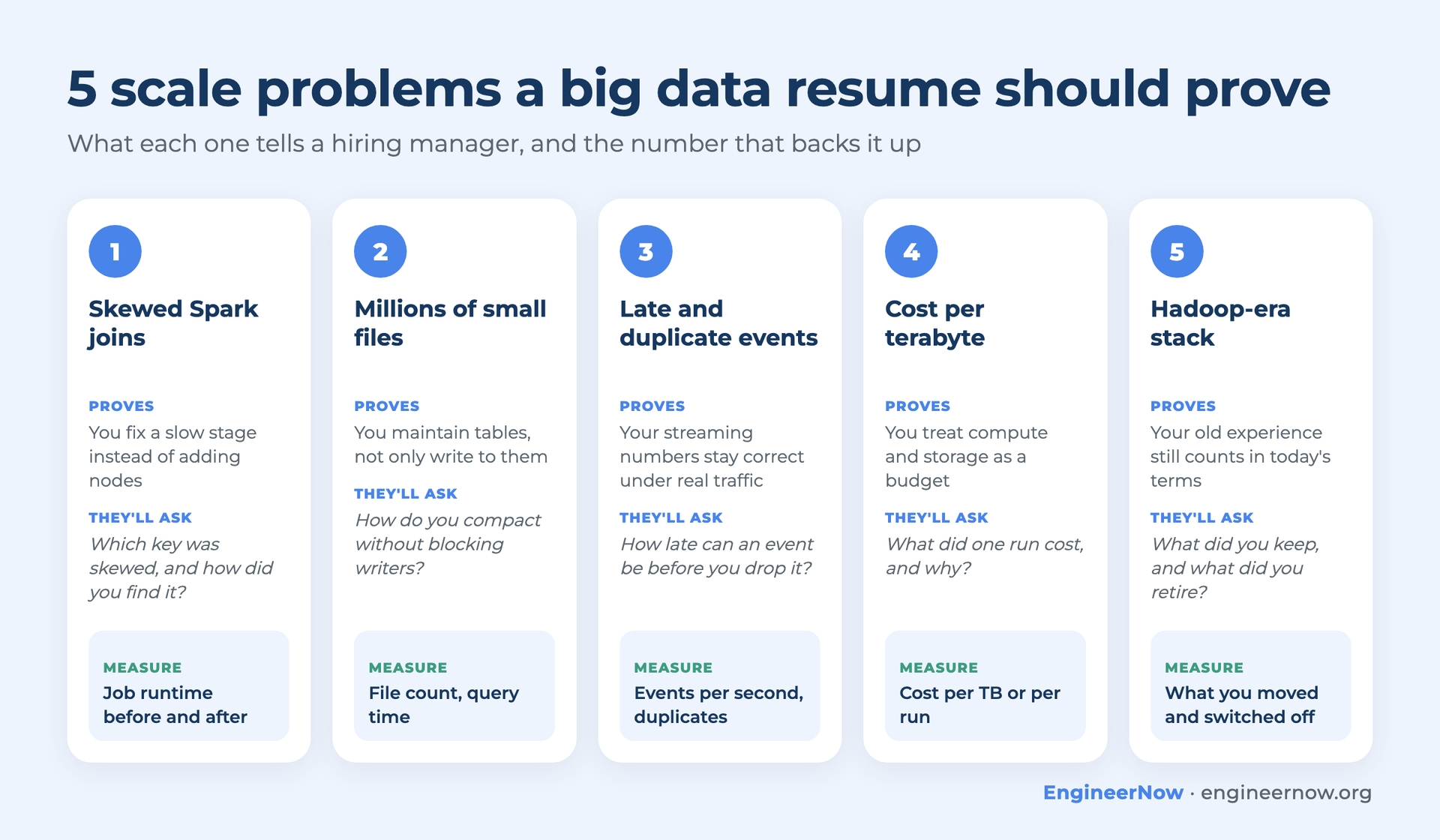
A big data engineer resume has one job: prove you've handled scale, not just tools. Show the problems that only appear at volume: skewed Spark joins, millions of small files, late events in a stream and runaway compute cost. Then give each one a number.
Almost every candidate lists Spark, Kafka and Hadoop. Recruiters and hiring managers can't tell from that list who ran a cluster and who finished a course. To me, a bare tool list reads as a question, not an answer. I've conducted 200+ job interviews from the hiring side and I'm a Certified Professional Resume Writer (CPRW).
Below are five scale problems, a bullet template for each and one fictional example. Fill the [brackets] with your own data.
What Makes a Big Data Engineer Resume Different
A data engineer resume shows that you build data pipelines and ETL processes. A big data resume shows what happened to them when the volume grew: large-scale data processing, data storage and data quality under load. That difference lives in your work experience bullets, not in the skills section. Years of experience and a list of big data technologies don't prove it.
Four numbers tell a reader the size of your work:
- volume: GB or TB a day, rows in the largest datasets;
- speed: events per second in a stream;
- latency: how long data takes from source to report;
- cost: what one run, one TB or one month of the platform costs.
You don't need all four in every line. One per bullet is enough, and it has to be a number you can explain. If most of your proof still comes from projects, our guide to the entry-level data engineer page fits you better.
Keep the job description open while you write. If the posting says Databricks, Delta Lake or Kafka, use those exact words in the bullets where they're true.
#1 Skewed Joins and Slow Spark Jobs
Data skew is the classic big data problem: a few keys hold most of the rows, so a few tasks run for hours while the rest of the cluster waits. Apache Spark's documentation says skew "can severely downgrade the performance of join queries" (Spark performance tuning).
Adaptive Query Execution has been enabled by default since Spark 3.2.0, and its skew join feature splits skewed tasks in a sort-merge join on its own. So "enabled AQE" is not an achievement in 2026. Show what you did beyond the defaults: broadcasting a small table, salting a hot key, changing the partitioning, or rewriting the query. Then show the processing time before and after.
Template: Fixed data skew in [job] processing [volume] a day by [what you changed]; runtime fell from [X] to [Y] and [who] got the data [how much] earlier.
Fictional example: made-up company and numbers. Fixed a skewed join in a retailer's sales job (2 TB a day) by broadcasting the store table and salting hot keys; runtime fell from 3 hours to 40 minutes.
This one works for a Spark developer resume and a PySpark resume the same way. The tool name matters less than the stage you fixed.
#2 Millions of Small Files
Small files are a quiet scale problem. Each streaming micro-batch or hourly data ingestion load writes new files, and after a year a table can hold millions of them. Queries slow down, and nobody changed the code.
The Apache Iceberg docs explain why: small files add metadata and cause "less efficient queries from file open costs". Iceberg compacts them with the `rewriteDataFiles` action and recommends expiring old snapshots regularly (Iceberg maintenance). Delta Lake has `OPTIMIZE`, which coalesces small files into larger ones to speed up reads.
A bullet here proves you maintain storage and tables, not just write to them. Many candidates have built a data lake. Fewer have kept one fast in its second year.
Template: Set up [compaction / OPTIMIZE / snapshot expiry] for [N] tables in [Iceberg / Delta Lake]; files per table fell from [X] to [Y] and query time from [X] to [Y].
Fictional example: made-up company and numbers. Scheduled nightly compaction for 40 streaming-fed Iceberg tables at a logistics company; the largest went from 3 million files to 60,000, dashboard queries from 90 to 12 seconds.
#3 Late and Duplicate Events in Streaming
Real-time data arrives late, out of order and sometimes twice. A phone loses signal, a producer retries, a consumer restarts. If your pipeline counts each event once and on time for analysts, that's a skill worth a bullet.
The tools have names, and interviewers will ask about them. In Spark Structured Streaming, a watermark sets "the threshold on how late the data is expected to be"; data within it is still aggregated, and later data may be dropped. `dropDuplicatesWithinWatermark` removes repeated events by a unique ID within the watermark's time range (Structured Streaming guide). In Apache Kafka, the idempotent producer makes sure a resend doesn't create duplicate entries in the log. Transactions write to several partitions so that either all messages land or none do (Kafka design).
Write "exactly-once" only if you can explain how you got it. Spark's own sink table lists the Kafka sink as at-least-once, so the answer is usually idempotent writes or deduplication, not a checkbox.
Template: Built a [Kafka / Spark / Flink] streaming pipeline for [N] events per second with a [X]-minute watermark and dedup by [key]; duplicates in reports fell from [X] to [Y].
Fictional example: made-up company and numbers. Built a Kafka and Spark pipeline for 15,000 payment events per second with a 10-minute watermark and ID-based dedup; duplicate payments in reports fell from about 300 to zero.
#4 Cost per Terabyte Processed
At small volume, nobody looks at the bill. At big data volume, cost becomes a design limit. Databricks lists "Cost & Performance Optimisation" as 13% of its Data Engineer Professional exam (exam guide), so the vendors treat it as a core skill too.
Pick the unit your company already watches: cost per TB scanned, per pipeline run or per month for the platform. Query engines that bill by data scanned, like Amazon Athena or BigQuery on-demand, make it easy. Columnar formats like Parquet, partitioning and compression lower the bytes read, and the bill drops with them.
On cloud platforms, cluster cost moves with autoscaling, instance types and how long jobs run. For senior roles, a savings figure shows cost optimization and efficiency, not just code. The GCP review has more on cost bullets for BigQuery.
Template: Cut the cost of [pipeline / platform] from [X] to [Y] per [TB / run / month] by [what you changed], with no loss in [freshness / SLA].
Fictional example: made-up company and numbers. Moved raw clickstream at a media company from JSON to partitioned Parquet; data scanned per daily report fell by 85% and monthly query cost from $9,000 to $1,600.
No exact figure? Write the share ("by about a third") and be ready to say how you measured it.
#5 Your Resume Still Speaks Hadoop
Plenty of strong engineers spent years on the Hadoop ecosystem: HDFS, MapReduce, Hive, Pig, Sqoop, Oozie and YARN on a Hadoop cluster, with HBase as the NoSQL database. That experience is real. The problem is the wording. A hadoop developer resume from 2016 lists tools, and today's reader wants outcomes on today's stack.
Some of those tools are gone. Apache Sqoop was retired in June 2021 and moved to the Apache Attic. So keep the old names in your history, but lead each line with the problem, the volume and the result.
| Hadoop-era line | How to write it now |
|---|---|
| Wrote MapReduce jobs in Java | Built [N] batch jobs for [purpose] on [N] TB; rewrote [N] of them in Spark, runtime from [X] to [Y] |
| Imported data from Oracle to HDFS with Sqoop | Ingested [N] tables from Oracle into the data lake, [N] GB a day; Sqoop goes under legacy skills |
| Wrote Pig and Hive scripts | Built [N] Hive or Spark SQL transformations behind [report or model]; refresh from [X] to [Y] |
| Scheduled jobs in Oozie | Kept [N] daily Oozie workflows on schedule, missed SLAs from [X] to [Y] a month, then moved them to [Airflow / other] |
| Administered a Cloudera cluster | Ran a [N]-node cluster with [N] TB; kept [SLA]; planned the move to [cloud platform] |
| Tuned YARN and HDFS settings | Cut queue wait for [team] from [X] to [Y] by changing [setting] |
| Wrote shell scripts to run Hive jobs | Moved [N] cron shell scripts to [Airflow] DAGs; failed runs from [X] to [Y] a month |
The strongest Hadoop line today is often the move off it: the terabytes, the jobs you rewrote and the month the old cluster was shut down. A move from an on-prem cluster to Amazon Web Services, Azure or Google Cloud shows both stacks in one bullet. Hadoop experience still counts where part of the data lives on-prem.
Turn Each Problem Into One Bullet You Can Defend
You don't need all five problems. Two or three bullet points, written well, beat a page of Hadoop, Spark, Kafka, Hive, Scala, Python and SQL with nothing behind them. Put the strongest one first under your latest job, then repeat the key tools in a short technical skills line so the ATS finds them. Add one number to your resume summary as well.
Fictional example: made-up company and numbers. One job, three bullets and a skills line.
Senior Data Engineer, online retailer, 2022 to present
- Fixed a skewed join in the daily sales job (2 TB a day) by broadcasting the store table and salting hot keys; runtime fell from 3 hours to 40 minutes.
- Scheduled nightly compaction for 40 streaming-fed Iceberg order tables; the largest went from 3 million files to 60,000, dashboard queries from 90 to 12 seconds.
- Moved raw clickstream from JSON to partitioned Parquet; data scanned per daily report fell by 85% and monthly query cost from $9,000 to $1,600.
Technical skills: Apache Spark (PySpark), Spark SQL, Kafka, Apache Iceberg, Delta Lake, Hive, HDFS, Airflow, AWS (S3, EMR, Athena), Python, SQL, Scala
In that skills line, keep programming languages (Python, SQL, Scala) apart from frameworks, as the sample does at the end.
In my current engineering work, I use AI tools and equipment data, such as oil analysis results, to assess machine condition. From the user's side, a pipeline is only as good as the data it delivers on time.
So add who used your data and what changed for them: analysts, a machine learning model, a maintenance team. A bullet with scale and a user is complete. Monitoring, alerts and reducing failed runs belong here too, because users notice them first.
Fictional example: made-up company and numbers. Three bullets that name the user.
- Developed data ingestion jobs using Python for 30 source systems; the data management team now sees every new table in the catalog within a day.
- Designed and implemented data quality checks on 400 GB of daily clickstream data using Spark, a quality assurance step that cut bad rows in the data analytics team's daily reports from 2% to 0.1%.
- Rewrote 12 Hive jobs in Spark using Scala; the finance team got month-end numbers a day earlier.
Every number on your resume becomes an interview question. Round it if you must, but never invent it.
Where the line sits between rounding and lying is covered in what you can and can't stretch on a resume. If you lead a platform team, your page also needs people and decisions, so read our notes on the lead data engineer resume.
Our achievement generator turns a task and a number into a clean bullet. Start with the problem you know best.

Then pick a plain, single-column layout so the bullets carry the page.


What's the difference between a data engineer resume and a big data engineer resume?
The sections are the same. The proof is different. A data engineer resume can win with clean pipelines, transformation workflows and good data modeling. A big data one has to show scalable, distributed processing at volume: partitions, shuffles, streaming state, file layout and cost. If none of your bullets would change at ten times the data, the page reads as general data engineering.
What if the data I worked with wasn't really big?
Don't call it big data. Write the real volume and show where the work was distributed or growing. "50 GB a day, built to handle five times that" is honest and still says a lot. Inflated terabytes fall apart at the first follow-up question, and the rest of your page loses trust with them.
Which certifications fit a big data engineer resume now?
Look at current ones. Databricks Certified Data Engineer Professional has 59 scored questions, 120 minutes, a $200 fee and 2-year validity. AWS Certified Data Engineer Associate has 65 questions, 130 minutes, costs $150 and is valid for 3 years. Microsoft retired the Azure Data Engineer Associate (DP-203) on March 31, 2025 (Microsoft Learn), so don't list it as active. Microsoft's current data engineering certification is Fabric Data Engineer Associate (DP-700).
Should I write Spark or PySpark on my resume?
Write both if you used the Python API: "Apache Spark (PySpark)". Job postings use either word, and ATS keyword matching is literal. Then show the Spark work in a bullet with a volume or runtime, and mention the architecture or infrastructure only if you shaped it. Listing Scala or Java with Spark makes sense only if you wrote production code in them.
Can a business analyst write a big data engineer resume?
Yes, if the page shows engineering work. Business analyst resumes often stop at SQL and dashboards. Add the pipeline side: a job you scheduled, a table you modeled, the volume it handled. One true bullet with a real number beats a list of new tools.

Written by
Recent Posts


Pub: 12 Oct 2025 - Upd: 01 May 2026
27 min. read
Structural Engineering Resume Examples: Complete Guide for 2026
Pub: 18 Sep 2025 - Upd: 01 May 2026
14 min. read
Engineering Student Resume Examples | Samples & Guide to Land Jobs
Pub: 29 Oct 2025 - Upd: 11 May 2026
20 min. read
Engineering Cover Letter Examples: Complete Guide for 2026!