Published · Updated · 11 min. read
Wind Turbine Technician Resume: What Gets You Up the Tower
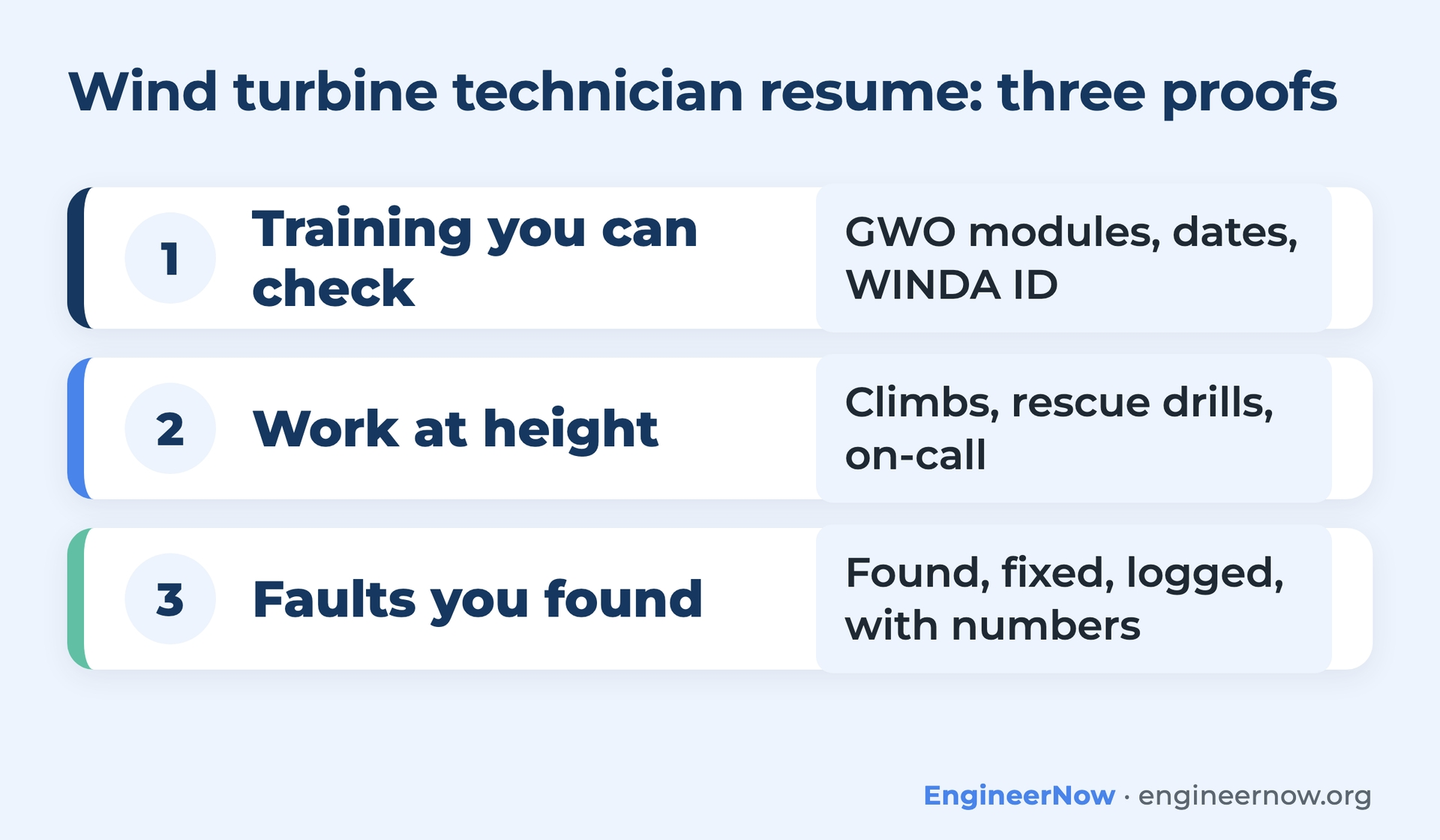
A wind turbine technician resume has to prove three things fast. Your safety training is current and can be checked, you can work at height, and you find faults instead of just following a checklist. Most windtech resumes list "GWO" and a column of duties, and stop there.
I'm a Certified Professional Resume Writer and a CMRP (Certified Maintenance and Reliability Professional), with 200+ interviews as the interviewer behind me. Let's be honest from the start: I've never worked on wind turbines.
I'm a rotating equipment engineer in oil and gas. At Shell I set up condition-based maintenance, vibration and lubrication programs, and later headed a field mechanical maintenance department of 50+ engineers, technicians and fitters. Every wind fact here is taken from the BLS, O*NET, GWO and OSHA pages. The view on what makes a maintenance record useful is mine.
What a site lead looks for in a wind turbine technician resume
Your resume usually lands with a hiring manager who is also a site supervisor, a lead technician or a maintenance engineer. BLS says 42% of these technicians work in wind electric power generation, and another 12% in commercial and industrial machinery repair and maintenance. So the reader is often an operator's operations team or a service contractor. Both read the same way: can this person climb, work safely and fix my turbines?
The BLS describes the work environment plainly: outdoors, in confined spaces and at great heights. Its list of important qualities answers part of the question. You must be able to work at heights, and physical strength matters, because you lift equipment, parts and tools, some of them 50 pounds or more. Most work is full time, with possible evening or weekend on-call duty. Offshore work may keep you away from home for several days or weeks at a time.
On a wind technician resume, put your ability to climb next to the training that backs it up, not in a list of adjectives.
So three proofs go to the top of the page: training, height and faults. Everything in our technician resume guide holds here too. Below is only the part that's different on a wind farm.
How to list GWO training so an employer can check it
BLS says certification isn't mandatory, but it lets you show a level of knowledge and competence, in subjects like workplace electrical safety, tower climbing and self-rescue. When a posting asks for Global Wind Organisation (GWO) training, it means specific modules. Writing "GWO certified" is the weak version. Write each module, the year and where the record lives.
Since no certificate is required by BLS, include only the modules you hold, and put the ones most relevant to the posting first.
| Training | What it covers | How to write it |
|---|---|---|
| GWO Basic Safety Training (BST) | First Aid, Manual Handling, Fire Awareness, Working at Height; Sea Survival for offshore | One line per module with the year; add the refresher year |
| GWO Basic Technical Training (BTT) | Mechanical, Electrical, Hydraulic, Bolt Tightening, Installation Mechanical, Installation Electrical, Hazardous Energies Basic Safety | List only the modules you hold |
| GWO Advanced Rescue Training (ART) | Hub, spinner and inside blade rescue; nacelle, tower and basement rescue | Name the module, not just "ART" |
| WINDA ID | Your record in GWO's training database | "WINDA ID available on request" in the training section |
| OSHA 10 or OSHA 30 | Outreach safety course | "OSHA 10-hour course completion card", under training |
The WINDA ID is the part most resumes miss. GWO describes it as "a unique, random and system generated number", and you give it to your training provider before the course and to employers when they ask (GWO). Employers use WINDA to verify your current training status. GWO also says a printout of your records is not valid as a certificate, so don't attach one and call it that.
The rule worth keeping: if a site lead can't check it in WINDA or on a card, it doesn't go under certifications.
Be careful with the word "certified". BTT courses, in GWO's own words, "will not make the participant a trained person" allowed to do that work without supervision. So write "BTT Mechanical, 2024", not "certified mechanical technician".
OSHA is clear too: none of its Outreach courses is a certification. You get a course completion card for the 10-hour or 30-hour course (OSHA). An honest training section is easy for a site lead to verify. So is a padded one.
Write what you found, not what you did
Here's where most wind turbine technician resume examples go wrong. They copy the job description: performed maintenance and repair, did troubleshooting and repair of electrical and hydraulic systems, climbed turbine towers. That's wind turbine maintenance as every technician on the site did it. O*NET even lists "collect turbine data for testing or research and analysis" among its tasks. The data you collected and what came out of it is your real work history.
From the field
In my view, a gearbox or a main bearing doesn't care whether it sits in a nacelle or on a compressor skid. A note that says what was found, a hot bearing, metal on a magnetic plug, a rising vibration trend, gives the engineer something to act on. "Performed preventive maintenance" doesn't. In one of my roles, gear pumps kept breaking down within about three months. A detailed investigation found the real cause, and MTBF reached 5 years. In my view, an investigation like that starts with what people on the job wrote down.
If you already work on turbines
Turn each duty into a finding with a number. Borrow the wording of the job ad: SCADA, CMMS, pitch system, yaw, converter, torque checks. O*NET uses the same terms for software and variable pitch systems. Here are some templates, with [brackets] for your own data.
- "Completed [N] scheduled inspections a quarter; logged [N] defects (leading edge erosion, loose bolts, oil leaks) and closed [N]% before the next service."
- "Diagnosed [N] variable pitch, yaw and control system faults a month from SCADA alarms and diagnostic software; repeat faults on my turbines down from [N] to [N] a quarter."
- "Took oil samples on [N] gearboxes a year; [N] findings went to engineering and became planned corrective work."
- "Did torque and tension checks on [N] bolted joints per service with zero rework, in line with site safety standards."
- "Flagged a rising generator bearing temperature on [N] turbines, and the bearing was changed in a planned stop."
If you did commissioning or installation work, give it its own line: [N] turbines commissioned, [N] main components replaced with a rigging crew. If you switch high voltage or work in the substation, say which voltage level and under whose procedures. Write the platform as "[N] MW onshore platform" unless the posting names a model you know. And keep the safety record honest: "[N] years without a recordable incident" only if it's true.
If you're coming from another trade
Most people start without wind energy experience. BLS says the typical entry route is a postsecondary nondegree award, then long-term on-the-job training from the employer or manufacturer. O*NET shows 34% of new workers with a post-secondary certificate and 29% with a high school diploma, and it lists "Wind Turbine Technician" as a registered apprenticeship title.
So for an entry level wind turbine technician, lead with what carries over. Industrial maintenance, electrical work, the military or heavy equipment all give you lockout/tagout, hydraulics, reading drawings and schematics, routine maintenance activities and working by procedure. Open with a resume summary, not a vague resume objective, that names your trade and the GWO modules you hold. Then put that related experience in your work experience section, and your wind course under education. If you're still choosing between solar and wind, our solar installer resume guide covers the other side.
If you're still in a program, such as an apprenticeship or a college course, include the start date and the modules finished so far.
Try the tool below on your own duty lines.

Wind turbine technician resume example
Below is a full wind turbine technician resume sample: a Wind Turbine Technician II with four years on an onshore wind farm, after two years as an industrial maintenance mechanic. Fictional example: made-up name, company, site and numbers. Copy the structure, not the numbers. In Europe the same document is usually called a CV, and the rules don't change.
Look at the order: GWO modules and the WINDA line sit in the header, the summary names the turbine size and the job, and the achievements are findings with counts. The skills list stays short and technical: preventive maintenance, pitch and yaw troubleshooting, SCADA, CMMS, torque checks, LOTO, climbing and rescue. Those are the skills a wind turbine technician needs, so match them to the posting's wording.
The second common case is a career change. Here's a short summary for an industrial mechanic moving into wind.
Fictional example: made-up name and numbers. Industrial maintenance mechanic moving into wind.
Summary: Industrial maintenance mechanic with 5 years on pumps, gearboxes and hydraulic presses in a food plant. Changes bearings and seals, follows LOTO on every job and keeps lubrication routes on schedule. Completed GWO BST (First Aid, Manual Handling, Fire Awareness, Working at Height) and BTT Mechanical and Hydraulic in 2026; WINDA ID available on request. Comfortable at height and on-call.
A site lead can check every line of it.


So: training you can check, height you can prove and faults you found. Get those three on the first page and the rest is detail. Good luck, friends.
What does a wind turbine technician do?
Wind turbine technicians (O*NET calls them wind turbine service technicians) do routine maintenance and repair of wind turbine generators. They climb turbine towers more than 200 feet tall, test and troubleshoot electrical, mechanical and hydraulic systems, replace worn wind turbine components and collect turbine data. BLS counts 11,800 jobs in 2025, with 30% projected growth from 2025 to 2035, number 4 on its list of fastest-growing occupations.
What qualifications do you need to work on a wind turbine?
BLS says most wind turbine technicians enter with a postsecondary nondegree award, such as a certificate. Then they get long-term training on the job from the employer or manufacturer. Certification isn't mandatory, but employers often ask for safety training such as GWO modules. I'd also show early that you're comfortable at height, because a site lead checks that first.
Is it hard to get a job as a wind turbine technician?
It's a small field: about 1,500 openings a year across the whole country, by the BLS estimate. So the competition is real, especially for entry level roles near home. Being open to travel, on-call work or offshore helps, and so does a resume that shows checkable training instead of a vague "GWO certified".
How much does a wind turbine technician make?
The BLS median was $64,120 a year in May 2025. The bottom 10% earned under $49,230 and the top 10% over $92,460. By industry, the median was $65,000 in wind electric power generation and $70,670 in commercial and industrial machinery repair and maintenance. Your own pay depends on the site, travel and overtime.
Can a wind turbine technician become a maintenance or reliability engineer?
In my opinion, yes, and your field records are the bridge. Technicians who log findings and trends already think like a reliability engineer. The usual next steps are a lead technician role, then planning or engineering, often with a degree along the way. See what a maintenance engineer does and my guide to the reliability engineer role.

Written by
Recent Posts