Published · Updated · 11 min. read
Engineering Career Paths: Expert, Manager or Business Owner
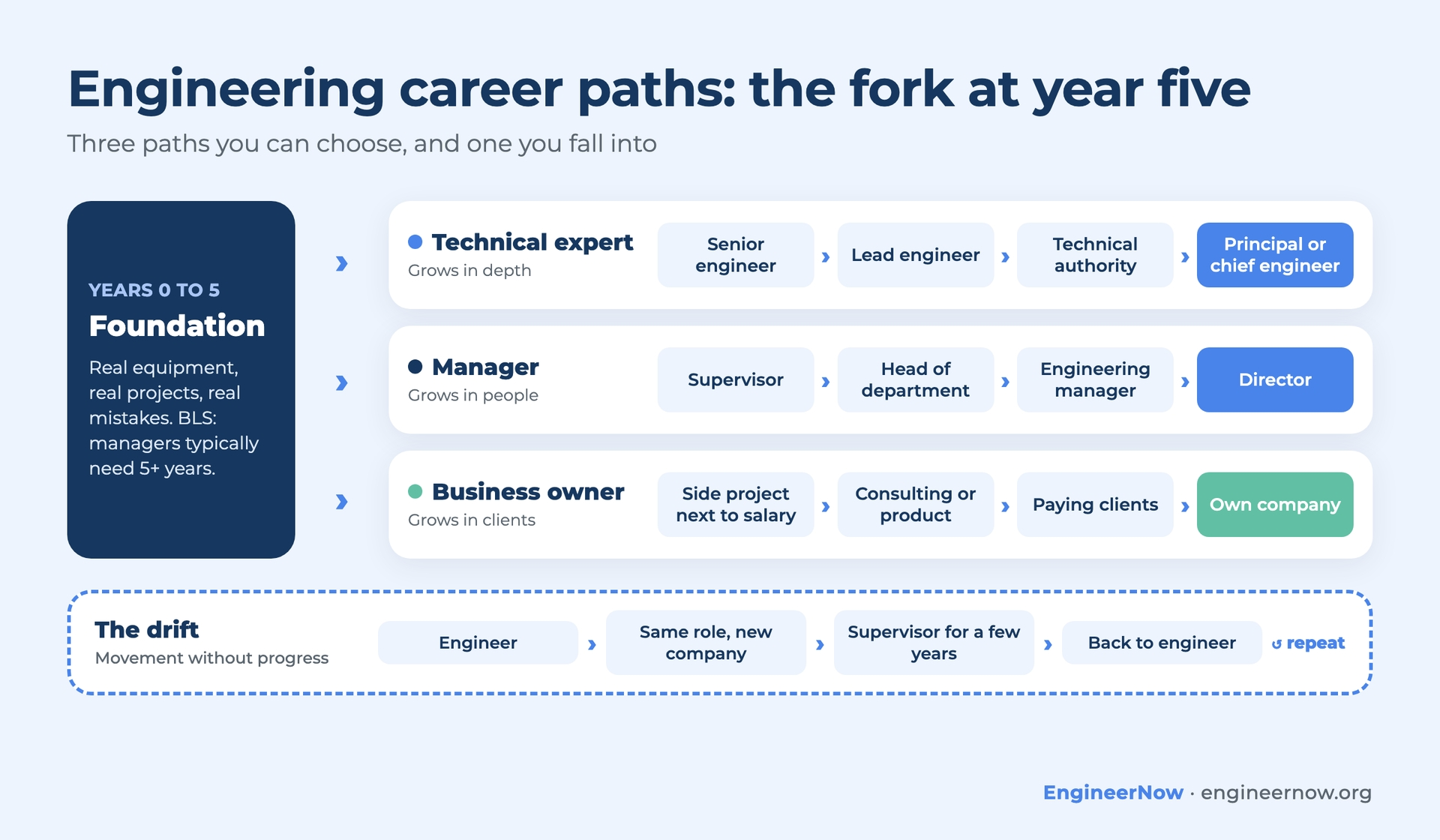
There are three real engineering career paths once you have a few years behind you: grow as a technical expert, move into management or build a business. There's also a fourth path, drifting sideways between similar jobs, and many engineers end up on it without ever choosing it.
This isn't about picking a discipline like mechanical or civil. It's about the career path for engineers after the degree, when the question changes from "what to study" to "where to grow".
Engineering careers branch the same way across multiple disciplines. Mechanical, electrical, chemical and industrial engineers, manufacturing engineers and health and safety engineers all reach this fork. If you're still one of the students at university, choosing between science and engineering, start with how engineering degrees rank by pay and growth.
I'm Alex, a Chartered Mechanical Engineer with 18+ years in engineering, including Shell and Saudi Aramco. I've walked parts of all three paths. Before 30, I was head of a department of 50+ people. At Shell, I also became a Technical Authority Level 3 for rotating equipment. And for the last few years, I've been building a business next to my engineering job.
The 3 Engineering Career Paths (and the One Nobody Chooses)
The first years look similar for everyone. You learn real equipment, real projects and real mistakes. Somewhere around year five, a fork appears. BLS lists 5 years or more of work experience as typical for architectural and engineering managers, so that's roughly when management becomes an option on paper.
From there, each path rewards different things. The expert grows in depth, the manager in people and scope, the business owner in clients. The fourth path, the drift, gives you movement without progress. I'll come back to it below.
Technical Expert Path: From Senior Engineer to Technical Authority
The technical career path grows in depth and technical expertise, not in headcount. A typical engineering career ladder on this side goes senior engineer, lead engineer, subject matter expert or technical authority, then principal or chief engineer. Some companies run a dual career ladder, with technical grades next to management grades, so an expert can grow without managing people.
on this path, career advancement comes from results with your name on them, not from titles.
At Shell, root cause analysis on our main gas compressors raised their availability from 68% to 95%. A detailed investigation took the time between failures on gear pumps from 3 months to 5 years. Later, as a lead rotating equipment engineer, I designed detuning plates that cut vibration on critical vertical pumps from 31 to 3 mm/s rms.
Process improvement counts on this path too. Think of a procedure that cut downtime, or a maintenance plan that moved equipment from run-to-failure to a schedule. If it has a before and an after, it's a result with your name on it.
Credentials support this path too, like Chartered Engineer status. A PhD is a separate question. BLS calls it essential for engineering faculty positions in higher education and important for some research and development programs (BLS). In industry, it's your choice, and I wrote about what I'd do differently about a PhD.
From the field
After heading a department at Shell, I made a conscious choice. I went back to an engineering role abroad, as an offshore rotating equipment engineer at Saudi Aramco, because I wanted an international career. Here's how I got my first job abroad. Choosing the engineering path, with Shell Technical Authority Level 3 already behind me, gave me international recognition, new prospects and a new level of professionalism. A step down in title isn't always a step back.
Management Path: How to Become an Engineering Manager
This is the path I took at Shell. At Shell, I moved up 4 job grades in 6 years and became head of mechanical maintenance before I turned 30. My title was Head of Field Mechanical Maintenance and Integrity: 50+ engineers, technicians and fitters, and 8 contracts to hold.
Shell took development seriously. Every year I had an individual development plan. At the end of the year, my manager and I spent 2 to 3 hours reviewing the results.
The price of this path, in my opinion, is engineering time. As an individual contributor, you solve the problem yourself. As an engineering manager, you make sure other people can solve it, and you answer for the budget, the team and the contracts. If that sounds like a loss, management may not be your path. If it sounds like a bigger machine to run, it might be.
The engineering management career path can go further, up to director, executive roles and the top of the company. If that's your aim, here's why so many CEOs started as engineers.
Business Path: Start It While You Still Have a Salary
For engineers, the realistic starting points are consulting in your own area of expertise or a product or service that solves a problem you know from work. Engineer to entrepreneur rarely happens in one jump.
My own business started next to my engineering job. When I had achieved what I wanted as an engineer, I wanted something more: to use my knowledge and experience to help other engineers develop. That's how Engineer-Millionaire and EngineerNow were born.
Not every bet worked. I've also put money into startups and crypto, not very successfully. Usually, the first few businesses fail, and that's where you learn the skills for the next one.
My advice: keep working, and spend your free time on both professional and business skills. A business also needs skills that engineering school doesn't teach, like sales, marketing and finance.
By the way, if you want my personal approach to growing an engineering career and income, that's what my Engineer-Millionaire course is about.
The Drift Path: How Engineers Get Stuck Without Noticing
The fourth path is the drift, and in my opinion many engineers end up on it. You move from one company to another, mostly sideways. Maybe you become a supervisor or line manager for a few years, then go back to being an engineer, and so on.
After 10 or 20 years, there are no leaps forward. Work becomes routine, and routine leads to burnout. Paperwork is also one reason engineers leave the profession.
How do you know if you're drifting? Check these signs:
- your last 2 or 3 job changes gave you the same role with a different logo;
- most of your week goes to admin, not to engineering decisions;
- there's no design, repair or decision with your name on it;
- you can't name one result from the last 12 months in numbers;
- nobody, including you, has written a plan for your next 3 years.
If two or more are true, don't panic. The fix starts with writing down what you've actually achieved, and our achievement generator helps turn tasks into results.

How to Choose Your Engineering Career Path by Year Five
Here's a check you can do in one evening. Write down your main tasks from the last 12 months. Mark each one as technical, people or commercial. Then identify the tasks that gave you energy, not just the ones you were good at.
Often a pattern shows up right away. Technical tasks point to the expert path, people tasks to management, commercial tasks to business.
Then ask your manager for a development plan. If you don't ask, you won't get it. Set one direction as your career goal for year five. Then test it within a year: a complex technical project, standing in for your manager or your first paid consulting job.
| Technical expert | Manager | Business owner | |
|---|---|---|---|
| Every day | Solve complex technical problems, sign off designs and repairs, guide junior engineers | Project management, budgets, hiring, communication with people and contractors | Find clients, sell solutions, run consulting or a product |
| How growth shows | Results and decisions with your name on them | Bigger team, budget and scope | Paying clients and repeat work |
| Pay reference (BLS, May 2025) | $99,520 median, architecture and engineering occupations (mechanical engineers: $104,110; not split by level) | $171,270 median, architectural and engineering managers | No official number. No ceiling, no floor |
| What it demands | Deep technical expertise, continuous learning, professional credentials | 5 years or more as an engineer, communication and people skills | Expertise plus sales, marketing and financial skills |
| Main risk | You stop learning, and old expertise becomes a comfortable trap | Less engineering, more meetings | Unstable income |
| Who it suits | People who love the technical problem itself | People who get energy from teams and want influence | People who want freedom to act and like innovation |
What I'd choose and why: I still believe the best path is a PhD plus a business. I don't have a PhD myself, so take it as my opinion, not a rule.
Whatever you pick, build technical depth first, start the business next to your salary, and take management if people give you energy, not because of the title.
So sometimes you have to give up something to get something better. Good luck, friends.
What is the best career path in engineering?
There's no single best path for everyone. My personal opinion is a PhD plus a business, although I don't have a PhD myself. For most engineers, I'd start with deep technical knowledge, because both management and business grow on it. Then choose by what gives you energy: solving problems, leading people or building something of your own. Each path can be successful.
Is it better to stay technical or move into management?
It depends on what you want your days to look like. The technical vs management career path is a choice between solving problems yourself and making sure others can solve them through communication, influence and project management. BLS median pay for managers is higher: $171,270 against $99,520 for architecture and engineering occupations (May 2025). I've done both, and I've done both. Focus on what your days will look like. Focus on what your days will look like, and on new opportunities you want in the future.
How many years does it take to become an engineering manager?
BLS lists 5 years or more of work experience as typical for architectural and engineering managers, usually with a bachelor's degree. In my case at Shell, I moved up 4 job grades in 6 years and was heading a department before 30. Speed depends on the company, its expectations and on whether you ask. A development plan agreed with your manager helps a lot.
Do I need a PhD to grow as an engineer?
Not for most industry roles. BLS says a PhD is essential for engineering faculty positions in higher education and important for some research and development programs. In industry, BLS notes that a PE license allows higher levels of leadership and independence. Still, I think a part-time PhD next to a job is a strong long-term investment if you want to pursue research or innovation.

Written by
Recent Posts

Pub: 10 Sep 2025 - Upd: 01 May 2026
7 min. read
The WORST Engineering Professions! I wish I knew earlier...