Published · Updated · 11 min. read
Geotechnical Engineer Resume: EIT, PE and Field Proof
A geotechnical engineer resume gets read for two things first. Where are you on the license path (FE, EIT, PE, and in California GE)? And did you do the ground work yourself: borings, laboratory testing, analysis and reports with real counts? Get those two right, and the rest of the resume is ordinary.
I'm a Certified Professional Resume Writer (CPRW), and I've done 200+ interviews as the interviewer. I work in rotating equipment in oil and gas, though, not soils. So every licensing fact below comes from NCEES, the BLS and the state licensing boards themselves.
Below is the license line for each stage of your career. Then come field, lab and analysis bullets with [brackets] for your own data, how to list software, and a full sample.
What Does a Geotechnical Engineer Do, and What Must Your Resume Prove?
BLS describes it in one line: geotechnical engineers ensure the safety and sturdiness of foundations for streets, buildings and other structures. In practice, that's geotechnical investigations, soil and rock testing, foundation design, slope stability analysis, retaining structures and groundwater checks. Then come the geotechnical reports that turn all of it into recommendations for the client.
There's no separate federal job code for this role. O*NET lists "Geotechnical Engineer" among the job titles of Civil Engineers. One of its tasks reads: test soils or materials to determine the adequacy and strength of foundations.
For civil engineers, the BLS reports a median pay of $100,840 in May 2025 and about 380,600 jobs. It projects 6% growth from 2025 to 2035, with about 22,700 openings a year (BLS).
Geotechnical engineering is a branch of civil engineering, so your resume lands in the civil pile and is checked for relevant ground work first.
So who reads your resume? Usually the geotechnical group lead or one of the project managers at a consulting firm. Hiring managers there know the work, so duties and responsibilities don't impress them. They want three kinds of proof:
- Field: what you drilled, logged and observed on construction projects.
- Lab: which tests you ran or checked, and how many.
- Analysis and reports: what you calculated and what the report recommended.
If you design the footing rather than the ground under it, our structural engineer resume guide fits better. And if your site work is mostly contamination and permits, look at the environmental engineer resume guide instead.
Geotechnical Engineer License Line: FE, EIT, PE and GE
You don't need a license for your first job: according to the BLS, entry-level civil engineers don't need one. It's typically required once you offer your services directly to the public. Each state issues its own licenses. That's why the reader looks for your stage and your state before anything else.
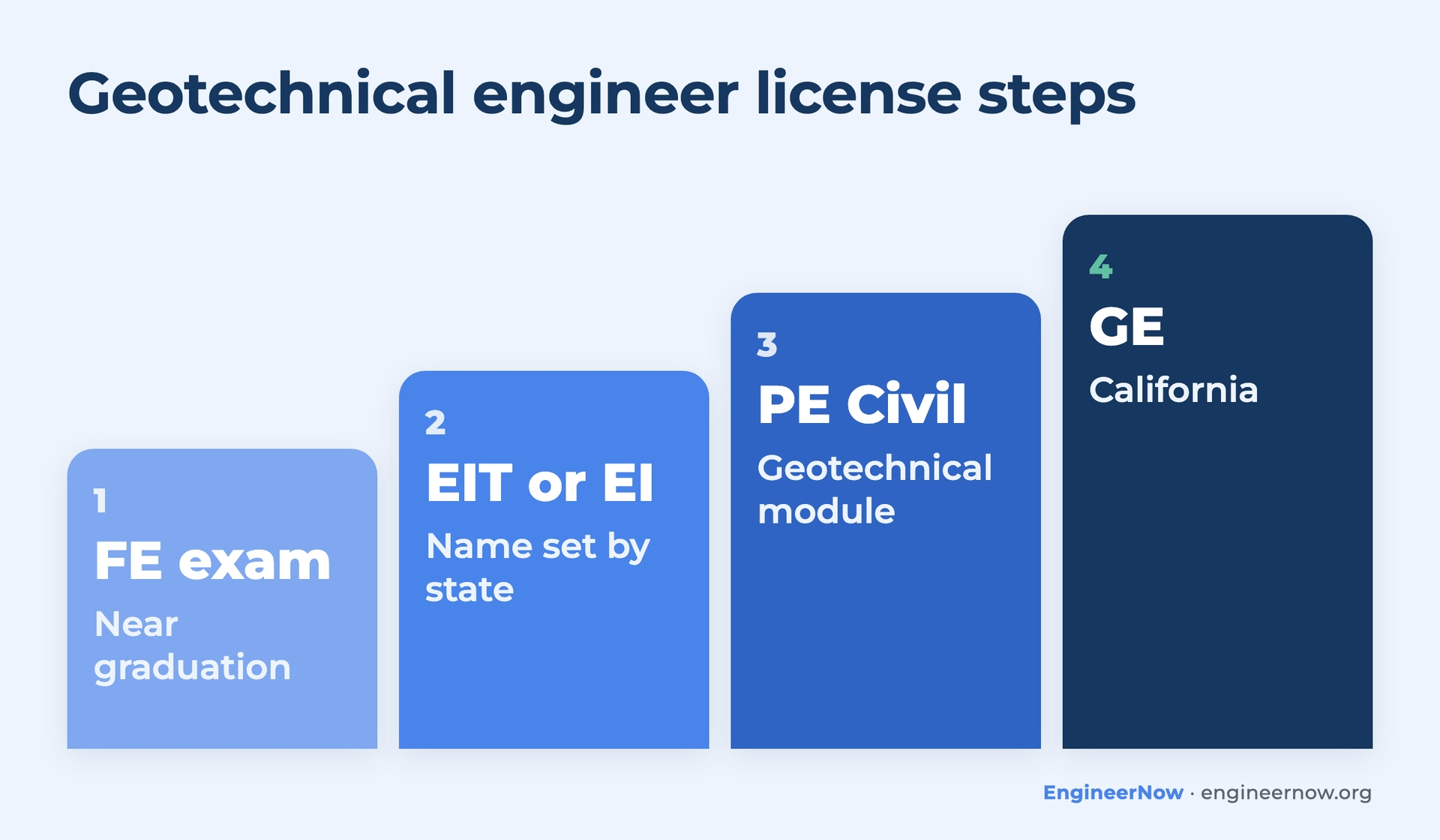
Here's how the steps work, according to the boards themselves.
Step 1, the FE exam. NCEES calls the FE "generally your first step" toward the PE license. It's meant for final-year students and recent graduates of ABET-accredited programs, so a bachelor's student can take it before the first job (NCEES). Civil is one of its disciplines.
Step 2, EIT or EI. After the FE, your state board may issue a certificate, and the name depends on the state. Texas calls it Engineer in Training (EIT) and says it doesn't entitle you to practice as a professional engineer. Florida calls it Engineer Intern (EI) and says plainly that it's a certification, not a license.
Step 3, PE Civil: Geotechnical. The PE Civil exam has five modules, and Geotechnical is one of them. It has 80 questions, and NCEES aims it at engineers with at least four years of work after college (NCEES). Most states require four years of acceptable, verifiable experience.
Step 4, GE in California. The California board grants the title "Geotechnical Engineer" only to licensed California civil engineers. You need four years of geotechnical experience after that civil license. The GE exam runs once a year in a two-week window (BPELSG).
| Your status | How to write it |
|---|---|
| Student, FE not taken yet | FE Civil exam: scheduled [month year] (only if you booked it) |
| FE passed, no certificate yet | Passed FE Civil exam, [year] |
| Certificate issued by your state | Engineer in Training (EIT), [state], [year] or Engineer Intern (EI), [state], [year] |
| PE exam booked | PE Civil: Geotechnical exam scheduled, [month year] |
| Licensed | PE, [state] (license number optional) |
| California GE | PE (California), GE |
Three rules here. A PE is a license, so don't file it under "certifications" next to a safety card. Always write the state. And use the exact name your board uses, because EIT in one state is EI in another.
Field, Lab and Analysis Lines That Read Like Real Work
Most geotechnical engineer resume examples online say "conducted site investigations" or "performed geotechnical analysis". Every candidate did that. The reader wants scale: how many, how deep, which test, which structure, and what the report decided.
Field work
Count borings and test pits, depths, samples and days on site. Name the project types: buildings, roads and other transportation infrastructure, bridges, embankments, tanks. Drilling oversight and construction observation count too: compaction testing, footing inspections, excavation checks, ground improvement if you watched it go in. "Logged [N] borings to [N] ft" tells the reader more than "managed field activities."
If you worked a remote site where a diesel generator powered the drill rig or lab equipment, one factual line about that setup shows you handled field logistics. Keep it to two or three bullet points per project, and put your experience in order: the most relevant project first, including internships and student work.
Field bullet
Conducted site investigations and performed geotechnical analysis for various projects.
Wrong
Field bullet
Logged [N] borings to [N] ft on [N] building sites and drafted the foundation recommendations, reviewed and sealed by a PE.
Right
Lab testing
Say what you ran yourself and what you only reviewed. Name the methods (moisture content, Atterberg limits, gradation, consolidation, triaxial) and give the number of samples. Soil testing done to a standard, with a count, shows quality. If you supervised technicians, say how many.
Analysis and reports
Name the calculation and the structure: bearing capacity and settlement for shallow foundations, slope stability for embankments and cuts, landslides and slope stabilization, retaining walls, excavations. Then count the reports. If you're an EIT, write it straight: the report was reviewed and sealed by a PE. That's normal, and it reads as honest report writing, not a weakness.
Here's the same pattern for lab, analysis and report lines.
Fictional example: made-up projects and numbers. Use the pattern, put in your own data.
Three bullets for a staff engineer:
- Ran or checked [N] [test type] tests and built the boring logs and lab summaries in gINT.
- Prepared [N] geotechnical reports with bearing capacity and settlement recommendations for [structure type], reviewed and sealed by a PE.
- Ran [N] slope stability models in [software] for [embankment or cut]; [result: slope flattened, wall added, design approved].
Keep only the numbers you can explain in an interview: which boring, which test, why the slope changed. A small real number beats a big borrowed one, and every one of them is a question you may get.
Project management belongs in a bullet too, not in a skills label. If you scheduled a drilling crew or tracked a lab queue, say what you handled and for how many people. A strong bullet shows your ability through the task, because proven work convinces more than the word "management".
Software: Name the Program and the Job It Did
A technical skills line with twenty programs says very little. Name each tool once in your skills section. Then prove it in a bullet: the project, the task, the result.
For geotechnical projects, that usually means geotechnical software like PLAXIS for finite element models, GeoStudio (SLOPE/W) for slope stability and gINT for boring logs. Add AutoCAD if you draw boring plans. List only what you used. If the job description names a tool you know, use its exact name, so both the reader and the ATS see the match.
One honest line works better than a list: "SLOPE/W: [N] embankment models, [result]." Then run your resume against the posting and see which tools and terms are missing.

Resume Scanner
AI scanner performs 15 essential checks to ensure your resume is optimized for the jobs you're applying to.
SCAN RESUMEGeotechnical Engineer Resume Example
Here's a full geotechnical engineer resume sample for a staff engineer with three years of experience in testing and consulting, an EIT and the FE passed. Fictional example: made-up name, firms and numbers. Copy the format and the logic, not the numbers.
Look at the header first: EIT, the state and the FE year sit under the job title. The summary is short. The work history is counts of borings, tests, models and reports, not duties. Education comes after the professional experience, because three years of project experience now matter more than the degree. And the PE seal is mentioned the way it really works for an EIT.
Your qualifications (license stage, degree, key courses) stay short. Knowledge of soil mechanics shows in the tests and reports below them.
Now pick a clean layout and put your own data in.


Your license line tells employers where you are, and your counts prove what you did with the ground. Good luck, friends.
What should a geotechnical engineer resume summary say?
Three lines: your level and years of experience, the ground work you do (field, lab, analysis), and your license stage with the state. For example: "Staff geotechnical engineer with [N] years in site investigation and foundation reports. EIT, [state]." Leave out adjectives like "hardworking".
Can I put EIT on my resume after passing the FE?
Only if your state board issued the certificate. Texas calls it Engineer in Training (EIT), and Florida calls it Engineer Intern (EI). If you passed the FE but haven't applied for the certificate, write "Passed FE Civil exam, [year]". That's true, and anyone can verify it. Write the title the way your board writes it.
How do I write a geotechnical engineer resume with no experience?
Lead with your FE status, then laboratory and field work from your degree. That means soil mechanics labs, a capstone with a foundation or slope design, or an internship with a drilling or testing firm. A short objective that names the role is fine here. Count samples, borings and reports the same way as on a full resume. Our resume for engineering students guide covers the layout.
Does a geotechnical resume look different outside the US?
Yes, mainly the license line. In the UK there's no PE. The best-known professional title is Chartered Engineer (CEng), and you get it through an institution licensed by the Engineering Council. For civil and geotechnical work, one of them is the Institution of Civil Engineers (ICE). I explained the route in my article on how to become a chartered engineer.
Is a CV the same as a resume for a geotechnical job?
Mostly yes. Outside the US, and in the UK in particular, a resume is usually called a CV, and the same counts, license line and report bullets apply. Check the posting for the term and the length it expects.

Written by
Recent Posts